


People who are planning to travel overseas in the fourth quarter of this year might want to consider tour groups to Southeast Asia and South Korea due to the relatively mild increase in travel costs compared with 2019, based on a quarterly report by the Travel Quality Assurance Association yesterday.
The association also published reasonable group tour prices to popular travel destinations in the fourth quarter for consumers to use as a reference.
Fun Travel International Travel Service general manager Dave Hsieh (謝天恩), who is also the association’s director of tourism for Indonesia, Malaysia, Philippines, Singapore and Thailand, said that the prices for tours in these countries would increase about 15 percent in the fourth quarter from the same period in 2019, due to international oil price hikes and increases in accommodation costs.
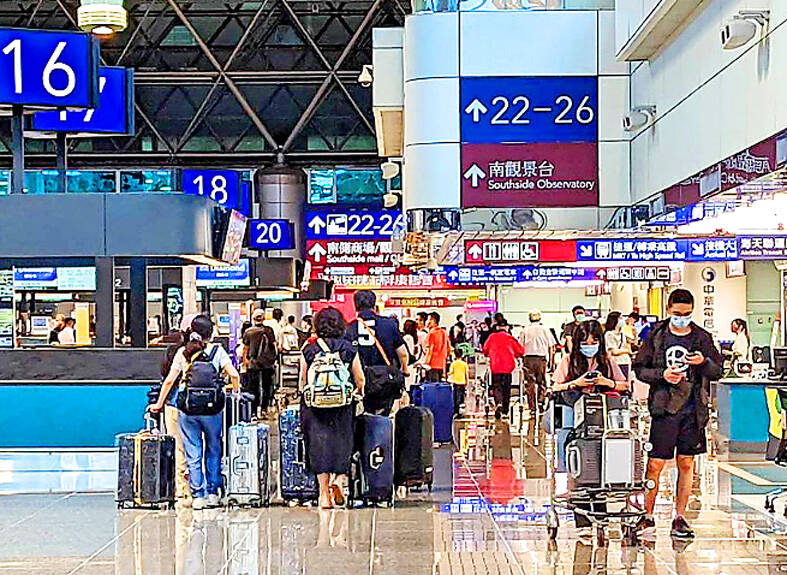
Photo courtesy of Taiwan Taoyuan International Airport
However, overall tour prices would drop about 5 percent from the third quarter of this year due to a decrease in flight prices, he said.
“Airlines in general give about a 20 percent discount to boost the passenger loading factor. However, most of the flight seats are allocated to individual travelers as it is the holiday season in Malaysia, Singapore and Thailand,” he said.
Accommodation in Southeast Asian countries has become harder to find after China allowed its citizens to join overseas tour groups in February, he said, adding that some hoteliers have even raised their room prices by about 30 percent for China’s National Day long weekend from Oct. 1 to Oct. 7.
Worldwide Travel Service deputy general manager Chan Kuo-ching (常國慶) said prices for tours to South Korea would increase about 15 percent in the fourth quarter from the same period in 2019, due to an increase in flight prices.
However, the overall tour price would be about 20 percent higher than the third quarter, Chan said.
Flight prices might “have room to decrease” as some of the airlines would resume flight services or launch new ones, he said, adding that 90 percent of flights between Taiwan and South Korea have so far resumed.
Kuan Ming-chieh (關銘傑), a special assistant to the chairman of Pin Kuan International Travel Service, said that costs of tours to Vietnam would increase about 20 to 30 percent from 2019 due to global oil price hikes and inflation.
“As Indochina is entering the peak season for international travelers, tour costs in the fourth quarter would be about 10 to 20 percent higher than those in the third quarter due to the increase in flight prices and accommodation costs,” Kuan said.
Meanwhile, costs of tours to Europe would jump about 20 percent in the fourth quarter from the same period in 2019 due to an increase in flight prices, accommodation, and transportation and dining expenses, the report said.
However, tour costs would drop about 10 percent from the third quarter, it said.
Although many airlines have launched new flight services to Japan, travel costs to the country have nearly tripled compared with 2019 due to flight prices, personnel shortages, devaluation of the yen, limited accommodation and the high percentage of Japanese traveling domestically, the report said.
Traveling in Japan on weekdays now costs twice as much it did during the New Year holiday in 2019, the report added.
“Compared with the third quarter, tours to Japan would cost 30 to 40 percent more in the fourth quarter due to the maple leaf season from next month to November. Many companies would treat their employees to incentive tours in Japan,” the report said.
Tours to Australia and New Zealand would cost 25 percent and 23 percent more than in 2019 respectively, whereas tours to the US and Canada would increase 50 to 70 percent due flight price hikes and other costs, it said.
Cost increases for tours to the Middle East, Central Asia and African countries would vary from 30 percent to 100 percent compared with 2019 because of rises in labor and accommodation costs, the report said.
Tours to Israel would rise 50 percent to 80 percent from 2019, while those to Egypt would double, it said.
Tours to East Africa in the fourth quarter would become 10 percent cheaper following the Mara River migration in the third quarter, while Turkey would cost 15 to 20 percent less than the third quarter because it would be winter, the report said.

Considering that most countries issue more than five denominations of banknotes, the central bank has decided to redesign all five denominations, the bank said as it prepares for the first major overhaul of the banknotes in more than 24 years. Central bank Governor Yang Chin-lung (楊金龍) is expected to report to the Legislative Yuan today on the bank’s operations and the redesign’s progress. The bank in a report sent to the legislature ahead of today’s meeting said it had commissioned a survey on the public’s preferences. Survey results showed that NT$100 and NT$1,000 banknotes are the most commonly used, while NT$200 and NT$2,000

The Centers for Disease Control (CDC) yesterday reported the first case of a new COVID-19 subvariant — BA.3.2 — in a 10-year-old Singaporean girl who had a fever upon arrival in Taiwan and tested positive for the disease. The girl left Taiwan on March 20 and the case did not have a direct impact on the local community, it said. The WHO added the BA.3.2 strain to its list of Variants Under Monitoring in December last year, but this was the first imported case of the COVID-19 variant in Taiwan, CDC Deputy Director-General Lin Ming-cheng (林明誠) said. The girl arrived in Taiwan on

South Korea is planning to revise its controversial electronic arrival card, a step Taiwanese officials said prompted them to hold off on planned retaliatory measures, a South Korean media report said yesterday. A Yonhap News Agency report said that the South Korean Ministry of Foreign Affairs is planning to remove the “previous departure place” and “next destination” fields from its e-arrival card system. The plan, reached after interagency consultations, is under review and aims to simplify entry procedures and align the electronic form with the paper version, a South Korean ministry official said. The fields — which appeared only on the electronic form

The Ministry of Foreign Affairs (MOFA) is suspending retaliation measures against South Korea that were set to take effect tomorrow, after Seoul said it is updating its e-arrival system, MOFA said today. The measures were to be a new round of retaliation after Taiwan on March 1 changed South Korea's designation on government-issued alien resident certificates held by South Korean nationals to "South Korea” from the "Republic of Korea," the country’s official name. The move came after months of protests to Seoul over its listing of Taiwan as "China (Taiwan)" in dropdown menus on its new online immigration entry system. MOFA last week


 RSS
RSS