


The Tourism Bureau yesterday hosted an exhibition at Taipei’s Songshan Cultural and Creative Park to raise awareness about finding legal accommodation, after a slew of illegal daily rentals, hostels and hotels were uncovered in the first half of the year.
The event offered people participants the chance to win vouchers worth NT$10,000 (US$314) and other prizes, the bureau said.
The exhibition also featured augmented reality installations, enabling participants to experience the environments of select establishments by scanning a QR code.

Photo: Cheng Wei-chi, Taipei Times
People tend to rely on Web sites to search for accommodation, but many illegal operators are active on the Internet, Department of Travel and Accommodations Director-General Tsao Yi-min (曹逸民) said.
The bureau also collaborated with illustrators Nipang and Ameow, commissioning illustrations that would help promote little-known facts about legal accommodation.
The easiest way to check whether accommodation is legal is to look up the establishment’s name on the Taiwan Stay Web site, the bureau said.
People who have stayed in illegal accommodation should provide proof of transactions, photographs of the establishment and recordings of phone calls with the establishment, it said.
They can also provide screenshots of their discussions with the establishment if they have contacted them via e-mail or a messaging app, it added.
The bureau said it found 989 illegal hotels in the first half of the year, down from 127 during the same period last year.
Owners of unlicensed hotels can be fined NT$100,000 to NT$500,000, the bureau said.
Taipei had the most offenders at 201. Taichung followed with 187, Yilan County had 131, Kaohsiung had 111 and Tainan had 110, it said.
The bureau also fined 656 illegal daily rental units a total of NT$51.50 million and 428 illegal hostels NT$10.68 million.
Illegal hostels and hotels that have advertised can be fined an additional NT$30,000 to NT$300,000, the bureau said.
The bureau said that known tourist spots, such as Taichung’s Fengchia Night Market (逢甲夜市), Kaohsiung’s 85 Sky Tower, and Taipei’s Qsquare building and Ximending area (西門町), are full of illegal accommodation, and warned people to be careful.


An essay competition jointly organized by a local writing society and a publisher affiliated with the Chinese Communist Party (CCP) might have contravened the Act Governing Relations Between the People of the Taiwan Area and the Mainland Area (臺灣地區與大陸地區人民關係條例), the Mainland Affairs Council (MAC) said on Thursday. “In this case, the partner organization is clearly an agency under the CCP’s Fujian Provincial Committee,” MAC Deputy Minister and spokesperson Liang Wen-chieh (梁文傑) said at a news briefing in Taipei. “It also involves bringing Taiwanese students to China with all-expenses-paid arrangements to attend award ceremonies and camps,” Liang said. Those two “characteristics” are typically sufficient
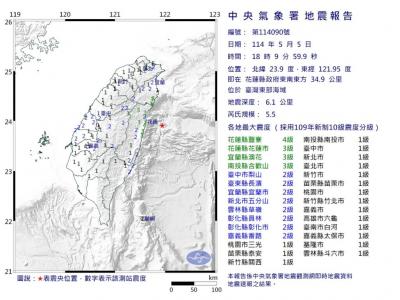
A magnitude 5.9 earthquake that struck about 33km off the coast of Hualien City was the "main shock" in a series of quakes in the area, with aftershocks expected over the next three days, the Central Weather Administration (CWA) said yesterday. Prior to the magnitude 5.9 quake shaking most of Taiwan at 6:53pm yesterday, six other earthquakes stronger than a magnitude of 4, starting with a magnitude 5.5 quake at 6:09pm, occurred in the area. CWA Seismological Center Director Wu Chien-fu (吳健富) confirmed that the quakes were all part of the same series and that the magnitude 5.5 temblor was

The brilliant blue waters, thick foliage and bucolic atmosphere on this seemingly idyllic archipelago deep in the Pacific Ocean belie the key role it now plays in a titanic geopolitical struggle. Palau is again on the front line as China, and the US and its allies prepare their forces in an intensifying contest for control over the Asia-Pacific region. The democratic nation of just 17,000 people hosts US-controlled airstrips and soon-to-be-completed radar installations that the US military describes as “critical” to monitoring vast swathes of water and airspace. It is also a key piece of the second island chain, a string of
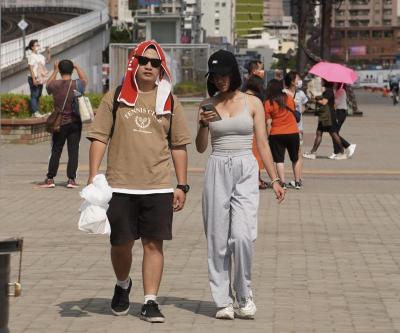
The Central Weather Administration has issued a heat alert for southeastern Taiwan, warning of temperatures as high as 36°C today, while alerting some coastal areas of strong winds later in the day. Kaohsiung’s Neimen District (內門) and Pingtung County’s Neipu Township (內埔) are under an orange heat alert, which warns of temperatures as high as 36°C for three consecutive days, the CWA said, citing southwest winds. The heat would also extend to Tainan’s Nansi (楠西) and Yujing (玉井) districts, as well as Pingtung’s Gaoshu (高樹), Yanpu (鹽埔) and Majia (瑪家) townships, it said, forecasting highs of up to 36°C in those areas


 RSS
RSS