


The international community blames the rise in tension across the Taiwan Strait on China rather than Taiwan, and the reality is that Taiwan is already a country, Vice President William Lai (賴清德) said yesterday.
Speaking to foreign reporters in Taipei, Lai said it was not President Tsai Ing-wen (蔡英文) or Taiwan that was to blame for tensions.
“The international community understands that recent tensions are not because of President Tsai or because of Taiwan, but because of China,” said Lai, the Democratic Progressive Party’s (DPP) candidate for the presidential election in January.
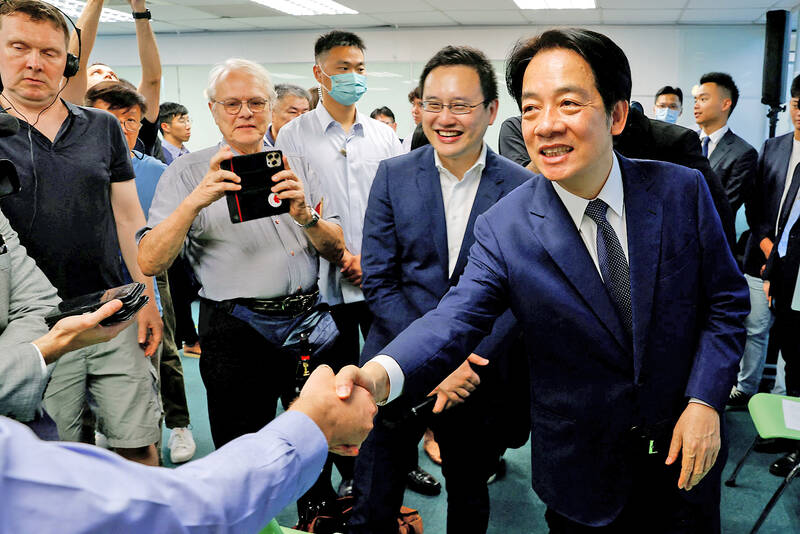
Photo: Ann Wang, Reuters
Lai has said he does not seek to change Taiwan’s official name, the Republic of China. Both Lai and Tsai have said that as Taiwan is already an independent country, there is no need for a separate declaration of independence.
The reality is that Taiwan routinely elects its own leaders, from the grassroots all the way to the top, giving it the right to be called a state, he said at DPP headquarters in Taipei.
“In fact, it is a sovereign, independent country; there’s no doubt about that,” he said.
China’s Taiwan Affairs Office did not immediately respond to a request for comment, but the Chinese government has repeatedly called Lai a “liar” and a separatist.
Lai said that China would try and use “various means” to interfere in the election and, if it was successful and affected the outcome, it would seriously damage Taiwan’s democratic system.
“I believe Taiwan’s people will firmly protect democratic values, and courageously decide their own next president,” he said.
Lai said his support for maintaining the “status quo” across the Taiwan Strait was “unwavering,” and vowed to ensure peace and stability in the Indo-Pacific region if elected, reiterating an offer for talks with China based on “parity and dignity.”
China has demanded that Taiwan’s government accept that both sides of the Strait belong to “one China,” which both Tsai and Lai have declined to do, before it would consider talks.
“Real peace cannot come from losing sovereignty for exchanges and cooperation,” Lai said.
In a separate interview that aired on Next TV on Thursday, Lai vowed to promote diplomacy based on universal values if elected president.
Lai proposed boosting “value diplomacy,” or fostering deeper and more stable connections with the international community with values such as democracy, peace and prosperity, he said.
He added that he does not consider the upcoming presidential election as a choice between war and peace, responding to a comment made by former president Ma Ying-jeou (馬英九).
The election is to decide Taiwan’s future — whether to continue its pursuit of democracy or to return to authoritarianism by accepting Beijing’s “one China” principle, Lai said.
“We are unable to choose peace as it has to be earned with strength,” which is why Taiwan is bolstering its defense capabilities and enhancing its economic security, he said.
Lai thanked US President Joe Biden’s administration for its efforts in maintaining peace and stability in the Taiwan Strait over the past three years.
Washington connected Asian countries such as South Korea, Japan and the Philippines with NATO and the EU to stabilize the global democratic order and safeguard regional peace and security, he said.
Taiwan can contribute to the promotion of peace, democracy and prosperity around the world, as shown during the COVID-19 pandemic, he said, adding: “Taiwan can help. Taiwan is helping.”
As it is Taiwanese culture to be friendly, the nation hopes to befriend every country, China included, he said.
The two sides share common enemies, such as natural disasters and infectious diseases, as well as a common goal, which is to improve the well-being of their people, he said.
Thanks to the funds, talent and technologies Taiwanese brought, China has seen rapid economic growth in the past 30 years, he said.
“Taiwan does not ask for anything in return, but only hopes for peace,” he added.
If he has an opportunity to dine with Chinese President Xi Jinping (習近平), Lai said that he would treat him to Tainan’s specialty shrimp rice and a glass of bubble milk tea, and tell him that there would be no winner in war.
Additional reporting by Liu Tzu-hsuan
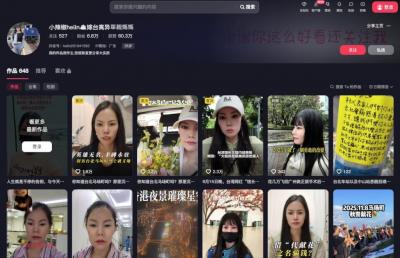
Chinese spouse and influencer Guan Guan’s (關關) residency permit has been revoked for repeatedly posting pro-China videos that threaten national security, the National Immigration Agency confirmed today. Guan Guan has said many controversial statements in her videos posted to Douyin (抖音), including “the red flag will soon be painted all over Taiwan” and “Taiwan is an inseparable part of China,” and expressing hope for expedited reunification. The agency last year received multiple reports alleging that Guan Guan had advocated for armed reunification. After verifying the reports, the agency last month issued a notice requiring her to appear and explain her actions. Guan

GIVE AND TAKE: Blood demand continues to rise each year, while fewer young donors are available due to the nation’s falling birthrate, a doctor said Blood donors can redeem points earned from donations to obtain limited edition Formosan black bear travel mugs, the Kaohsiung Blood Center said yesterday, as it announced a goal of stocking 20,000 units of blood prior to the Lunar New Year. The last month of the lunar year is National Blood Donation Month, when local centers seek to stockpile blood for use during the Lunar New Year holiday. The blood demand in southern Taiwan — including Tainan and Kaohsiung, as well as Chiayi, Pingtung, Penghu and Taitung counties — is about 2,000 units per day, the center said. The donation campaign aims to boost

The Kaohsiung Tourism Bureau audited six hotels in an effort to prevent price gouging ahead of Korean band BTS’ concert tour in the city scheduled for Nov. 19, 21 and 22 this year. The bureau on Friday said that the audits — conducted in response to allegations of unfair pricing posted on social media — found no wrongdoing. These establishments included the local branches of Chateau de Chine, Hotel Nikko, My Humble House, and Grand Hai Lai, it said, adding that the Consumer Protection Commission would have penalized price gougers had the accusations been substantiated. The bureau said the Tourism Development Act
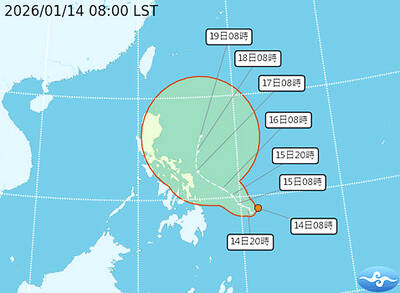
BACK TO WINTER: A strong continental cold air mass would move south on Tuesday next week, bringing colder temperatures to northern and central Taiwan A tropical depression east of the Philippines could soon be upgraded to be the first tropical storm of this year, the Central Weather Administration (CWA) said yesterday, adding that the next cold air mass is forecast to arrive on Monday next week. CWA forecaster Cheng Jie-ren (鄭傑仁) said the first tropical depression of this year is over waters east of the Philippines, about 1,867km southeast of Oluanpi (鵝鑾鼻), and could strengthen into Tropical Storm Nokaen by early today. The system is moving slowly from northwest to north, and is expected to remain east of the Philippines with little chance of affecting Taiwan,


 RSS
RSS