


Ariel Lo spends a couple of hours most weeks sharing anime art and memes on Chinese apps, often chatting with friends in China in a Mandarin slightly different from the one she uses at home in Taiwan.
“People use English on Instagram, and for Chinese apps they use Chinese phrases. If I am talking to friends in China, I would use them,” Lo said as she picked up a bubble tea at a street market in Taichung.
The 18-year-old Earth sciences student, who creates art in her spare time, is part of a generation whose online life is increasingly influenced by content from China. That is worrying politicians and experts who fear young Taiwanese drawn to shop and entertain themselves on apps ultimately controlled by Beijing might be getting more than style tips, and sharing more than memes.
Photo: Reuters
Social media companies can harvest valuable data and shape perspectives through the algorithms that control what posts viewers see. The FBI last year said that TikTok and its Chinese counterpart, Douyin, were a threat to national security.
In Taiwan, those worries are particularly acute. China has made clear that it wants to take control of the country, by force if necessary, and the two share a common language. That makes Chinese apps, music and drama particularly attractive and accessible to the Taiwanese and Taiwanese users a particularly important audience for Beijing.
“The similarities in language make the risk higher,” said Josh Wang (王孝成) of the Taiwan Pang-phuann Association of Education, which is building an education program to raise awareness among Taiwanese students of online risks and how to protect themselves. “Students in Taiwan don’t necessarily care much about politics, so when it comes to finding entertainment, it’s convenient and easy to [use Chinese apps].”
He sees the influence of those shows, songs and memes spreading in Taiwan in the way that young people speak.
Lo might restrict her use of phrases from China to chats on the apps, but others are sounding more like teenagers across the Taiwan Strait.
“For example, my own students start using language in daily life like niubi [牛逼, a popular Chinese slang word equating to ‘super cool’],” Wang said.
The two Chinese apps that are most popular in Taiwan are Douyin — the Chinese version of TikTok, run by the same parent company, ByteDance — and Xiaohongshu (Little Red Book), a lifestyle and social shopping site dubbed the “Chinese Instagram.”
In December last year, the government barred public sector employees from using TikTok and Xiaohongshu on official phones and other devices.
“Taiwan is the front line of China’s information war,” said Democratic Progressive Party Legislator Chiu Chih-wei (邱志偉), who wants to see the government ban matched by the private sector to protect the economy.
“It is impossible to ban these apps entirely as we are a democratic country, but today we already see the first small success. Now we should encourage big companies in Taiwan to ban it — ones linked to national security, to energy,” he said. “It takes time to get big firms behind something like this.”
Cultural influence is a relatively new concern for Taiwan. Decades ago, it was a style and culture beacon for China as the country struggled out of Maoist drabness and conformity, looking to icons like the Taiwanese late diva Teresa Teng (鄧麗君) and Oscar-winning director Ang Lee (李安). Now, older Taiwanese watch Chinese historical dramas and soap operas, and the younger generation is hooked on apps.
Scarlett Ling is a firm supporter of Taiwanese independence, and a heavy user of Douyin.
“I am so bored, I use it every day for over two hours,” the 16-year-old said, as she browsed a market in Taichung with a friend.
She said she worries about her data being siphoned off to servers controlled by Beijing, and refuses requests for her ID number.
However, the Chinese app has “better filters,” and she said she steers clear of politics anyway.
“I am just using it for lifestyle inspiration... I certainly can’t be influenced [about politics],” she said.
Rochelle Hsieh, a 21-year-old business logistics student snapping pictures of possible outfits in a Taipei clothing shop, said she gets much of her inspiration from Xiaohongshu, and spends two or three hours a day on there and Instagram.
In one of the many ironies of an autocratic Chinese state built on an official ideology of communism, but funded by unbridled capitalism, Xiaohongshu shares the same name as the book of Mao Zedong’s (毛澤東) writings that became a symbol of the Cultural Revolution in the 1960s and 1970s.
The “red” of that title referred to leftist ideology, but the modern-day “red” is a reference to hot fashions and trends. Perhaps the only things the two red books share are their wild popularity at home and fears about their impact beyond China’s border.
Young social media users said they rarely see overt Chinese propaganda, and that occasional clumsy attempts to promote their neighbor at Taiwan’s expense are more likely to make them laugh than change their politics.
“You just have to be aware, and it will be OK” using Chinese apps, said Lo, who mostly uses two obscure apps, Bilibili and Lofter.
“We saw one Taiwanese celebrity interviewed on Chinese state media, saying: ‘The seafood in China is so good — we don’t have that in Taiwan.’ We just thought it was funny,” she said.
Taiwan, surrounded by rich fishing grounds, is famous for its cuisine, including seafood.
Politicians and experts say this kind of heavy-handed messaging is not their main concern. They fear content on the apps carries subtle messages about language and culture that attempt to deny or even erase the existence of a Taiwanese national and cultural identity.
“The Chinese Communist party wants Taiwanese people to love Chinese culture,” Wang said. “They hope that by convincing the students or young people to agree on the culture, it can help them agree on Chinese politics and government ... maybe convince the Taiwanese students that we are all Chinese.”
Beijing has described its propaganda strategy for Taiwan as “into the island, into the household, into the brain, into the heart,” an approach that clearly aims to exploit popular culture, sociologist Wang Horng-Luen (汪宏倫) wrote in an article about China’s soft-power influence.
He said that Chinese content can reinforce colonial narratives that erase or minimize Taiwanese identity and culture.
“Thinking that China is the root of culture ... will indeed loosen the foundation of Taiwan’s sense of community,” he wrote.
It might also lead to “blind worship and dependence on China,” he added.
Students spend on average five hours a day online, outside of class, and more than two-thirds say they get most of their news and information from the Internet, Wang Horng-Luen’s team working on social media education found.
Media literacy classes are compulsory, but schools have not kept pace with student lives. Nearly nine out of 10 students think they have seen false information online, but two-thirds never or rarely used fact-checking.
“The education system requires media literacy classes, but teachers have no idea how to teach it,” he said. “They teach how to read a newspaper with a critical perspective, but the students don’t read newspapers.”
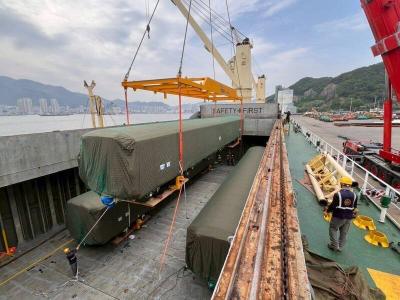
The first of 10 new high-capacity trains purchased from South Korea’s Hyundai Rotem arrived at the Port of Taipei yesterday to meet the demands of an expanding metro network, Taipei Rapid Transit Corp (TRTC) said yesterday. The train completed a three-day, 1,200km voyage from the Port of Masan in South Korea, the company said. Costing NT$590 million (US$18.79 million) each, the new six-carriage trains feature a redesigned interior based on "human-centric" transportation concepts, TRTC said. The design utilizes continuous longitudinal seating to widen the aisles and optimize passenger flow, while also upgrading passenger information displays and driving control systems for a more comfortable
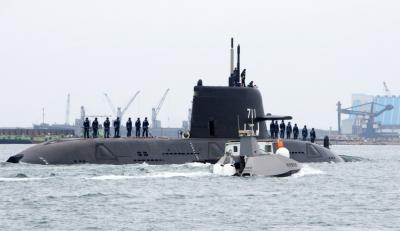
Taiwan's first indigenous defense submarine, the SS-711 Hai Kun (海鯤, or Narwhal), departed for its 13th sea trial at 7am today, marking its seventh submerged test, with delivery to the navy scheduled for July. The outing also marked its first sea deployment since President William Lai (賴清德) boarded the submarine for an inspection on March 19, drawing a crowd of military enthusiasts who gathered to show support. The submarine this morning departed port accompanied by CSBC Corp’s Endeavor Manta (奮進魔鬼魚號) uncrewed surface vessel and a navy M109 assault boat. Amid public interest in key milestones such as torpedo-launching operations and overnight submerged trials,
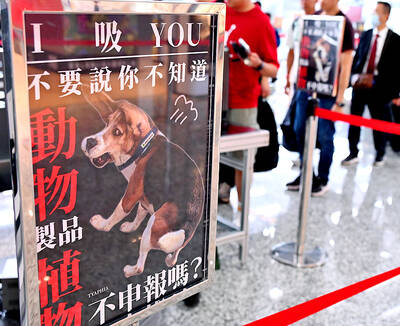
Quarantine awareness posters at Taiwan Taoyuan International Airport have gone viral for their use of wordplay. Issued by the airport branch of the Animal and Plant Health Inspection Agency, the posters feature sniffer dogs making a range of facial expressions, paired with advisory messages built around homophones. “We update the messages for holidays and campaign needs, periodically refreshing materials to attract people’s attention,” quarantine officials said. “The aim is to use the dogs’ appeal to draw focus to quarantine regulations.” A Japanese traveler visiting Taiwan has posted a photo on X of a poster showing a quarantine dog with a

Taiwan’s coffee community has launched a “one-person-one-e-mail” campaign, calling for people to send a protest-e-mail to the World Coffee Championships (WCC) urging it to redesignate Taiwanese competitors as from “Taiwan,” rather than “Chinese Taipei.” The call followed sudden action last week after the WCC changed all references to Taiwanese competitors from “Taiwan” to “Chinese Taipei,” including recent World Latte Art champion Bala (林紹興), who won the World Latte Art Championship in San Diego earlier this month. When Bala received the trophy, he was referred to as representing Taiwan, as well as in the announcement on the WCC’s Web site, until it


 RSS
RSS