


Next year’s presidential election is a choice between peace or war, Chinese Nationalist Party (KMT) lawmakers said yesterday.
“The Democratic Progressive Party’s (DPP) cross-strait policy these past few years has been one of confrontation, not dialogue, one of preparing for war and not avoiding war,” KMT Legislator Lai Shyh-bao (賴士葆) said, adding that the policy has brought cross-strait relations to the brink of war.
Lai said that President Tsai Ing-wen (蔡英文) has spoken of maintaining regional stability, while Vice President William Lai (賴清德) has said that he would not let war happen.
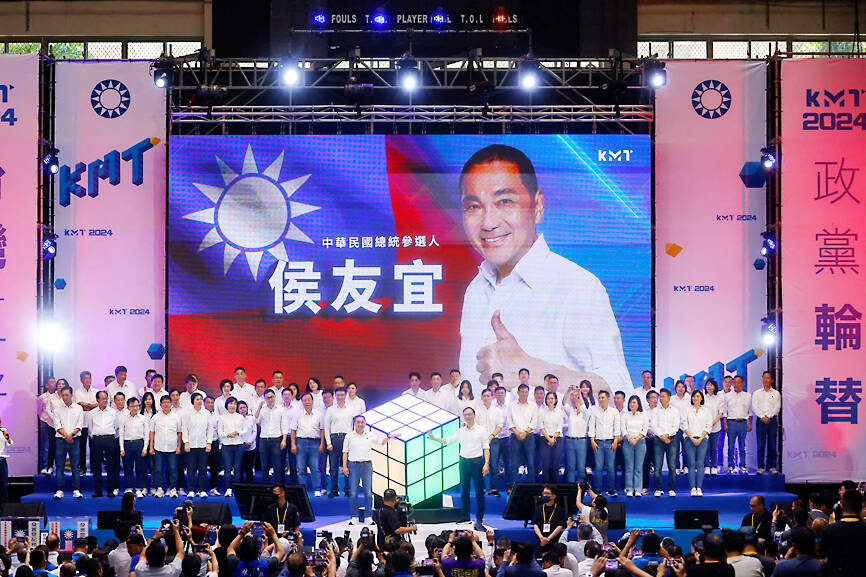
Photo: Ann Wang, Reuters
“However, how are people to believe promises made by politicos from a party that likes to lie and plagiarize theses?” he said, alluding to allegations of academic plagiarism involving several DPP politicians leading up to last year’s local elections.
“Removing the DPP from power is the mainstream opinion, the hope of not having a war is also the goal of the whole Taiwan,” he added.
For security’s sake, Taiwan needs to prepare for combat, while avoiding war from happening, Lai Shyh-bao said.
“However, what the Tsai administration has been doing now is 100 percent preparing for war,” he said.
“More exchanges are needed to avoid war, but as soon as [we] engage in cross-strait exchanges, the Tsai government would paint you [the opposition] with a pro-China brush,” he added.
KMT Legislator Wu Sz-huai (吳斯懷) said that the greatest common denominator is pursuing peace and avoiding war.
“However, that cannot be achieved with slogans only. Concrete actions are needed,” he said. “Yet what we see the direction of the Tsai administration these past few years, which has only been focused on beefing up its readiness for war.”
New Taipei City Mayor Hou You-yi (侯友宜), the KMT’s presidential candidate, said at the launch of his campaign in June that peace is the main focus of next year’s presidential election.
Concern over cross-strait peace was the reason he decided to run for president, as only when there is peace can Taiwan develop sustainably, he said at the time.

Considering that most countries issue more than five denominations of banknotes, the central bank has decided to redesign all five denominations, the bank said as it prepares for the first major overhaul of the banknotes in more than 24 years. Central bank Governor Yang Chin-lung (楊金龍) is expected to report to the Legislative Yuan today on the bank’s operations and the redesign’s progress. The bank in a report sent to the legislature ahead of today’s meeting said it had commissioned a survey on the public’s preferences. Survey results showed that NT$100 and NT$1,000 banknotes are the most commonly used, while NT$200 and NT$2,000

The Centers for Disease Control (CDC) yesterday reported the first case of a new COVID-19 subvariant — BA.3.2 — in a 10-year-old Singaporean girl who had a fever upon arrival in Taiwan and tested positive for the disease. The girl left Taiwan on March 20 and the case did not have a direct impact on the local community, it said. The WHO added the BA.3.2 strain to its list of Variants Under Monitoring in December last year, but this was the first imported case of the COVID-19 variant in Taiwan, CDC Deputy Director-General Lin Ming-cheng (林明誠) said. The girl arrived in Taiwan on

ANNUAL EVENT: Two massive Pokemon balloons are to be set up in Daan Park, with an event zone operating from 10am to 6pm This year’s Taipei Floral Picnic is to be held at Daan Park today and tomorrow, featuring an exclusive Pokemon Go event, a themed food market, a coffee rave picnic area and stage performances, the Taipei Department of Information and Tourism said yesterday. Two massive Pokemon balloons are to be set up in the park as attractions, with an exclusive event zone operating from 10am to 6pm, it said. Participants who complete designated tasks on-site would have a chance to receive limited-edition souvenirs, it added. People could also try the newly launched game Pokemon Pokopia in the trial area, the department said. Three PokeStops are

South Korea is planning to revise its controversial electronic arrival card, a step Taiwanese officials said prompted them to hold off on planned retaliatory measures, a South Korean media report said yesterday. A Yonhap News Agency report said that the South Korean Ministry of Foreign Affairs is planning to remove the “previous departure place” and “next destination” fields from its e-arrival card system. The plan, reached after interagency consultations, is under review and aims to simplify entry procedures and align the electronic form with the paper version, a South Korean ministry official said. The fields — which appeared only on the electronic form


 RSS
RSS