


The Taipei City Government on Wednesday said it is investigating National Taiwan Normal University Veterinary Hospital over accusations that a vet accidentally killed a dog by administering anesthesia without the owner’s authorization, with the results to be shared later this month.
Taipei City Councilor Angela Ying (應曉薇) convened a news conference earlier in the day with the owner of the dog, surnamed Chang (張).
Chang said she took her pomeranian, Micky, to the hospital’s behavioral clinic on July 24.

Photo: Tsai Ya-hua, Taipei Times
A vet surnamed Wang (王) said they would make the dog “comfortable and well-behaved” while drawing blood, she said.
Shortly afterward, Micky went into shock and died, Chang said, adding that she later discovered that Wang had administered anesthesia without her permission.
The hospital has yet to provide any surveillance footage or records to explain what happened, she said.
Another employee at the clinic alleged that the veterinarians did not take the situation seriously when Micky went into shock, and only administered first aid after an intern pointed out that something was wrong, Ying said.
However, Chang cannot claim medical negligence, as pets are considered property under the law, Ying said.
The primary issue with the case should be whether the veterinarian had Chang sign a consent form, but consent forms are not covered in the Veterinarian Act (獸醫師法), Taipei Animal Protection Office Commissioner Chen Ying-hao (陳英豪) said, recommending that vets use sample forms provided by the office.
Taipei Consumer Protection Officer Kung Chien-ya (龔千雅) said her office received a complaint about the case earlier this month and is already conducting an investigation.
The hospital in a statement said that Wang had already apologized multiple times for the unintentional error caused by personal negligence.
It also vowed to take responsibility if administrative or legal errors are discovered on the part of the hospital or Wang.

More than half of the bamboo vipers captured in Tainan in the past few years were found in the city’s Sinhua District (新化), while other districts had smaller catches or none at all. Every year, Tainan captures about 6,000 snakes which have made their way into people’s homes. Of the six major venomous snakes in Taiwan, the cobra, the many-banded krait, the brown-spotted pit viper and the bamboo viper are the most frequently captured. The high concentration of bamboo vipers captured in Sinhua District is puzzling. Tainan Agriculture Bureau Forestry and Nature Conservation Division head Chu Chien-ming (朱健明) earlier this week said that the

NAMING SPAT: The foreign ministry called on Denmark to propose an acceptable solution to the erroneous nationality used for Taiwanese on residence permits Taiwan has revoked some privileges for Danish diplomatic staff over a Danish permit that lists “Taiwan” as “China,” Eric Huang (黃鈞耀), head of the Ministry of Foreign Affairs’ Department of European Affairs, told a news conference in Taipei yesterday. Reporters asked Huang whether the Danish government had responded to the ministry’s request that it correct the nationality on Danish residence permits of Taiwanese, which has been listed as “China” since 2024. Taiwan’s representative office in Denmark continues to communicate with the Danish government, and the ministry has revoked some privileges previously granted to Danish representatives in Taiwan and would continue to review

The first bluefin tuna of the season, brought to shore in Pingtung County and weighing 190kg, was yesterday auctioned for NT$10,600 (US$333.5) per kilogram, setting a record high for the local market. The auction was held at the fish market in Donggang Fishing Harbor, where the Siaoliouciou Island-registered fishing vessel Fu Yu Ching No. 2 delivered the “Pingtung First Tuna” it had caught for bidding. Bidding was intense, and the tuna was ultimately jointly purchased by a local restaurant and a local company for NT$10,600 per kilogram — NT$300 ,more than last year — for a total of NT$2.014 million. The 67-year-old skipper
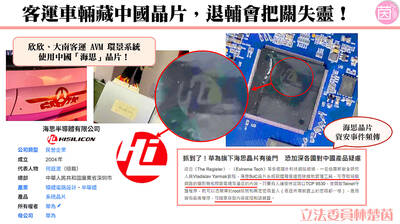
BREACH OF CONTRACT: The bus operators would seek compensation and have demanded that the manufacturer replace the chips with ones that meet regulations Two bus operators found to be using buses with China-made chips are to demand that the original manufacturers replace the systems and provide compensation for breach of contract, the Veterans Affairs Council said yesterday. Democratic Progressive Party Legislator Michelle Lin (林楚茵) yesterday said that Da Nan Bus Co and Shin-Shin Bus Co Ltd have fielded a total of 82 buses that are using Chinese chips. The bus models were made by Tron-E, while the systems provider was CYE Electronics, Lin said. Lin alleged that the buses were using chips manufactured by Huawei subsidiary HiSilicon Co, which presents a national security risk if the


 RSS
RSS