


The Global Anti-Scam Organization (GASO) is urging people to be alert when in Southeast Asia after a Taiwanese tourist was drugged and kidnapped by cyberscam criminals.
A Taiwanese in his 20s was seriously injured after falling out of a building while fleeing his kidnappers, GASO said on Friday.
In a video recording for GASO, the man said he was traveling alone in Chiang Mai, Thailand, and went to a bar, but could not remember what happened next, adding that someone must have spiked his drink.
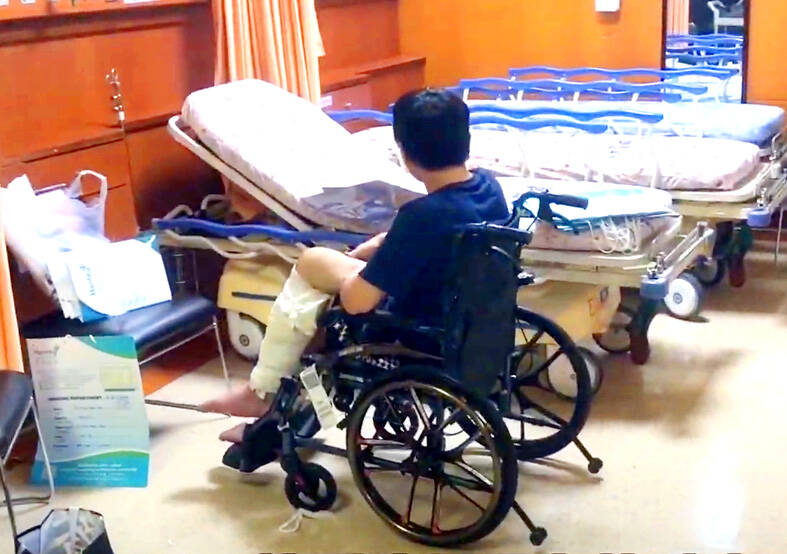
Photo courtesy of Global Anti-Scam Organization
He said that when he woke up, he was in a car heading to Kokang region in Myanmar’s Shan State, which is across the border from Chiang Mai.
The men escorting him wore military uniforms and carried firearms, he said.
He said he was taken to a guarded compound in Kokang, which borders China’s Yunnan Province, and was held captive by cyberscam operators.
For one month he was trained in investment fraud, learning to talk like a businessman to entice people with promises of making money, he said.
The dozens of captives got a chance to escape when their supervisor went out one day. They broke open a ventilation duct, then tied bedsheets together to form a rope and threw it out of a window on the seventh floor, he said.
The man said he went first, but could not hold on and fell about five stories, but his fellow captives fled the compound with him and took him for treatment.
He had broken both legs and fractured vertebrae in several places, among other injuries.
He said he bribed the security guard at the hospital managed to telephone his mother in Taiwan, who then contacted the GASO.
Local media reported on his case, and some Taiwanese businesspeople in Myanmar helped him.
The man said he had to pay NT$300,000 (US$9,435) in total to get home, and his medical expenses came to NT$200,000.
He said when people are kidnapped by cybercrime gangs, they have to work as instructed or be sold for NT$300,000 to NT$500,000 to other gangs, which might demand a ransom for them, or for organ harvesting.
“I was not beaten up, because I cooperated with them and did what I was told,” he said. “Do not go to Thailand alone, you must go with friends.”
GASO and international authorities have reported that Phnom Penh, and Kokang and Myawaddy in Myanmar are among the main centers for cyberscams, which are mainly run by Chinese gangs.
A GASO spokeman surnamed Chen (陳) said cyberscam gangs have moved their operations from Cambodia and Myawaddy, to Kokang, and adjacent regions on northern Thailand and Myanmar, where they are “a law unto themselves.”

The Ministry of Finance this afternoon announced the winning numbers for the March-April uniform invoice lottery. The winning number for the NT$10 million (US$318,060) special prize is 19531471, and the winning number for the NT$2 million grand prize is 85941329. Three numbers were drawn for the NT$200,000 first prize: 07225810, 20231230 and 83518781. Those with receipts matching the last seven digits of any of the first-prize numbers will win the NT$40,000 second prize, while those matching the last six digits will win the NT$10,000 third prize. Those whose receipts match the last five digits of the first-prize numbers can claim the NT$4,000 fourth prize,

SIX SUBSIDIES: The monthly allowance for older farmers is to increase to NT$10,000, and NT$5,000 is to be given to homemakers under the national pension system, Lai said The government is to implement major welfare policies for disadvantaged groups, including raising the monthly allowance for older farmers to NT$10,000 and providing homemakers with NT$5,000 per month, President William Lai (賴清德) said yesterday. Lai made the remarks during a visit to Wangling Temple in Chiayi County, saying that the planned increases were being introduced amid economic growth and an increase in tax revenue. Touting a policy, in which the government plans to provide a monthly allowance of NT$5,000 for every child under the age of 18 in a bid to address Taiwan’s low birthrate, Lai said that if received for the
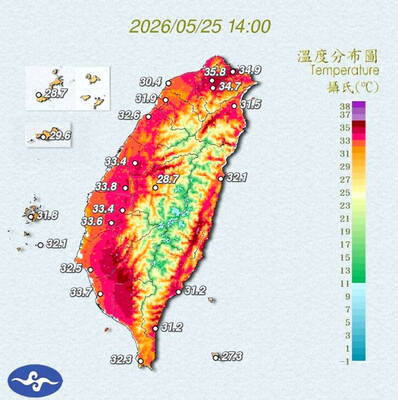
STAY COOL: The HPA recommended that people stay hydrated, use air-conditioning or fans while indoors, wear loose-fitting clothes and walk in the shade while outdoors Employers must implement measures such as installing cooling equipment, and providing drinking water and rest breaks for outdoor workers starting from Monday next week, the Taipei Department of Labor said on Sunday. Employers who fail to comply could face fines of NT$30,000 to NT$300,000 under the Occupational Safety and Health Act (職業安全衛生法), the department said. Businesses in Taipei employing fewer than 100 workers, as well as registered self-employed workers with labor insurance coverage, could receive on-site assessments and guidance from occupational safety consultants to help them apply for central government subsidies to implement or improve heat-protection measures, it said. Under the Ministry of
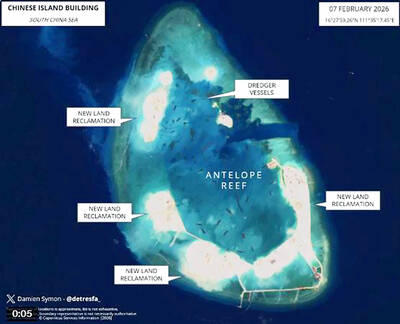
ISOLATION: The outposts would serve as support and backup bases, forcing US forces to either face China head-on or reroute, increasing travel time and operational costs China’s outposts in the South China Sea could be used to delay and constrain foreign forces during a conflict in the Taiwan Strait, giving Beijing a critical window to carry out amphibious landing and blockade operations, a report said. The Chinese Communist Party’s (CCP) forward operating bases on islands and reclaimed features in the South China Sea could delay foreign forces long enough for the Chinese People’s Liberation Army (PLA) to secure a key 48-to-72-hour window in the Taiwan Strait, a report commissioned by the Mainland Affairs Council found. The report, conducted by the Institute for National Defense and Security Research, examined


 RSS
RSS