


Top aides of Vice President William Lai (賴清德), the Democratic Progressive Party’s (DPP) presidential candidate, have formed a new strategy to counter disinformation and personal attacks against Lai from opposition parties.
Since Lai confirmed his candidacy, opposition parties have been promoting a false narrative that US leaders do not trust him, to sow skepticism at home and abroad, a DPP insider said on condition of anonymity.
The DPP formed an interdepartmental “Task Force to Combat Cognitive Warfare” to coordinate actions and provide a swift response, including clarifying issues, dispelling rumors and limiting damage from disinformation and false reports, the source said.

Photo: Chu Pei-hsiung, Taipei Times
“In recent weeks, opposition parties and certain media outlets have again raised the ‘US doubting Lai’ theory and further expanded on it,” the source said.
“It is a continuation of the cognitive warfare from last year, which initially targeted Lai’s family,” claiming that Lai’s two sons have US green cards, to insinuate that they would not serve if war breaks out, the source said.
The opposition also focused on the political wrangling and crime in Tainan in further attempts to undermine Lai, who served as city mayor from 2010 to 2017, the source said.
Quoting other DPP figures, the party source said that after it became apparent that these personal attacks did not have much effect, the opposition turned to disinformation, raising doubts about Lai’s competency on national governance and foreign affairs, and rumors of friction between Lai and President Tsai Ing-wen (蔡英文).
Lai’s advisers have identified three main tactics that the opposition uses to discredit Lai: tarnishing his image, questioning his governance and foreign affairs acumen, and arousing public anxiety by emphasizing the threat of war, the DPP source said.
The DPP task force is already at work, coordinating efforts between the party’s public information section, new media center and social movements section, as well as working with local chapters and affiliated organizations to monitor and report disinformation, and formulate an immediate response by issuing a statement of clarification or memes that are disseminated through social media, the sources said.
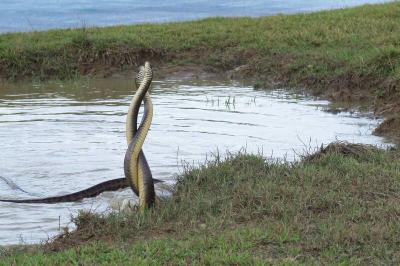
Kenting National Park service technician Yang Jien-fon (楊政峰) won a silver award in World Grand Prix Photography Awards Spring Season for his photograph of two male rat snakes intertwined in combat. Yang’s colleagues at Kenting National Park said he is a master of nature photography who has been held back by his job in civil service. The awards accept entries in all four seasons across six categories: architectural and urban photography, black-and-white and fine art photography, commercial and fashion photography, documentary and people photography, nature and experimental photography, and mobile photography. Awards are ranked according to scores and divided into platinum, gold and
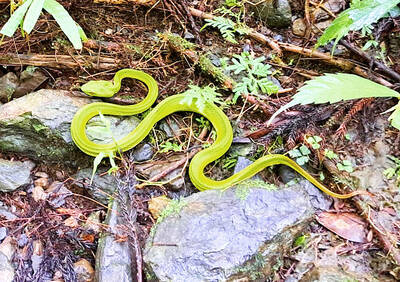
More than half of the bamboo vipers captured in Tainan in the past few years were found in the city’s Sinhua District (新化), while other districts had smaller catches or none at all. Every year, Tainan captures about 6,000 snakes which have made their way into people’s homes. Of the six major venomous snakes in Taiwan, the cobra, the many-banded krait, the brown-spotted pit viper and the bamboo viper are the most frequently captured. The high concentration of bamboo vipers captured in Sinhua District is puzzling. Tainan Agriculture Bureau Forestry and Nature Conservation Division head Chu Chien-ming (朱健明) earlier this week said that the

The Chinese Nationalist Party (KMT) caucus yesterday said it opposes the introduction of migrant workers from India until a mechanism is in place to prevent workers from absconding. Minister of Labor Hung Sun-han (洪申翰) on Thursday told the Legislative Yuan that the first group of migrant workers from India could be introduced as early as this year, as part of a government program. The caucus’ opposition to the policy is based on the assessment that “the risk is too high,” KMT caucus secretary-general Lin Pei-hsiang (林沛祥) said. Taiwan has a serious and long-standing problem of migrant workers absconding from their contracts, indicating that

SPACE VETERAN: Kjell N. Lindgren, who helps lead NASA’s human spaceflight missions, has been on two expeditions on the ISS and has spent 311 days in space Taiwan-born US astronaut Kjell N. Lindgren is to visit Taiwan to promote technological partnerships through one of the programs organized by the US for its 250th national anniversary. Lindgren would be in Taiwan from Tuesday to Saturday next week as part of the US Bureau of Educational and Cultural Affairs’ US Speaker Program, organized to celebrate the 250th anniversary of the signing of the Declaration of Independence, the American Institute in Taiwan (AIT) said in a statement yesterday. Lindgren plans to engage with key leaders across the nation “to advance cutting-edge technological partnerships and inspire the next generation of scientists and engineers,”


 RSS
RSS