


Purdue University is launching a center to advocate for Taiwan as a trusted partner and encourage US investment in the nation, former US undersecretary of state for economic growth, energy and the environment Keith Krach told a news conference in Taipei yesterday.
Krach, chairman of the Krach Institute for Tech Diplomacy at Purdue, first announced plans for the establishment of the Taiwan Center for Innovation and Prosperity before his arrival in Taiwan on Wednesday for a four-day visit.
The center would be a partnership between public and private sectors in the US and Taiwan to “advocate for Taiwan internationally and attract more global partners,” the institute said.
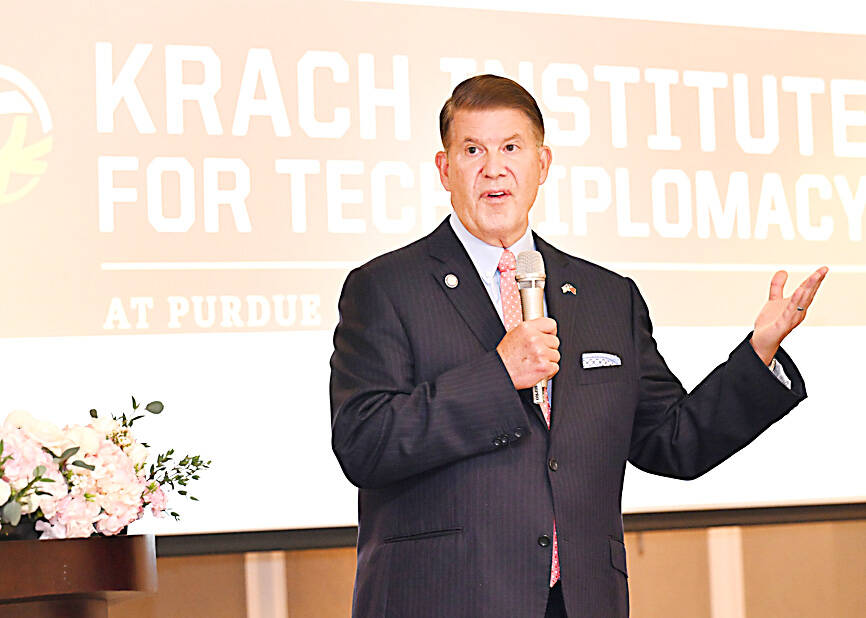
Photo: Tien Yu-hua, Taipei Times
While Western firms are pulling out of China due to security concerns, Taiwan has great opportunities to attract investment with its skilled labor force and a friendly government, Krach said.
The center hopes to facilitate such cooperation, as well as help foster and strengthen customer relationships as, for example, more than half of Taiwan Semiconductor Manufacturing Co’s customer base is in the US, he said.
The partnership also looks to address the shortage of skilled labor, a topic he discussed extensively with President Tsai Ing-wen (蔡英文) during their meeting, Krach said.
Purdue is the only university that offers bachelor’s, master’s and doctorate programs in semiconductor engineering and is a top university in national security research, he said.
By signing memorandums of understanding with National Chengchi University and National Yang Ming Chiao Tung University, the center is to provide tech diplomacy training for the private sector as well as diplomats, he said.
It is also to accelerate innovation, from research to development and adoption of trusted technology with its venture capital capabilities and mentor network, he added.
US President Joe Biden last year signed the Creating Helpful Incentives to Produce Semiconductors (CHIPS) and Science Act, which provides billions of US dollars for research in critical national security sectors such as biotechnology, cybersecurity, autonomous vehicles and aerospace.
“I think the opportunities for Taiwan to participate in that is huge,” Krach said.
Krach is also chairman of the Global Tech Security Commission, where Minister of Digital Affairs Audrey Tang (唐鳳) serves as a commissioner as Taiwan’s representative.
Tang is going to “play a pivotal role” in developing a set of trusted tech standards, Krach said.
Asked about Taiwan’s presidential election in January next year, Krach said that he hoped Taiwanese can select a transformational leader who has courage, like President Tsai.
“All eyes are on Taiwan. Taiwan is the linchpin of democracy,” he said. “I think if there’s anything that I’ve learned from the people of Taiwan, there is no prosperity without freedom.”

Considering that most countries issue more than five denominations of banknotes, the central bank has decided to redesign all five denominations, the bank said as it prepares for the first major overhaul of the banknotes in more than 24 years. Central bank Governor Yang Chin-lung (楊金龍) is expected to report to the Legislative Yuan today on the bank’s operations and the redesign’s progress. The bank in a report sent to the legislature ahead of today’s meeting said it had commissioned a survey on the public’s preferences. Survey results showed that NT$100 and NT$1,000 banknotes are the most commonly used, while NT$200 and NT$2,000

The Centers for Disease Control (CDC) yesterday reported the first case of a new COVID-19 subvariant — BA.3.2 — in a 10-year-old Singaporean girl who had a fever upon arrival in Taiwan and tested positive for the disease. The girl left Taiwan on March 20 and the case did not have a direct impact on the local community, it said. The WHO added the BA.3.2 strain to its list of Variants Under Monitoring in December last year, but this was the first imported case of the COVID-19 variant in Taiwan, CDC Deputy Director-General Lin Ming-cheng (林明誠) said. The girl arrived in Taiwan on

South Korea is planning to revise its controversial electronic arrival card, a step Taiwanese officials said prompted them to hold off on planned retaliatory measures, a South Korean media report said yesterday. A Yonhap News Agency report said that the South Korean Ministry of Foreign Affairs is planning to remove the “previous departure place” and “next destination” fields from its e-arrival card system. The plan, reached after interagency consultations, is under review and aims to simplify entry procedures and align the electronic form with the paper version, a South Korean ministry official said. The fields — which appeared only on the electronic form

The Ministry of Foreign Affairs (MOFA) is suspending retaliation measures against South Korea that were set to take effect tomorrow, after Seoul said it is updating its e-arrival system, MOFA said today. The measures were to be a new round of retaliation after Taiwan on March 1 changed South Korea's designation on government-issued alien resident certificates held by South Korean nationals to "South Korea” from the "Republic of Korea," the country’s official name. The move came after months of protests to Seoul over its listing of Taiwan as "China (Taiwan)" in dropdown menus on its new online immigration entry system. MOFA last week


 RSS
RSS