


Visiting former US undersecretary of state for economic growth, energy and the environment Keith Krach yesterday presented President Tsai Ing-wen (蔡英文) with a Tech Freedom Award in recognition of her contribution to tech diplomacy and commitment to advancing freedom.
As chairman of the Krach Institute for Tech Diplomacy at Purdue and cochair of the Global Tech Security Commission, Krach gave the award to Tsai “on behalf of the Krach Institute and free people everywhere around the world.”
“May our partnership continue to flourish and inspire the world. God bless you, President Tsai. God bless the people of Taiwan. We salute you. We admire you. We honor you with the Tech Freedom Award,” he said.
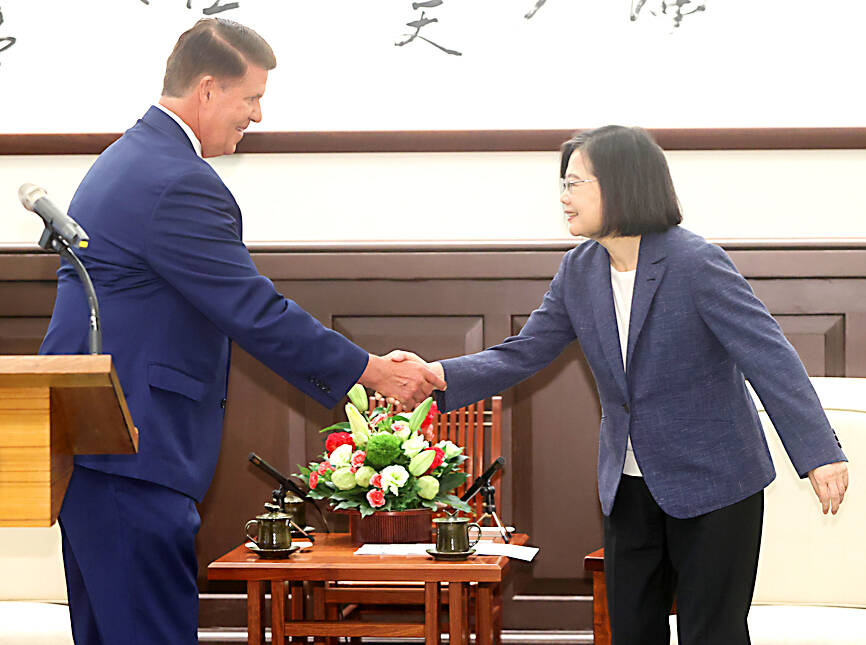
Photo: CNA
Following his previous trip to Taiwan three years ago as a government official, this time he came “as a friend,” Krach said.
Taiwan and the US have bonded based on common values and were both founded on the belief that “there is no prosperity without freedom,” he said.
Taiwan was at the heart of the US global economic security strategy when he served as undersecretary of state, as it is a beacon of democracy and the embodiment of liberty, has remarkable achievements in technological innovation and is a true friend of the US, Krach added.
The Science and Technology Agreement signed by Taipei and Washington in 2020, and Taiwan Semiconductor Manufacturing Co’s investment in the US “lay a foundation for a future free-trade agreement,” which is “long overdue,” Krach said.
“Technology must advance freedom” is the objective shared by both the institute and the commission, he added.
The commission is tasked by the US Congress to create a global tech security strategy to ensure that “technology serves humanity and isn’t weaponized against us by authoritarian regimes,” he said.
He welcomed Minister of Digital Affairs Audrey Tang (唐鳳) to the commission after she was tapped to be Taiwan’s representative.
Bolstering Taiwan’s prosperity, international standing and sovereignty is “a critical imperative” of the strategy, so the commission is to launch the Taiwan Center for Innovation and Prosperity, he said.
“Without a strong, resilient [and] free Taiwan, freedom everywhere will be imperiled by authoritarianism,” he said.
China is threatened by Taiwan because “free and prosperous Taiwan shatters [Chinese President] Xi Jinping’s [習近平] myth that the Chinese culture cannot thrive as a democracy, but it does,” Krach said.
The US and free countries around the globe stand with Taiwan, not only to demonstrate solidarity among democracies, but also because it is in their economic, technological, scientific and national security interest, he said.
Tsai thanked Krach for his staunch friendship with Taiwan, citing as examples his work to establish the US-Taiwan Economic Prosperity Partnership Dialogue and signing of the Science and Technology Agreement.
Taiwan hopes to further deepen cooperation and exchanges with the US and expedite the signing of an agreement on the avoidance of double taxation, which would create more opportunities for bilateral investment, she said.

Considering that most countries issue more than five denominations of banknotes, the central bank has decided to redesign all five denominations, the bank said as it prepares for the first major overhaul of the banknotes in more than 24 years. Central bank Governor Yang Chin-lung (楊金龍) is expected to report to the Legislative Yuan today on the bank’s operations and the redesign’s progress. The bank in a report sent to the legislature ahead of today’s meeting said it had commissioned a survey on the public’s preferences. Survey results showed that NT$100 and NT$1,000 banknotes are the most commonly used, while NT$200 and NT$2,000

The Centers for Disease Control (CDC) yesterday reported the first case of a new COVID-19 subvariant — BA.3.2 — in a 10-year-old Singaporean girl who had a fever upon arrival in Taiwan and tested positive for the disease. The girl left Taiwan on March 20 and the case did not have a direct impact on the local community, it said. The WHO added the BA.3.2 strain to its list of Variants Under Monitoring in December last year, but this was the first imported case of the COVID-19 variant in Taiwan, CDC Deputy Director-General Lin Ming-cheng (林明誠) said. The girl arrived in Taiwan on

South Korea is planning to revise its controversial electronic arrival card, a step Taiwanese officials said prompted them to hold off on planned retaliatory measures, a South Korean media report said yesterday. A Yonhap News Agency report said that the South Korean Ministry of Foreign Affairs is planning to remove the “previous departure place” and “next destination” fields from its e-arrival card system. The plan, reached after interagency consultations, is under review and aims to simplify entry procedures and align the electronic form with the paper version, a South Korean ministry official said. The fields — which appeared only on the electronic form

The Ministry of Foreign Affairs (MOFA) is suspending retaliation measures against South Korea that were set to take effect tomorrow, after Seoul said it is updating its e-arrival system, MOFA said today. The measures were to be a new round of retaliation after Taiwan on March 1 changed South Korea's designation on government-issued alien resident certificates held by South Korean nationals to "South Korea” from the "Republic of Korea," the country’s official name. The move came after months of protests to Seoul over its listing of Taiwan as "China (Taiwan)" in dropdown menus on its new online immigration entry system. MOFA last week


 RSS
RSS