


A law regulating free diving is needed to protect public safety and the environment, Democratic Progressive Party Legislator Chao Tien-lin (趙天麟) said on Wednesday in a call on the Ministry of Transportation and Communications’ Tourism Bureau to take legislative action.
Chao made the comment at a news conference in the Legislative Yuan in Taipei.
In response, the bureau said that officials have completed a draft and scheduled it for discussion with the public and outside agencies on Aug. 15, with the goal of passing the law by the end of the year.
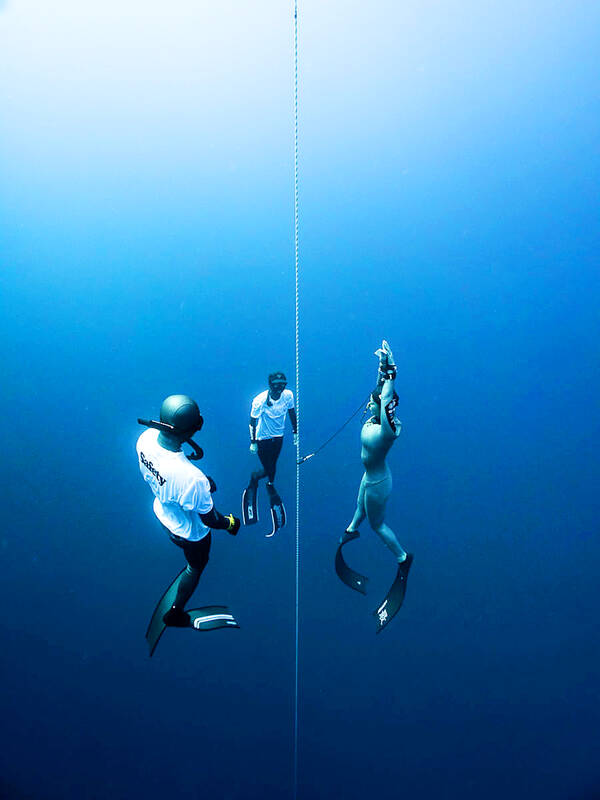
Photo courtesy of the Taiwan Freediving Development Association
Taiwan is experiencing a surge of interest in free diving, which brings vast business opportunities and challenges for the government to keep divers safe and the oceans unpolluted, Chao said.
Regulations Governing Water Recreation Activities (水域遊憩活動管理辦法) narrowly defines diving activities as diving with the aid of snorkels or scuba gear, leaving free diving entirely unregulated, he said.
The government should fill the regulatory gap, he said.
For-profit water sports are obligated to provide mandatory liability insurance according to the Act for the Development of Tourism (展觀光條例), but only one-third of Taiwanese diving instructors are insured, he said.
The lack of regulations put amateur enthusiasts at risk, as they might misjudge their skill level, stamina or weather, while diving tour groups sometimes behave badly around protected reefs, Pingtung Professional Union of Diving Instructors chairman Chan Hao-yu (詹皓宇) said.
Unskilled tourists often cause harm by trampling on coral, and tour groups are known to get into protected waters or sea lanes reserved for commercial fishing boats, he said.
Self-employed diving instructors qualify for insurance policies, which are carried by two domestic insurance companies, said Ting Yu-sheng (丁豫聖), a member of the Non-Life Insurance Association of the Republic of China.
The bureau has completed a draft and it anticipates that modifications would be made following discussions with officials, experts and the industry, bureau section chief Lin Hsiu-hsia (林秀霞) said.

NATIONAL SECURITY: Authorities are working to confirm the identities of the military personnel involved and investigating possible illegal conduct and regulatory violations Authorities are probing possible national security implications after Kinmen police and immigration officers on Sunday found a Chinese woman allegedly posing as a tourist while engaging in prostitution involving more than 10 military personnel. The woman, surnamed Chen (陳), has since been deported, authorities said, adding that investigators are still working to confirm the identities of those implicated, as the records only listed code names and aliases. The case stemmed from a report received by the Kinmen District Prosecutors’ Office on Friday last week from the Jinhu Precinct of the Kinmen County Police Bureau. On Sunday, police, along with the National Immigration

GLOBALGIVING: ‘ Caving to external pressure is not acceptable for an organization that has cultivated justice reform and human rights for 30 years,’ one NGO said A slew of non-government organizations (NGOs) have withdrawn from the GlobalGiving fundraising platform after it announced it would use “Chinese Taipei” instead of “Taiwan” from next month. The Taiwan Good Rice Association wrote on Facebook on Friday that it was informed on April 28 via a teleconference call of the change, which was made because the platform wanted to operate in China. Taiwan Good Rice is to terminate all cooperative relationships with GlobalGiving in response to the platform’s “unilateral and non-negotiable” decision to remove references to Taiwan, the NGO said. “Taiwan is in the official name of Taiwan Good Rice Association and the

HEAVY WEATHER: Typhoon Jangmi is due to crash straight into the Ryukyus as airlines look to shift flights to larger aircraft or cancel flights to Okinawa entirely Taiwan’s international air carriers announced flight adjustments over the weekend as Typhoon Jangmi is forecast to hit the Ryukyu Islands today and tomorrow. The Central Weather Administration (CWA) upgraded Jangmi from a tropical storm to a typhoon at 8am yesterday, with the eye located 580km south of Naha city. It was moving north at 19kph. Today, China Airlines’ CI-120, CI-121, CI-122 and CI-123 flights between Taoyuan and Naha, Okinawa, have been canceled as well as CI-132 and CI-133 between Kaohsiung and Naha. EVA Air’s BR-112, BR-113, BR-186 and BR-185 flights between Taoyuan and Naha are also canceled. Low-cost carrier Tigerair Taiwan canceled IT-230,

REASONS FOR TRAVEL: An assistant professor said that proposed amendments to penalize drivers if they used drugs overseas would not deter people from traveling People who operate a motor vehicle under the influence of marijuana would have their driver’s license revoked, even if they used the substance while overseas, the Ministry of Transportation and Communications said yesterday, citing proposed amendments to the Road Traffic Management and Penalty Act (道路交通管理處罰條例). The amendments would also authorize the government to revoke the licenses of people determined to have used Category 1 or Category 2 narcotics, even if they were not operating a vehicle while under the influence of drugs, as well as ban them from taking the license test for three years, the ministry said. People aged 18 or


 RSS
RSS