


A Taiwanese literature exhibition, organized by the National Museum of Taiwan Literature and funded by the Ministry of Culture, is being held in the Scottish capital of Edinburgh and is to run until Thursday next week, after which it is scheduled to visit six other European countries.
The “Sailing Onto the World Stage: Themes in Taiwan Literature” exhibition first opened at the Scottish Storytelling Centre on Monday last week and moved to Edinburgh Central Library on Tuesday.
It is also to visit the Netherlands, Germany, Austria, the Czech Republic, Slovakia and Hungary in the coming months, the ministry said in a statement on Tuesday.
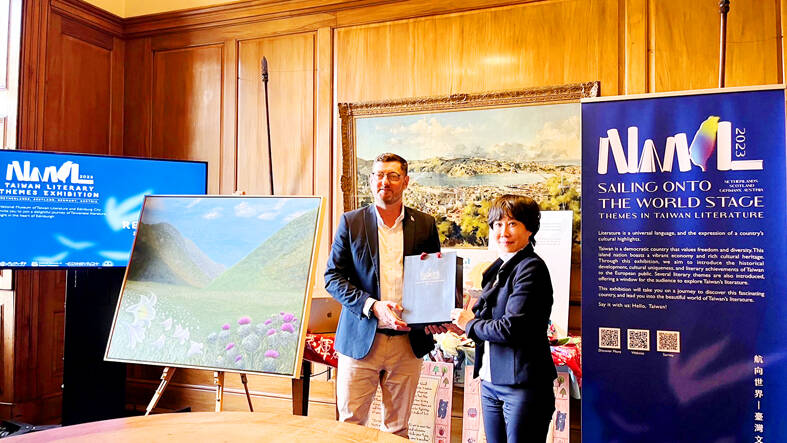
Photo: CNA
The exhibition displays English translations of Taiwanese authors’ works in different topics such as human rights, indigenous people, feminism, LGBTQ, ecology and culinary culture, the ministry said.
These include Pai Hsien-yung’s (白先勇) Crystal Boys (孽子), which depicts gay youth in Taipei the 1960s, and Notes of a Crocodile (鱷魚手記) written by Qiu Miao-jin (邱妙津).
The exhibition also shows Wu Chuo-liu’s (吳濁流) novel Orphan of Asia, which was written in Japanese during the last years of Japanese colonial rule in Taiwan, as well as indigenous writer Syaman Rapongan’s novel Eyes of Heaven (天空的眼睛), which tells the story of an indigenous elder’s life on Orchid Island (Lanyu, 蘭嶼).
The exhibition’s aim is to introduce the historical development, cultural uniqueness and literary achievements of Taiwan to the European public, so people better understand the literary context of the works, the museum said in a statement.
To celebrate the launch of the exhibition, museum director Nikky Lin (林巾力), along with foreign services’ officials and Cammy Day, the leader of the City of Edinburgh Council, attended a reception party on Friday last week, the ministry said.
Lin mentioned the cultural and historical links between Taiwan and Scotland by introducing the story of Scottish missionary and doctor James Laidlaw Maxwell, who imported the first moveable type printing press to Taiwan in the 19th century.
The story of another missionary, Hugh Ritchie, and his wife, Eliza Caroline Cooke, written in picture book form by Jenny Jamieson (陳韻如), was also read in Hoklo (also known as Taiwanese) and English at the reception by Jamieson and the pair’s descendant Joyce Lockhart, the ministry said.
Jenny Jamieson also gifted Day an oil painting of Taiwanese lilies and Scottish thistles thriving in the mountains of Taiwan, symbolizing growing bilateral cooperation, the ministry said.
Moreover, when speaking about bilateral exchanges, Day said that not only an Edinburgh delegation had visited Taiwan in March, but the city is also working with the Taiwanese authorities to erect a monument of Maxwell, as well as establish cooperation between The Usher Hall and the National Kaohsiung Center for the Arts (Weiwuying).

LOUD AND PROUD Taiwan might have taken a drubbing against Australia and Japan, but you might not know it from the enthusiasm and numbers of the fans Taiwan might not be expected to win the World Baseball Classic (WBC) but their fans are making their presence felt in Tokyo, with tens of thousands decked out in the team’s blue, blowing horns and singing songs. Taiwanese fans have packed out the Tokyo Dome for all three of their games so far and even threatened to drown out home team supporters when their team played Japan on Friday. They blew trumpets, chanted for their favorite players and had their own cheerleading squad who dance on a stage during the game. The team struggled to match that exuberance on the field, with
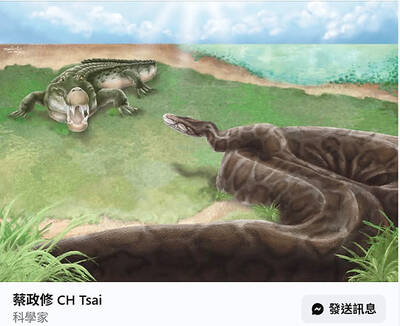
Taiwanese paleontologists have discovered fossil evidence that pythons up to 4m long inhabited Taiwan during the Pleistocene epoch, reporting their findings in the international scientific journal Historical Biology. National Taiwan University (NTU) Institute of Ecology and Evolutionary Biology associate professor Tsai Cheng-hsiu (蔡政修) led the team that discovered the largest snake fossil ever found in Taiwan. The single trunk vertebra was discovered in Tainan at the Chiting Formation, dated to between 400,000 and 800,000 years ago in the Middle Pleistocene, the paper said. The area also produced Taiwan’s first avian fossil, as well as crocodile, mammoth, saber-toothed cat and rhinoceros fossils, it said. Discoveries

Taiwanese paleontologists have discovered fossil evidence that pythons up to 4m long inhabited Taiwan during the Pleistocene epoch, reporting their findings in the international scientific journal Historical Biology. National Taiwan University (NTU) Institute of Ecology and Evolutionary Biology associate professor Tsai Cheng-hsiu (蔡政修) led the team that discovered the largest snake fossil ever found in Taiwan. A single trunk vertebra was discovered in Tainan at the Chiting Formation, dated to between 800,000 to 400,000 years ago in the Middle Pleistocene, the paper said. The area also produced Taiwan’s first avian fossil, as well as crocodile, mammoth, sabre-toothed cat and rhinoceros fossils, it said. Discoveries

Whether Japan would help defend Taiwan in case of a cross-strait conflict would depend on the US and the extent to which Japan would be allowed to act under the US-Japan Security Treaty, former Japanese minister of defense Satoshi Morimoto said. As China has not given up on the idea of invading Taiwan by force, to what extent Japan could support US military action would hinge on Washington’s intention and its negotiation with Tokyo, Morimoto said in an interview with the Liberty Times (sister paper of the Taipei Times) yesterday. There has to be sufficient mutual recognition of how Japan could provide


 RSS
RSS