


Police have arrested 13 people involved in an operation that allegedly defrauded people using promises of high returns on cryptocurrency investments.
A man surnamed Sun (孫), who promoted himself as a wealthy cryptocurrency mogul, set up a currency trading company in Taipei, with investigators saying that bank records show it made up to NT$540 million (US$17.08 million) in illegal gains.
Sun, 35, and other suspects were questioned yesterday, said Yen Chih-hao (鄢志豪), section chief of the Kaohsiung police force’s criminal investigation unit.
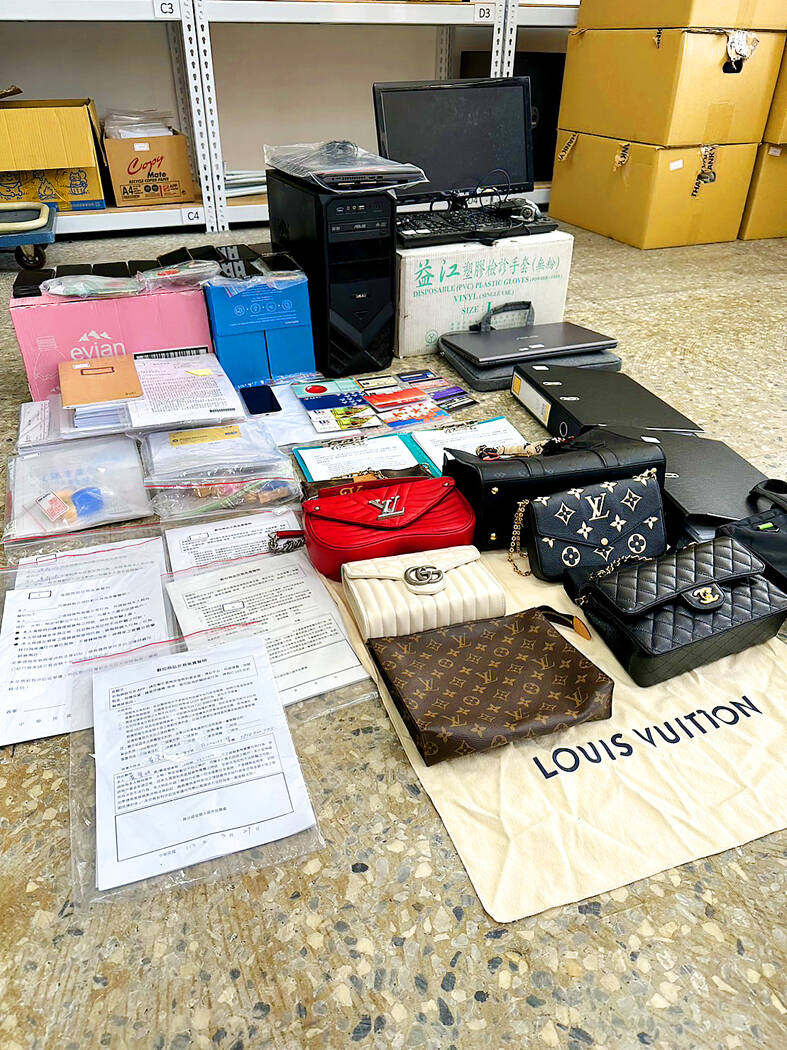
Photo copied by Huang Liang-chieh, Taipei Times
Sun, his wife, younger sister and two friends face charges of aggravated fraud and illegal profiteering, as well as contravening the Organized Crime Prevention Act (組織犯罪防制條例) and the Money Laundering Control Act (洗錢防制法), Yen said.
Taipei and Kaohsiung police work has showed that Sun recruited eight people who worked for food delivery platforms to collect money, with the drivers paid 1 percent of the conveyed amount capped at NT$5,000 per job, he said.
Sun posted adverts online that “guaranteed” high returns and touting “experts in stock and cryptocurrency trading,” investigators said, adding that he would make small payments to investors to falsely demonstrate earning ability to deceive people into putting in more money.
From March to December last year, the operation had 422 investors, Yen said, adding that police had confiscated NT$5 million from bank accounts, NT$4 million from tether cryptocurrency wallets, NT$326,700 in cash, an imported sedan worth NT$3 million and a property in Taipei valued at NT$25 million.
Records indicated that Sun had transferred at least NT$87 million abroad via cryptocurrencies to launder it, Yen said.
Evidence showed that Sun’s wife, sister and the two friends had assisted in the laundering by trading cryptocurrency, Yen said.
Separately, police officials on Wednesday spoke at a meeting with people who invested in Lonhai Enterprise, a subsidiary of Kaohsiung-based Wuhu Group.
About 40 people at the meeting demanded the return of investments they had made in Lonhai, as Wuhu Group chairwoman Chen Chiu-pai (陳秋白) has been convicted of fraud and contravening the Banking Act (銀行法) in a first ruling in May.
Chen was given a 10-year, six-month sentence and fined NT$200 million, although she has appealed the ruling.
Chen deceived at least 20,000 people across Taiwan over the past 10 years, with an estimated NT$22 billion invested in Lonhai schemes since 2013, investigators said.
The best option for those who lost money would be to file a class-action lawsuit, police officials told the meeting.
Many of the people at the meeting said that they are immigrants, mostly Chinese women married to Taiwanese.
One told reporters that she had invested NT$15 million and was unable to get any of the money back.
Fast food chain McDonald's is to raise prices by up to NT$5 on some products at its restaurants across Taiwan, starting on Wednesday next week, the company announced today. The prices of all extra value meals and sharing boxes are to increase by NT$5, while breakfast combos and creamy corn soup would go up by NT$3, the company said in a statement. The price of the main items of those meals, if ordered individually, would remain the same. Meanwhile, the price of a medium-sized lemon iced tea and hot cappuccino would rise by NT$3, extra dipping sauces for chicken nuggets would go up
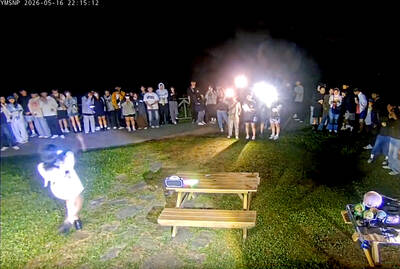
Yangmingshan National Park’s Qingtiangang (擎天崗) nature area has gone viral after a park livestream camera observed a couple in the throes of intimate congress, which was broadcast live on YouTube, drawing large late-night crowds and sparking a backlash over noise, bright lights and disruption to wildlife habitat. The area’s livestream footage appeared to show a couple engaging in sexual activity on a picnic table in the park on Friday last week, with the uncensored footage streamed publicly online. The footage quickly spread across social media, prompting a tide of visitors to travel to the site to “check in” and recreate the
Carrefour Taiwan is to begin using a new name from the start of July, but it cannot divulge the name until then, the chairman of the supermarket chain's parent company said today. President Chain Store Co chairman Lo Chih-hsien (羅智先) was asked by reporters after a shareholders' meeting to confirm whether the company has settled on a new name for the supermarket brand. In March, the government-registered name of two Carrefour Taiwan branches was quietly changed to "Le Chia Kang" (樂家康) in Chinese, raising speculation that has been selected as the name. Lo said that because of local regulations and contractual obligations, the
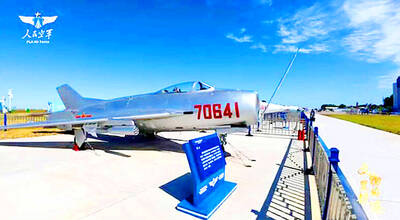
GROUNDED: A KMT lawmaker proposed eliminating drone development programs and freezing funding for counterdrone systems, despite China’s adoption of the technology China has deployed attack drones at air bases near the Taiwan Strait in a strategy aimed at overwhelming Taiwan’s air defense systems through saturation attacks, the Mainland Affairs Council (MAC) said. The council’s latest quarterly report on China said that satellite imagery and open-source intelligence indicate that the Chinese People’s Liberation Army (PLA) had converted retired J-6 fighter jets into J-6W drones, which the PLA has stationed at six air bases near Taiwan, five in China’s Fujian Province and one in Guangdong Province. The report cited J. Michael Dahm, a senior fellow at the US-based Mitchell Institute, as saying that China has


 RSS
RSS