


Construction of Taiwan Taoyuan International Airport’s Terminal 3 continues, and yesterday, Taoyuan International Airport Corp (TIAC) chairman Yang Wei-fuu and chief executive officer Fan Hsiao-lun visited the main terminal construction site to inspect the assembly of the first giant roof structure column and to encourage the hardworking construction team.
This year, Taiwan Taoyuan International Airport’s travel recovery has been significant, with passenger volume in the first half of the year already surpassing 60 percent of pre-COVID-19 levels. The initiation of the giant column lifting project marks a new milestone in the construction of Terminal 3, moving toward its completion in 2026, which aims to provide service for 82 million passengers annually.
NEW PHASE BEGINS
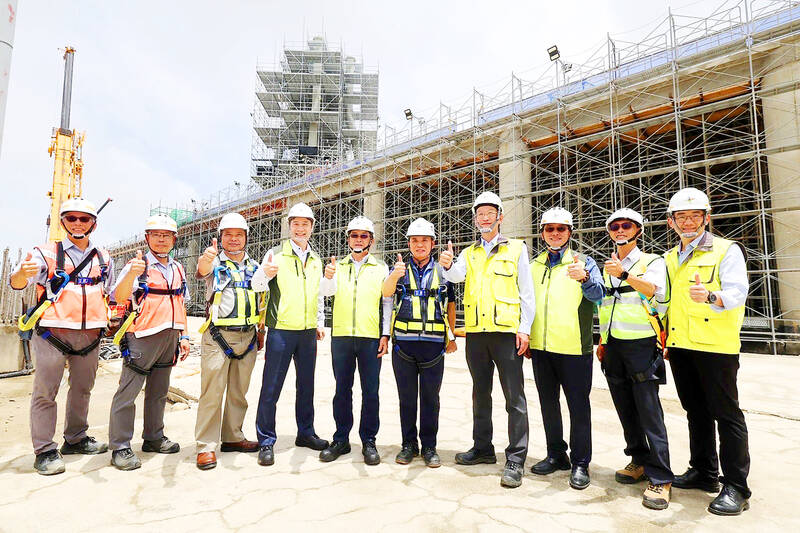
Photo courtesy of TIAC
Yang said that the giant column lifting is an important milestone in the Terminal 3 project, signifying the entry into the next critical stage as the 210,000m2 terminal begins to take shape.
With the full efforts of TIAC and the construction team, as of Monday, the overall progress of the Terminal 3 civil engineering project, jointly undertaken by Samsung C & T and RSEA Engineering Corp, has reached 19.67 percent, slightly ahead by 0.32 percent.
The steel structure from the second basement to the third floor of the terminal has been fully completed. The construction of the north boarding concourse, the first phase target, is visible with its architectural outline.
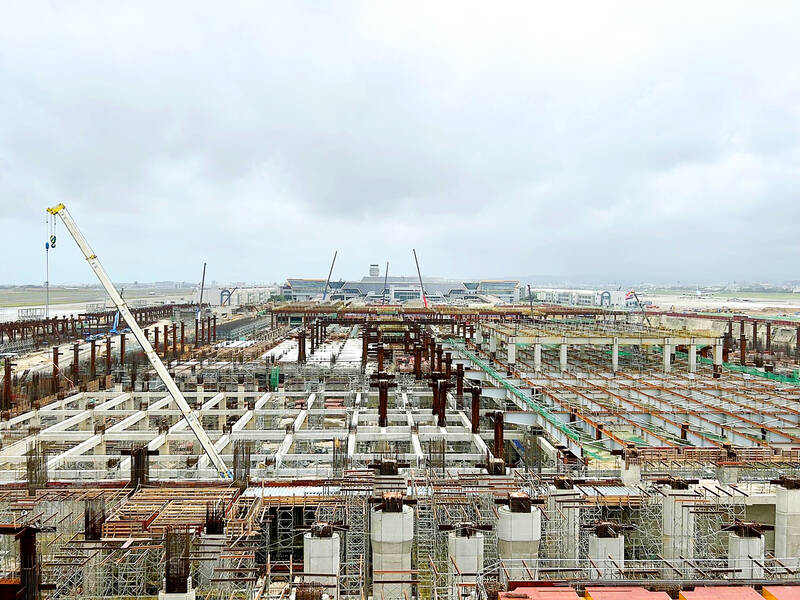
Photo courtesy of TIAC
The steel structure and reinforced concrete works below the third floor are currently underway, and it is expected to be completed by the end of next year, providing passenger services connected to the operation of Terminal 2.
Simultaneously, the main terminal, office building, north airport road, and north boarding concourse are all under construction simultaneously and have now entered a peak construction period.
After completion, they are to accommodate more passengers and flights, improve travel service quality, consolidate the airport’s position as an important aviation hub in East Asia and enhance the nation’s competitiveness.
A MASSIVE PROJECT
TIAC said that Terminal 3 measures 414m in length from east to west and 242m in width from north to south, equivalent to three laid-flat Taipei 101 buildings. With three underground floors and four above ground, the total floor area is 580,000m2, making it the largest single-volume public project in the country after the Ten Major Construction Projects.
The most distinctive features of the building are the large-span wave-like roof along with indoor and outdoor cloud ceiling systems. To reduce structural physical volume and increase stability, it is supportan ) by 16 giant columns, each 19m high and weighing about 200 tonnes, along with their trusses. Therefore, the giant column lifting is the most challenging project in the overall plan.
In order to familiarize the staff with this high-difficulty construction work in advance, the construction team has specially created a simulation model site, producing models of the giant columns, ceilings, curtains and other objects.
Through careful calculations and testing before construction, they have confirmed the construction methods and planned standard operating procedures, reducing uncertainties on the construction site while ensuring safety and control of the construction schedule.
Taoyuan International Airport special report

FUKUOKA SITUATION: Japanese media reported that the pathogen is expected to be identified by the summer, while the CDC downplayed the idea that it was hMPV A “mysterious cold-like illness” reported in Japan’s Fukuoka Prefecture does not seem to be a new disease, but Japanese authorities have been asked about the situation, the Centers for Disease Control (CDC) said yesterday. The Fukuoka Prefectural Medical Association on Wednesday told a news conference that a “mystery cold” that has become a hot topic on social media is “highly likely to be caused by some kind of viral infection,” Japan’s KBC News reported. “Many people are experiencing symptoms starting with a sore throat, followed by a runny nose, phlegm and a severe cough,” KBC News reported, citing association officials. Health authorities are

Nvidia Corp CEO Jensen Huang (黃仁勳) arrived in Taiwan yesterday ahead of upcoming AI and technology events, saying he plans to meet with clients and Taiwan Semiconductor Manufacturing Co Chairman C.C. Wei (魏哲家) during his visit. After landing at Taipei Songshan Airport, Huang posed for photos with fans and handed out Yakult drinks to reporters and supporters waiting at the scene, saying he has “a lot to do” during the trip. Asked about reports that Nvidia’s planned headquarters site in Taipei’s Beitou Shilin Technology Park could break ground on May 27, Huang said that if the company holds an event, he would

The Ministry of Finance this afternoon announced the winning numbers for the March-April uniform invoice lottery. The winning number for the NT$10 million (US$318,060) special prize is 19531471, and the winning number for the NT$2 million grand prize is 85941329. Three numbers were drawn for the NT$200,000 first prize: 07225810, 20231230 and 83518781. Those with receipts matching the last seven digits of any of the first-prize numbers will win the NT$40,000 second prize, while those matching the last six digits will win the NT$10,000 third prize. Those whose receipts match the last five digits of the first-prize numbers can claim the NT$4,000 fourth prize,
Taiwan Travelogue (臺灣漫遊錄), which earlier this week became the first Taiwanese novel to win the International Booker Prize, is to be adapted into a television series through a Taiwan-Japan coproduction, producer Chang Chen-yu (張辰漁) said yesterday. Chang, a producer at World Softest Production Film Co, wrote on Facebook that the company had been searching for projects with international appeal that retain a strong Taiwanese identity after colleagues and Japanese partners strongly recommended the novel. After reading the book, Chang said he immediately decided to pursue the screen rights. “A great story has the power to transcend time and borders, and connect countless people,”


 RSS
RSS