


The Chinese Communists Party’s (CCP) cognitive warfare against Taiwan focuses on creating internal divisions and persuading Taiwanese who are noncommittal on their views of cross-strait policies, Doublethink Lab chairman Puma Shen (沈伯洋) said yesterday.
Shen, who coauthored the Chinese-language book If China Attacks (中共打來怎麼辦), was invited to speak at a forum in Taipei about Chinese cognitive warfare against Taiwan.
He was asked how some of the warfare tactics would affect next year’s presidential election, given his research on Chinese influence on the 2020 presidential election.

Photo: Lo Pei-de, Taipei Times
“For the upcoming presidential election, Beijing’s tactics should still be from offline to online, but their focus is not necessarily helping a specific candidate get elected. Rather, it would focus on creating internal division within Taiwan,” Shen said.
“We must first focus on tackling rumors that were spread offline by the CCP. When some of these offline rumors begin spreading online or over the air, addressing them should become our top priority,” he said.
The Chinese Nationalist Party (KMT) has become the biggest victim of China’s cognitive warfare given the CCP’s extensive experience in dealing with the party, he said.
Meanwhile, China would continue to influence public opinion in Taiwan by causing people to question the US commitment to defend Taiwan, Shen said.
Results of opinion polls show that about 50 to 60 percent of Taiwanese said they would defend the nation should China invade, while 23 to 25 percent said they would surrender without a fight, Shen said.
This shows that about 20 percent of people remain noncommittal about cross-strait relations, he said.
Some political scientists recently found watching videos on TikTok, or Douyin in China, would change neither Democratic Progressive Party (DPP) supporters’ perception about China nor those of KMT supporters.
However, it received diverse reactions among those who were identified as center voters, he said.
“If I were China, I would look at the data and try to figure out ways to persuade some of the 20 percent noncommittal people so that they can join those who would surrender in a cross-strait war,” he said. “This would be seen as an important success of China’s united front campaign.”
An exit poll conducted by Doublethink Lab during the 2020 presidential election showed that more than 40 percent of voters who were 65 or older at the time highly doubted Chinese influence in Taiwan’s elections, as did voters in the age group 20 to 29.
“They would ask why we cannot watch videos on TikTok when we can watch Hollywood movies and Japanese manga. This kind of statement shows a lack of awareness of who our enemies are,” he said.
Psychological war and “united front” campaigns are the two common tactics that China uses against Taiwan, Shen said, adding that the former invovles threats to weaken the public’s will to resist, while the latter aims to cause people to identify with China using the economy or other “soft” approaches.
“We have noticed that there is a change in how different Chinese agencies conduct cognitive warfare,” Shen said.
“We are seeing an increase in offline activities while there is a decrease in the spreading of fake news online,” he said. “This probably explains why recently there was a decline in online offensives from China while military threats increased along with offline activities, and it also shows that Beijing is trying to distribute its resources in a more efficient manner.”
Beijing has expanded its invitations to Taiwan’s local government officials to visit China to intensify “united front” activities, he said.
“We have seen some borough wardens who returned from a tour in China telling residents that they can now exercise on fitness equipment donated by the Chinese government,” Shen said.
“They even told residents to stop listening to the Taiwanese government about China, as no government that cared so much about people’s health during the COVID-19 pandemic would attack Taiwan,” he said.
“You will not see such news online, but it is a part of typical ‘united front’ tactics,” Shen said.

Alain Robert, known as the "French Spider-Man," praised Alex Honnold as exceptionally well-prepared after the US climber completed a free solo ascent of Taipei 101 yesterday. Robert said Honnold's ascent of the 508m-tall skyscraper in just more than one-and-a-half hours without using safety ropes or equipment was a remarkable achievement. "This is my life," he said in an interview conducted in French, adding that he liked the feeling of being "on the edge of danger." The 63-year-old Frenchman climbed Taipei 101 using ropes in December 2004, taking about four hours to reach the top. On a one-to-10 scale of difficulty, Robert said Taipei 101

Nipah virus infection is to be officially listed as a category 5 notifiable infectious disease in Taiwan in March, while clinical treatment guidelines are being formulated, the Centers for Disease Control (CDC) said yesterday. With Nipah infections being reported in other countries and considering its relatively high fatality rate, the centers on Jan. 16 announced that it would be listed as a notifiable infectious disease to bolster the nation’s systematic early warning system and increase public awareness, the CDC said. Bangladesh reported four fatal cases last year in separate districts, with three linked to raw date palm sap consumption, CDC Epidemic Intelligence
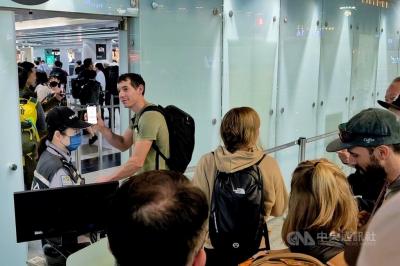
US climber Alex Honnold left Taiwan this morning a day after completing a free-solo ascent of Taipei 101, a feat that drew cheers from onlookers and gained widespread international attention. Honnold yesterday scaled the 101-story skyscraper without a rope or safety harness. The climb — the highest urban free-solo ascent ever attempted — took just more than 90 minutes and was streamed live on Netflix. It was covered by major international news outlets including CNN, the New York Times, the Guardian and the Wall Street Journal. As Honnold prepared to leave Taiwan today, he attracted a crowd when he and his wife, Sanni,

Two Taiwanese prosecutors were questioned by Chinese security personnel at their hotel during a trip to China’s Henan Province this month, the Mainland Affairs Council (MAC) said yesterday. The officers had personal information on the prosecutors, including “when they were assigned to their posts, their work locations and job titles,” MAC Deputy Minister and spokesman Liang Wen-chieh (梁文傑) said. On top of asking about their agencies and positions, the officers also questioned the prosecutors about the Cross-Strait Joint Crime-Fighting and Judicial Mutual Assistance Agreement, a pact that serves as the framework for Taiwan-China cooperation on combating crime and providing judicial assistance, Liang


 RSS
RSS