


For more than six decades, bamboo lantern handicraft maestro Tang Chiu-shui (唐秋水) has been incorporating Chinese calligraphy and painting into his craft, and his works — which are all completed by hand — are hung at many temples nationwide.
The 73-year-old said he now wants to create a large lantern that would be recognized by Guinness World Records to help showcase Taiwanese traditional handicrafts on the international stage.
Tang said he had not been interested in studying in his younger years, adding: “I was instead more interested in illustrations and comics.”
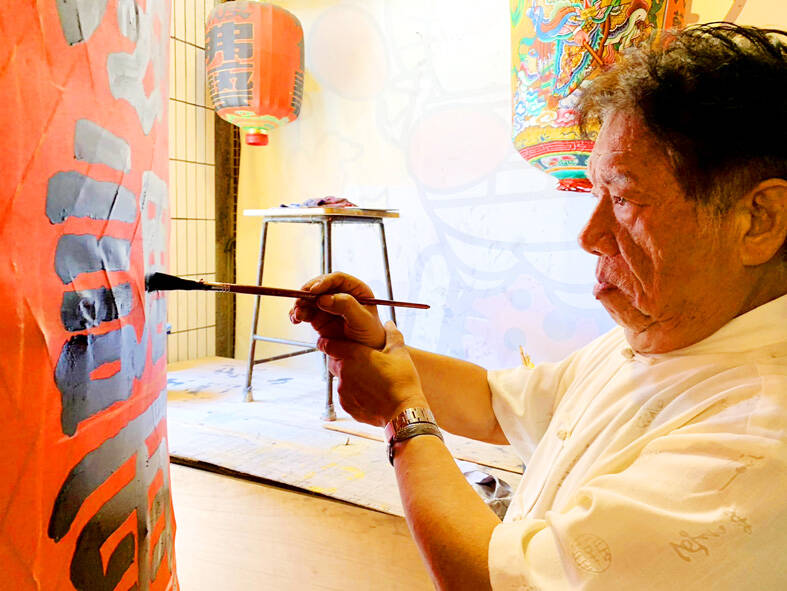
Photo: Tang Shih-ming, Taipei Times
Tang said that lanterns were a creation that was incredibly symbolic to people under the Sinosphere, as it represents a creation or tool that lit one’s way forward, adding that he felt the handicraft included bits and pieces of all the essential handicrafts and he feels obligated to preserve and pass on the craft.
Citing Yeh Hung-chia’s (葉洪甲) Chu Ko Ssu Lang (諸葛四郎) and Liu Hsing-chin’s (劉興欽) A San Go and Da Shen Po (阿三哥與大嬸婆) as works that inspired him, Tang said his father had made him an apprentice under artists painting movie billboards, or portraits in the Western style.
As his father was a renowned lantern maker, Tang said he and his father opened a shop in 1972 that offered a one-stop service for colored illustrations and handmade lanterns.
While his second son, Tang Chia-hsing (唐嘉興), had previously worked as a teacher after graduating, he returned home to take up the family business in 2010.
Tang Chia-hsing said he had decided to quit his teaching job and take up the family business as his father grew older.
The process of splitting a bamboo pole to make the bamboo strips, which are then worked into a lantern, is done entirely by hand, Tang Chiu-shui said.
As one feels the blade slicing through the bamboo, the artisan can make cuts in line with the fiber of the bamboo, Tang Chiu-shui said, adding that using a machine to split bamboo into strips would inadvertently harm the fibers and thus make the lanterns less sturdy.
Tang Chiu-shui said a medium-sized lantern requires hundreds of bamboo strips to form the frame, adding that the cloth has to be dyed, illustrations drawn on it, and then stretched over the lantern.
He said the Changhua City Office had commissioned them to make eight large lanterns — each 220cm tall and 424cm in diameter — to commemorate the city’s third centennial celebrations.
The Jade Emperor’s Temple in Changhua’s Fushan Borough (福山) in March commissioned from the Tangs two lanterns that are 300cm tall and 192cm in diameter.
The first is nearing completion and the second is expected to be finished by the end of the year.

Considering that most countries issue more than five denominations of banknotes, the central bank has decided to redesign all five denominations, the bank said as it prepares for the first major overhaul of the banknotes in more than 24 years. Central bank Governor Yang Chin-lung (楊金龍) is expected to report to the Legislative Yuan today on the bank’s operations and the redesign’s progress. The bank in a report sent to the legislature ahead of today’s meeting said it had commissioned a survey on the public’s preferences. Survey results showed that NT$100 and NT$1,000 banknotes are the most commonly used, while NT$200 and NT$2,000

The Centers for Disease Control (CDC) yesterday reported the first case of a new COVID-19 subvariant — BA.3.2 — in a 10-year-old Singaporean girl who had a fever upon arrival in Taiwan and tested positive for the disease. The girl left Taiwan on March 20 and the case did not have a direct impact on the local community, it said. The WHO added the BA.3.2 strain to its list of Variants Under Monitoring in December last year, but this was the first imported case of the COVID-19 variant in Taiwan, CDC Deputy Director-General Lin Ming-cheng (林明誠) said. The girl arrived in Taiwan on

South Korea is planning to revise its controversial electronic arrival card, a step Taiwanese officials said prompted them to hold off on planned retaliatory measures, a South Korean media report said yesterday. A Yonhap News Agency report said that the South Korean Ministry of Foreign Affairs is planning to remove the “previous departure place” and “next destination” fields from its e-arrival card system. The plan, reached after interagency consultations, is under review and aims to simplify entry procedures and align the electronic form with the paper version, a South Korean ministry official said. The fields — which appeared only on the electronic form

The Ministry of Foreign Affairs (MOFA) is suspending retaliation measures against South Korea that were set to take effect tomorrow, after Seoul said it is updating its e-arrival system, MOFA said today. The measures were to be a new round of retaliation after Taiwan on March 1 changed South Korea's designation on government-issued alien resident certificates held by South Korean nationals to "South Korea” from the "Republic of Korea," the country’s official name. The move came after months of protests to Seoul over its listing of Taiwan as "China (Taiwan)" in dropdown menus on its new online immigration entry system. MOFA last week


 RSS
RSS