


All compound drugs containing phenobarbital and chlordiazepoxide are to be classed as Schedule 4 controlled substances by default under new rules to be implemented as early as September, the Food and Drug Administration (FDA) announced on Saturday.
The FDA’s announcement comes after four doctors in Kaohsiung were fined and had their licenses temporarily suspended for improperly prescribing phenobarbital to patients, including children under the age of two, to treat colds and acute respiratory infections.
The decision to tighten controls for compound drugs was reached after a thorough discussion and examination of other countries’ regulations on June 27, FDA Deputy Director-General Chen Hui-fang (陳惠芳) told a news conference.

Photo courtesy of the Pingtung County Government via CNA
Although phenobarbital, an anti-seizure medication, and chlordiazepoxide, a benzodiazepine primarily prescribed for anxiety, are already classed as Schedule 4, compound drugs containing the two substances are classified separately.
Under the changes proposed by the FDA, all compound drugs containing phenobarbital or chlordiazepoxide would be classed as Schedule 4 controlled substances by default.
The changes mean institutions using substances that contain phenobarbital or chlordiazepoxide would be required to apply for a registration certificate and keep usage records, the Cabinet said in a statement on July 3.
Those wanting to use the drugs for research would have to apply for and receive approval, the Cabinet said.
Importing, exporting, manufacturing, selling or purchasing any substance containing phenobarbital or chlordiazepoxide must be in accordance with the Controlled Drugs Act (管制藥品管理條例), it added.
Chen said 17,562 businesses or institutions hold licenses for controlled pharmaceuticals nationwide, with 15 holding licenses for phenobarbital-related substances.
Among them, six licenses pertain to single-component drugs, that are all classified as Schedule 4 controlled substances and are used to treat epilepsy, she said, adding that the remaining nine licenses are for compound drugs.
In Taiwan, usual government practice involves publicly disclosing proposed new or revised regulations 60 days prior to their implementation — referred to as “the announcement period.”
During this period, stakeholders are invited to provide feedback for the consideration of the authorities.
However, Chen said that the announcement period has been shortened to 14 days, in light of the urgency of the situation.
“Considering the duration of the procedural requirements by the Ministry of Justice and other relevant authorities, which is estimated to be roughly 14 days, [we aim to implement the change] as fast as possible,” she said.
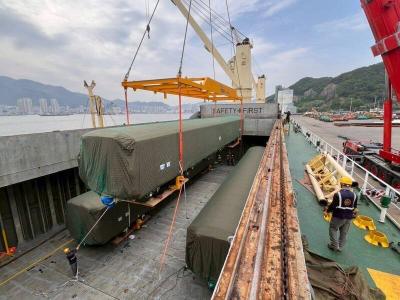
The first of 10 new high-capacity trains purchased from South Korea’s Hyundai Rotem arrived at the Port of Taipei yesterday to meet the demands of an expanding metro network, Taipei Rapid Transit Corp (TRTC) said yesterday. The train completed a three-day, 1,200km voyage from the Port of Masan in South Korea, the company said. Costing NT$590 million (US$18.79 million) each, the new six-carriage trains feature a redesigned interior based on "human-centric" transportation concepts, TRTC said. The design utilizes continuous longitudinal seating to widen the aisles and optimize passenger flow, while also upgrading passenger information displays and driving control systems for a more comfortable
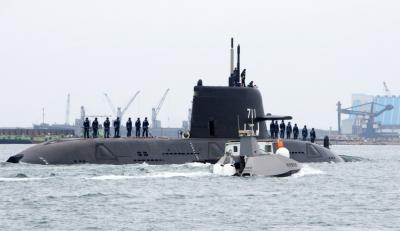
Taiwan's first indigenous defense submarine, the SS-711 Hai Kun (海鯤, or Narwhal), departed for its 13th sea trial at 7am today, marking its seventh submerged test, with delivery to the navy scheduled for July. The outing also marked its first sea deployment since President William Lai (賴清德) boarded the submarine for an inspection on March 19, drawing a crowd of military enthusiasts who gathered to show support. The submarine this morning departed port accompanied by CSBC Corp’s Endeavor Manta (奮進魔鬼魚號) uncrewed surface vessel and a navy M109 assault boat. Amid public interest in key milestones such as torpedo-launching operations and overnight submerged trials,
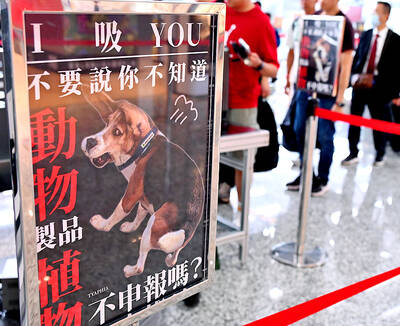
Quarantine awareness posters at Taiwan Taoyuan International Airport have gone viral for their use of wordplay. Issued by the airport branch of the Animal and Plant Health Inspection Agency, the posters feature sniffer dogs making a range of facial expressions, paired with advisory messages built around homophones. “We update the messages for holidays and campaign needs, periodically refreshing materials to attract people’s attention,” quarantine officials said. “The aim is to use the dogs’ appeal to draw focus to quarantine regulations.” A Japanese traveler visiting Taiwan has posted a photo on X of a poster showing a quarantine dog with a

Taiwan’s coffee community has launched a “one-person-one-e-mail” campaign, calling for people to send a protest-e-mail to the World Coffee Championships (WCC) urging it to redesignate Taiwanese competitors as from “Taiwan,” rather than “Chinese Taipei.” The call followed sudden action last week after the WCC changed all references to Taiwanese competitors from “Taiwan” to “Chinese Taipei,” including recent World Latte Art champion Bala (林紹興), who won the World Latte Art Championship in San Diego earlier this month. When Bala received the trophy, he was referred to as representing Taiwan, as well as in the announcement on the WCC’s Web site, until it


 RSS
RSS