


Taiwan’s pigeon racing scene is rife with animal cruelty and organized crime, Taiwan Bird Rescue Association said on Thursday, after Tainan authorities last month arrested members of a group that allegedly kidnapped racing pigeons for ransom.
The average lifespan of a pigeon is 15 years, and 10-year-old race pigeons are not uncommon in the West, but Taiwan’s racing scene uses birds less than one year old in grueling 320km races, the association said.
Less than 5 percent of racing pigeons return home in an average season and the animal rights group People for the Ethical Treatment of Animals made a documentary about the practice, which brought notoriety to the nation on the world stage, it said.
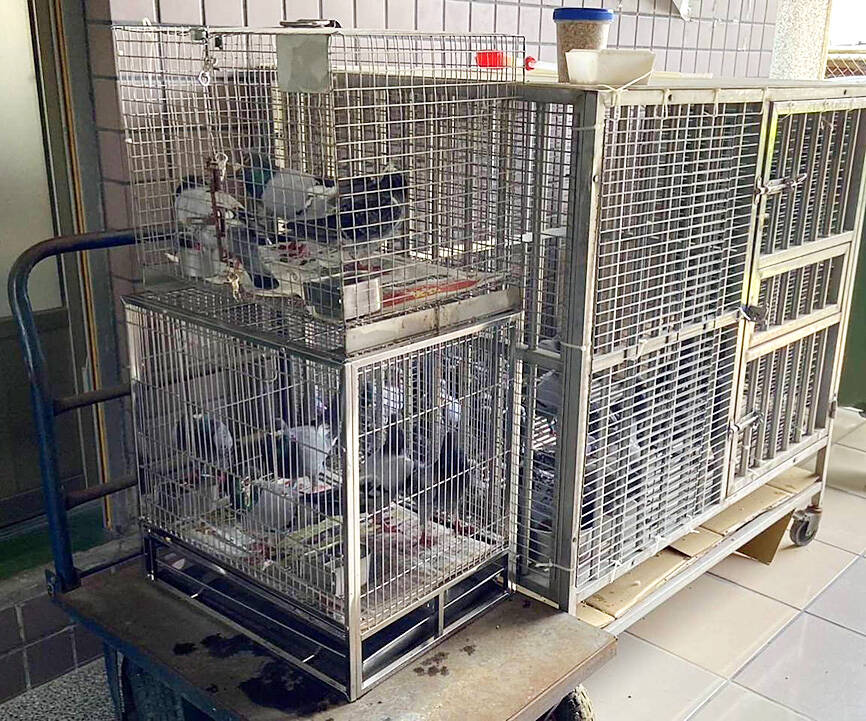
Photo courtesy of the Taichung City Animal Protection Office
The association receives about 13 reports per month regarding race pigeons needing rescue and they account for 40 percent of all rescue cases it handles, the association said.
The majority of the incidents involve abandoned pigeons whose wings and feet are often cut off to ensure they would be unable to return home, it said.
Some older pigeons were killed outright and eaten or thrown away, it said.
Last month, Taipei police busted an alleged kidnapping ring that targeted race pigeons that operated nationwide, and Tainan law enforcement officials over the past 30 days arrested several people who were in possession of 734 race pigeons suspected to be stolen, it said.
More recently, Taitung police found 34 abandoned race pigeons whose wings and legs were cut off, the association said.
Law enforcement authorities that held the birds as possible evidence were ill-equipped to take care of the pigeons, and the birds’ former owners would have little use for pigeons that could no longer race, it said.
The investigations also revealed that the local pigeon racing ring can rake in up to NT$40 million (US$1.29 million) in bets and pigeon kidnappers placed ransoms between NT$5,000 and NT$20,000 for a pigeon, it said.
The Taiwanese pigeon racing market is estimated to be worth NT$70 billion, it said.
The authorities have made a good start in confiscating race pigeons utilized for gambling and they should give the same attention to rescuing the birds as they do busting illegal racing, it said.
The Council of Agriculture and local animal protection agencies should begin serious efforts to regulate pigeon racing to prevent animal abuse and curb public health risks, it said.
Animal protection agencies face a significant challenge in caring for confiscated race pigeons since they lack the space to house the birds, said Cheng Chu-ching (鄭祝菁), head of the Council of Agriculture’s Department of Animal Husbandry and Animal Protection.
Killing pigeons is a criminal offense and abusing the birds can incur administrative fines, she said.
Enforcement against pigeon racing is difficult because the pens are scattered across different parts of the country and the racing clubs are closed organizations wary of outsiders, said Chiang Wen-chuan (江文全), director of the council’s Department of Animal Industry.
Any effort to go after pigeon racing would be complicated due to the requirements for planning and coordination across multiple agencies and levels of government, he said.

Yangmingshan National Park authorities yesterday urged visitors to respect public spaces and obey the law after a couple was caught on a camera livestream having sex at the park’s Qingtiangang (擎天崗) earlier in the day. The Shilin Police Precinct in Taipei said it has identified a suspect and his vehicle registration number, and would summon him for questioning. The case would be handled in accordance with public indecency charges, it added. The couple entered the park at about 11pm on Thursday and began fooling around by 1am yesterday, the police said, adding that the two were unaware of the park’s all-day live

Fast food chain McDonald's is to raise prices by up to NT$5 on some products at its restaurants across Taiwan, starting on Wednesday next week, the company announced today. The prices of all extra value meals and sharing boxes are to increase by NT$5, while breakfast combos and creamy corn soup would go up by NT$3, the company said in a statement. The price of the main items of those meals, if ordered individually, would remain the same. Meanwhile, the price of a medium-sized lemon iced tea and hot cappuccino would rise by NT$3, extra dipping sauces for chicken nuggets would go up

Yangmingshan National Park’s Qingtiangang (擎天崗) nature area has gone viral after a park livestream camera observed a couple in the throes of intimate congress, which was broadcast live on YouTube, drawing large late-night crowds and sparking a backlash over noise, bright lights and disruption to wildlife habitat. The area’s livestream footage appeared to show a couple engaging in sexual activity on a picnic table in the park on Friday last week, with the uncensored footage streamed publicly online. The footage quickly spread across social media, prompting a tide of visitors to travel to the site to “check in” and recreate the

Minister of Digital Affairs Lin Yi-ching (林宜敬) yesterday cited regulatory issues and national security concerns as an expert said that Taiwan is among the few Asian regions without Starlink. Lin made the remarks on Facebook after funP Innovation Group chief executive officer Nathan Chiu (邱繼弘) on Friday said Taiwan and four other countries in Asia — China, North Korea, Afghanistan and Syria — have no access to Starlink. Starlink has become available in 166 countries worldwide, including Ukraine, Malaysia, the Philippines and Vietnam, in the six years since it became commercial, he said. While China and North Korea block Starlink, Syria is not


 RSS
RSS