


The peak period of bacterial food poisoning in Taiwan is between May and October, and 1,707 people were reported as having bacterial food poisoning last year, the Food and Drug Administration (FDA) said yesterday, as it suggested steps to prevent food poisoning.
There were 499 outbreaks and 4,495 people were reported to have food poisoning last year. Among them, there were 57 outbreaks and 1,707 people had bacterial food poisoning, FDA said.
The bacterial food poisoning cases last year included infections with bacteria Vibrio parahaemolyticus, salmonella, enteropathogenic Escherichia coli, Staphylococcus aureus, Bacillus cereus and Vibrio cholerae, the data showed.
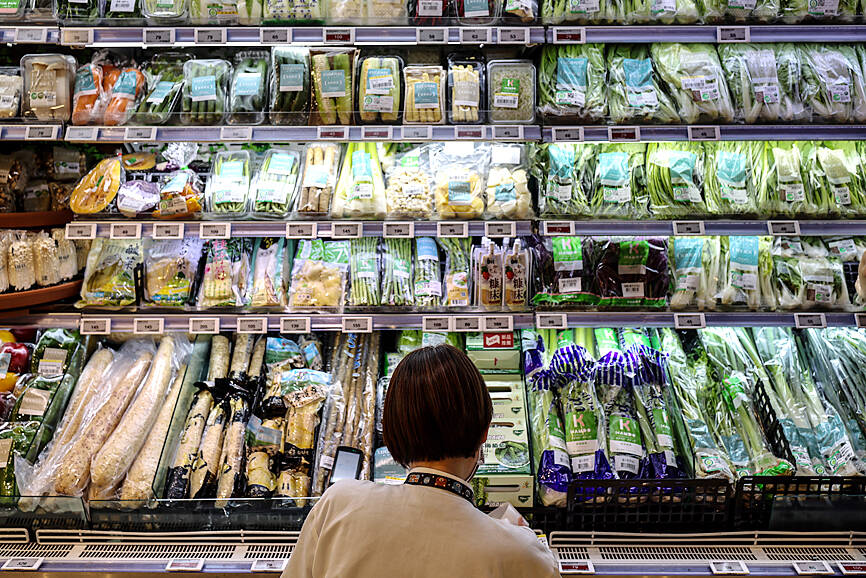
Photo: Ritchie B. Tongo, EPA-EFE
Based on FDA data collected from 2013 to last year, the peak period of bacterial food poisoning is between May and October each year.
Food Safety Division official Cheng Wei-chih (鄭維智) said an increasing number of people often eat salads, raw seafood (such as raw oysters, sashimi, salmon roe and marinated shrimp), mayonnaise and undercooked or raw eggs.
However, in hot and humid conditions, raw or undercooked food might easily be contaminated by bacteria, such as Vibrio parahaemolyticus or salmonella, he said.
People who eat contaminated food might experience nausea, vomiting, belly pain and diarrhea, Cheng said.
People should keep in mind five principles to prevent food poisoning when preparing food: wash hands thoroughly before, during and after preparing food; use fresh ingredients; separate raw foods from ready-to-eat foods; cook food thoroughly; and keep it at proper temperatures, Cheng said.
Two other behaviors that people should avoid are drinking untreated spring water and eating unknown fruit and animals, he said.
Fresh fruit, vegetables, meat and seafood should be thoroughly washed before it is prepared and cooked, and fruits and vegetables with rough or textured surfaces should be cleaned with a brush, Cheng said.
Raw foods should be put in separate containers and handled with separate utensils to avoid cross-contamination, he said.
When heating food, aim to reach a core temperature of 70°C or higher to remove most bacteria, Cheng said.
Drinking water should also be boiled to remove bacteria, he added.
The FDA said if suspected food poisoning incidents occur, people should seek medical attention immediately, adding that they are encouraged to cooperate with the agency’s investigation to clarify causes of food poisoning.

Considering that most countries issue more than five denominations of banknotes, the central bank has decided to redesign all five denominations, the bank said as it prepares for the first major overhaul of the banknotes in more than 24 years. Central bank Governor Yang Chin-lung (楊金龍) is expected to report to the Legislative Yuan today on the bank’s operations and the redesign’s progress. The bank in a report sent to the legislature ahead of today’s meeting said it had commissioned a survey on the public’s preferences. Survey results showed that NT$100 and NT$1,000 banknotes are the most commonly used, while NT$200 and NT$2,000

The Centers for Disease Control (CDC) yesterday reported the first case of a new COVID-19 subvariant — BA.3.2 — in a 10-year-old Singaporean girl who had a fever upon arrival in Taiwan and tested positive for the disease. The girl left Taiwan on March 20 and the case did not have a direct impact on the local community, it said. The WHO added the BA.3.2 strain to its list of Variants Under Monitoring in December last year, but this was the first imported case of the COVID-19 variant in Taiwan, CDC Deputy Director-General Lin Ming-cheng (林明誠) said. The girl arrived in Taiwan on

South Korea is planning to revise its controversial electronic arrival card, a step Taiwanese officials said prompted them to hold off on planned retaliatory measures, a South Korean media report said yesterday. A Yonhap News Agency report said that the South Korean Ministry of Foreign Affairs is planning to remove the “previous departure place” and “next destination” fields from its e-arrival card system. The plan, reached after interagency consultations, is under review and aims to simplify entry procedures and align the electronic form with the paper version, a South Korean ministry official said. The fields — which appeared only on the electronic form

The Ministry of Foreign Affairs (MOFA) is suspending retaliation measures against South Korea that were set to take effect tomorrow, after Seoul said it is updating its e-arrival system, MOFA said today. The measures were to be a new round of retaliation after Taiwan on March 1 changed South Korea's designation on government-issued alien resident certificates held by South Korean nationals to "South Korea” from the "Republic of Korea," the country’s official name. The move came after months of protests to Seoul over its listing of Taiwan as "China (Taiwan)" in dropdown menus on its new online immigration entry system. MOFA last week


 RSS
RSS