


Kuo Downing-Reese (郭慧如), a US flight paramedic who might have been the victim of a Taiwanese child-trafficking ring in the early 1980s, on Thursday appealed for the public’s help in finding her birth parents.
Accompanied by her adoptive mother Mary Reese, Downing-Reese has returned to Taiwan in an attempt to locate her birth family.
Private firms that provide genetic testing to help locate relatives are not common in Taiwan, Downing-Reese said, adding that her search on Web sites such as Ancestry.com and 23&me had proven unfruitful, reducing her hopes of finding her parents.
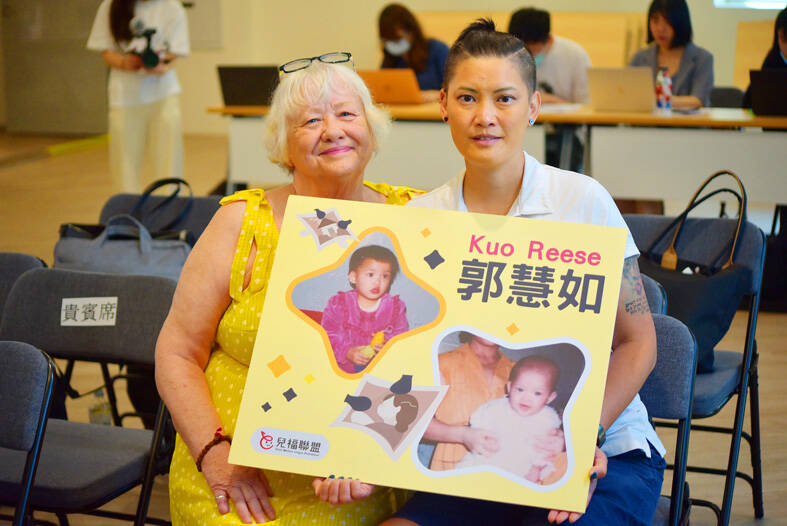
Photo: Wu Po-hsuan, Taipei Times
However, after a number of adoptees reported success in reuniting with their families in Taiwan, she became hopeful and decided to embark on her own campaign, Downing-Reese said.
She told a news conference organized by the Child Welfare League Foundation on Thursday that she wants to find her biological family because she wants the opportunity to get to know them.
If she has to go home empty-handed, she would try to use the trip as an opportunity to get to know Taiwan and its people better, Downing-Reese said.
In a mini-documentary on YouTube made by Taiwan-born New York filmmaker Hsi Cheng, Downing-Reese said she believes she is one of the “Julie Chu Babies.”
Although she has given Taiwanese media her birth information, the details might prove unhelpful if she is a victim of Julie Chu.
Chu, more commonly known in Taiwan as Chu Li-ching (褚麗卿), was a law clerk who was arrested on suspicion of leading a child-trafficking ring that was exposed in 1982.
Chu was allegedly the middleperson who helped families in Western countries such as the US, Australia, Finland and Sweden adopt children from Taiwan.
The families were all made aware of the opportunity to adopt through a British lawyer based in Thailand. After the families arrived in Taiwan, Chu took the parents through the process of adoption.
However, not all of the Taiwanese parents who gave up their children were who they claimed to be. It was found that the children were either given up by their birth parents or abducted at an early age.
To legalize the status of those toddlers, Chu was suspected of having hired people to pose as birth parents, as well as medical professionals to forge birth certificates and fake the children’s names, even going so far as to sometimes pass some children off as twins.
As a result, it is unknown whether Downing-Reese was trafficked or legally put up for adoption.
Chu was convicted and served time for forgery. She maintains she was not involved in a ring and is innocent of kidnapping, saying she was only guilty of falsifying papers to help orphans live a better life.
The foundation presented the information of two other Taiwan-born women whose adoptions were mediated by Chu.
Both women, Sabina Soderlund-Myllyharju (范嫚倫) and Kimbra Smith (陳信惠), have unsuccessfully attempted to find their biological families in Taiwan.

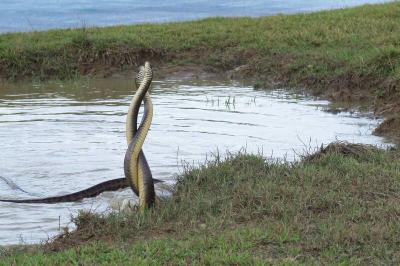
Kenting National Park service technician Yang Jien-fon (楊政峰) won a silver award in World Grand Prix Photography Awards Spring Season for his photograph of two male rat snakes intertwined in combat. Yang’s colleagues at Kenting National Park said he is a master of nature photography who has been held back by his job in civil service. The awards accept entries in all four seasons across six categories: architectural and urban photography, black-and-white and fine art photography, commercial and fashion photography, documentary and people photography, nature and experimental photography, and mobile photography. Awards are ranked according to scores and divided into platinum, gold and
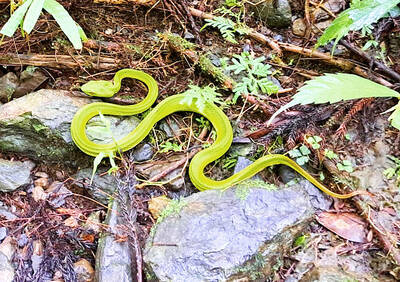
More than half of the bamboo vipers captured in Tainan in the past few years were found in the city’s Sinhua District (新化), while other districts had smaller catches or none at all. Every year, Tainan captures about 6,000 snakes which have made their way into people’s homes. Of the six major venomous snakes in Taiwan, the cobra, the many-banded krait, the brown-spotted pit viper and the bamboo viper are the most frequently captured. The high concentration of bamboo vipers captured in Sinhua District is puzzling. Tainan Agriculture Bureau Forestry and Nature Conservation Division head Chu Chien-ming (朱健明) earlier this week said that the
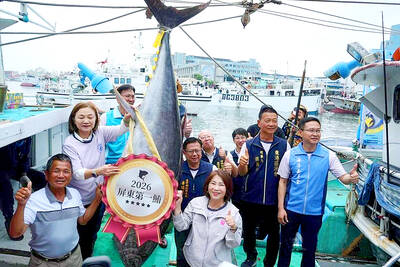
The first bluefin tuna of the season, brought to shore in Pingtung County and weighing 190kg, was yesterday auctioned for NT$10,600 (US$333.5) per kilogram, setting a record high for the local market. The auction was held at the fish market in Donggang Fishing Harbor, where the Siaoliouciou Island-registered fishing vessel Fu Yu Ching No. 2 delivered the “Pingtung First Tuna” it had caught for bidding. Bidding was intense, and the tuna was ultimately jointly purchased by a local restaurant and a local company for NT$10,600 per kilogram — NT$300 ,more than last year — for a total of NT$2.014 million. The 67-year-old skipper
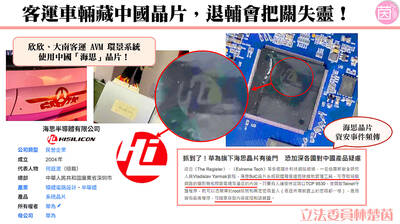
BREACH OF CONTRACT: The bus operators would seek compensation and have demanded that the manufacturer replace the chips with ones that meet regulations Two bus operators found to be using buses with China-made chips are to demand that the original manufacturers replace the systems and provide compensation for breach of contract, the Veterans Affairs Council said yesterday. Democratic Progressive Party Legislator Michelle Lin (林楚茵) yesterday said that Da Nan Bus Co and Shin-Shin Bus Co Ltd have fielded a total of 82 buses that are using Chinese chips. The bus models were made by Tron-E, while the systems provider was CYE Electronics, Lin said. Lin alleged that the buses were using chips manufactured by Huawei subsidiary HiSilicon Co, which presents a national security risk if the


 RSS
RSS