


Visiting deputy leader of the Canadian Conservative Party Melissa Lantsman yesterday called for a foreign investment promotion and protection agreement (FIPA) between Canada and Taiwan.
Lantsman, who is leading seven other Canadian lawmakers on a trip to Taiwan, made the remark during a meeting with President Tsai Ing-wen (蔡英文) at the Presidential Office in Taipei.
The delegation members are cross-party representatives of the three major political parties in the Canadian House of Representatives, Lantsman said, adding that they all are “staunch friends and supporters of Taiwan and the Taiwanese people.”
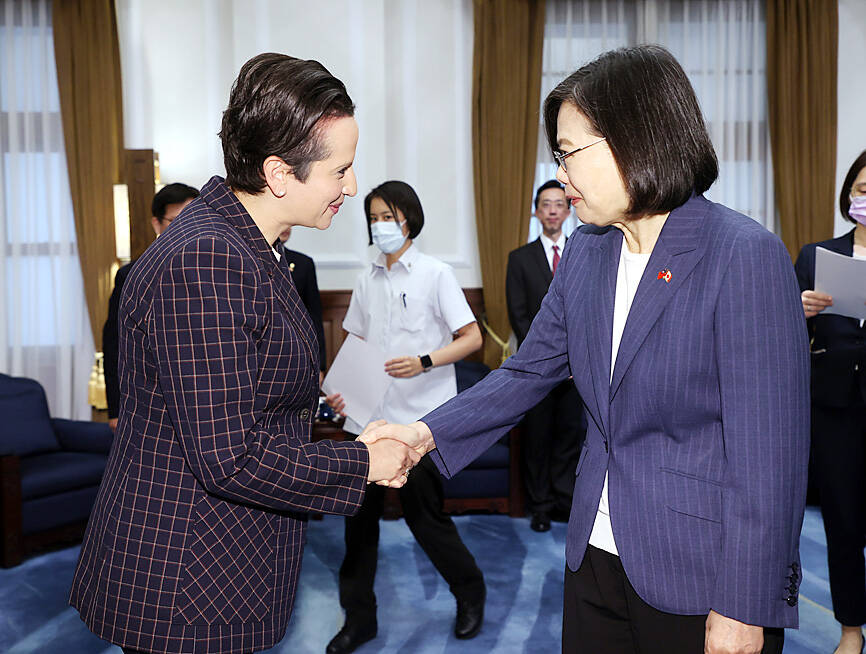
Photo: CNA
The relationship between Canada and Taiwan is based on mutual respect, strong people-to-people ties and shared values, such as freedom, democracy and the rule of law, she said.
Lantsman said she believes that the meetings with government officials would help boost bilateral relations.
Lawmakers at the Canadian parliament support Taiwan’s participation in international organizations, such as the WHO and the International Civil Aviation Organization, she said.
Many of them have publicly advocated for Taiwan’s inclusion in the Comprehensive and Progressive Agreement for Trans-Pacific Partnership (CPTPP), she added.
They hope that a FIPA can be signed soon, Lantsman said, adding that Canadian officials at the ministerial level should travel to Taiwan for its signing.
Tsai said that Taiwan and Canada at the beginning of this year began negotiations for a FIPA, which would deepen economic and trade cooperation between the two nations.
She thanked Canada for its support for Taiwan, including issuing a joint statement with other countries to underline the importance of peace and stability in the Taiwan Strait after the G7 summit in May, and sending the HMCS Montreal to transit the Taiwan Strait with a US destroyer last month.
Taiwan, which has improved its regulations and adheres to the standards of international economic and trade norms, is ready to join the CPTPP and hopes to enlist the support of Canada, which is to chair the bloc’s commission next year, she said.
The delegation also met with Vice President William Lai (賴清德) and Legislative Speaker You Si-kun (游錫?), and attended a banquet presided over by Minister of Foreign Affairs Joseph Wu (吳釗燮) on Wednesday.
In related news, Tsai sought the support of Japan for Taiwan’s participation in the CPTPP during a meeting with visiting Japanese lawmaker Keiji Furuya on Wednesday.
Furuya, who serves as the chairman of the Japan-Republic of China Diet Members’ Consultative Council, said that the council’s support for Taiwan to join the the trade bloc and the World Health Assembly as an observer “will not change.”
The council is also willing to do its best to help safeguard peace and stability across the Taiwan Strait, as that would contribute to peace and stability in East Asia, he said.
After meeting with You on Japan’s Yonaguni Island on Tuesday, Furuya said that he hopes to encourage more Taiwanese to visit the island and the nearby Ishigaki Island.
He also expressed the hope that the next generation of Taiwanese and Japanese can build a deeper friendship, and mentioned the excitement of Kyoto Tachibana Senior High School Band members when they saw Tsai at the Presidential Office before performing at the Double Ten National Day celebrations in Taipei last year.

The Ministry of Finance this afternoon announced the winning numbers for the March-April uniform invoice lottery. The winning number for the NT$10 million (US$318,060) special prize is 19531471, and the winning number for the NT$2 million grand prize is 85941329. Three numbers were drawn for the NT$200,000 first prize: 07225810, 20231230 and 83518781. Those with receipts matching the last seven digits of any of the first-prize numbers will win the NT$40,000 second prize, while those matching the last six digits will win the NT$10,000 third prize. Those whose receipts match the last five digits of the first-prize numbers can claim the NT$4,000 fourth prize,

SIX SUBSIDIES: The monthly allowance for older farmers is to increase to NT$10,000, and NT$5,000 is to be given to homemakers under the national pension system, Lai said The government is to implement major welfare policies for disadvantaged groups, including raising the monthly allowance for older farmers to NT$10,000 and providing homemakers with NT$5,000 per month, President William Lai (賴清德) said yesterday. Lai made the remarks during a visit to Wangling Temple in Chiayi County, saying that the planned increases were being introduced amid economic growth and an increase in tax revenue. Touting a policy, in which the government plans to provide a monthly allowance of NT$5,000 for every child under the age of 18 in a bid to address Taiwan’s low birthrate, Lai said that if received for the
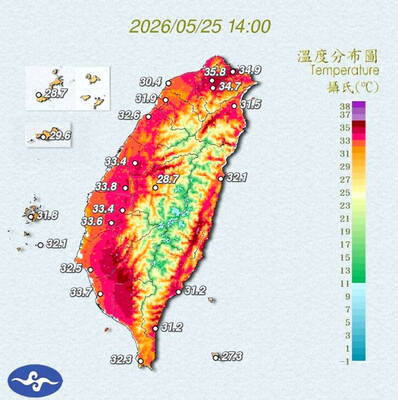
STAY COOL: The HPA recommended that people stay hydrated, use air-conditioning or fans while indoors, wear loose-fitting clothes and walk in the shade while outdoors Employers must implement measures such as installing cooling equipment, and providing drinking water and rest breaks for outdoor workers starting from Monday next week, the Taipei Department of Labor said on Sunday. Employers who fail to comply could face fines of NT$30,000 to NT$300,000 under the Occupational Safety and Health Act (職業安全衛生法), the department said. Businesses in Taipei employing fewer than 100 workers, as well as registered self-employed workers with labor insurance coverage, could receive on-site assessments and guidance from occupational safety consultants to help them apply for central government subsidies to implement or improve heat-protection measures, it said. Under the Ministry of

NATIONAL SECURITY: Authorities are working to confirm the identities of the military personnel involved and investigating possible illegal conduct and regulatory violations Authorities are probing possible national security implications after Kinmen police and immigration officers on Sunday found a Chinese woman allegedly posing as a tourist while engaging in prostitution involving more than 10 military personnel. The woman, surnamed Chen (陳), has since been deported, authorities said, adding that investigators are still working to confirm the identities of those implicated, as the records only listed code names and aliases. The case stemmed from a report received by the Kinmen District Prosecutors’ Office on Friday last week from the Jinhu Precinct of the Kinmen County Police Bureau. On Sunday, police, along with the National Immigration


 RSS
RSS