


The Overseas Community Affairs Council is to hold the International Summit on Mandarin Education in Taiwan next month to help promote Taiwan’s Mandarin-language education sector.
The event is to take place on July 11 and 12 at the Chang Yung-Fa Foundation International Convention Center in Taipei and would be broadcast live online, the council said in a press release yesterday.
As learning Mandarin is booming around the world, the council is seizing the opportunity to expand Taiwan’s Mandarin-learning market through cross-ministerial cooperation, it said.
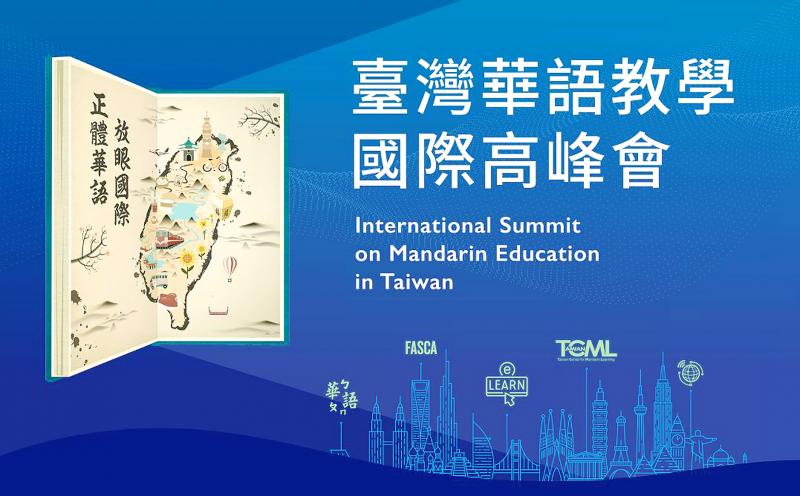
Photo: Screen grab from the Overseas Community Affairs Council’s Web site
It has been helping overseas compatriot schools establish Taiwan Centers for Mandarin Learning, and encouraging them to cooperate with educational institutions and industry in Taiwan, it added.
The council is working with the American Institute in Taiwan to bolster cooperation in language education based on the US-Taiwan Education Initiative with Taiwan, which was signed in December 2020, the council said.
The initiative allows Taiwan to introduce its high-quality Mandarin teaching model to US society, it added.
Some of the focus points in this year’s event include facilitating exchanges between Mandarin educational institutions and smart industry, and tackling educational challenges in the post-COVID-19 pandemic era, it said.
Heads of Taiwan Centers for Mandarin Learning and compatriot schools have been invited to exchange ideas with the representatives of Taiwanese colleges and universities, academia, smart industries and the government, it said.
In related news, 23 students from top US universities have begun attending a Mandarin course at National Cheng Kung University (NCKU) under the Critical Language Scholarship program, a collaboration between the university and the US Department of State.
The NCKU Chinese Language Center has been organizing the program since 2016, the university said in a press release.
Scholarship holders from Yale University, Johns Hopkins University, the University of California, Davis, the US Naval Academy and other US universities attended this year’s opening ceremony on Monday, NCKU said.
The students are to complete the one-year Mandarin course in the eight-week program in Taiwan, it said.
NCKU recruited 24 host families and 18 NCKU students to serve as language partners for the US students, the university said, adding that the program helps Taiwanese and US students learn about each other’s cultures and communicate with people from different backgrounds.
NCKU vice president Chen Yuh-neu (陳玉女) encouraged the students to experience Taiwanese culture during their time in the nation so that they can serve as a bridge between Taiwan and the US, it said.
Another 15 university students from the US began an eight-week Mandarin course at NCKU under the Taiwan Intensive Summer Language Program on Monday last week, it said.

Considering that most countries issue more than five denominations of banknotes, the central bank has decided to redesign all five denominations, the bank said as it prepares for the first major overhaul of the banknotes in more than 24 years. Central bank Governor Yang Chin-lung (楊金龍) is expected to report to the Legislative Yuan today on the bank’s operations and the redesign’s progress. The bank in a report sent to the legislature ahead of today’s meeting said it had commissioned a survey on the public’s preferences. Survey results showed that NT$100 and NT$1,000 banknotes are the most commonly used, while NT$200 and NT$2,000

The Centers for Disease Control (CDC) yesterday reported the first case of a new COVID-19 subvariant — BA.3.2 — in a 10-year-old Singaporean girl who had a fever upon arrival in Taiwan and tested positive for the disease. The girl left Taiwan on March 20 and the case did not have a direct impact on the local community, it said. The WHO added the BA.3.2 strain to its list of Variants Under Monitoring in December last year, but this was the first imported case of the COVID-19 variant in Taiwan, CDC Deputy Director-General Lin Ming-cheng (林明誠) said. The girl arrived in Taiwan on

South Korea is planning to revise its controversial electronic arrival card, a step Taiwanese officials said prompted them to hold off on planned retaliatory measures, a South Korean media report said yesterday. A Yonhap News Agency report said that the South Korean Ministry of Foreign Affairs is planning to remove the “previous departure place” and “next destination” fields from its e-arrival card system. The plan, reached after interagency consultations, is under review and aims to simplify entry procedures and align the electronic form with the paper version, a South Korean ministry official said. The fields — which appeared only on the electronic form

The Ministry of Foreign Affairs (MOFA) is suspending retaliation measures against South Korea that were set to take effect tomorrow, after Seoul said it is updating its e-arrival system, MOFA said today. The measures were to be a new round of retaliation after Taiwan on March 1 changed South Korea's designation on government-issued alien resident certificates held by South Korean nationals to "South Korea” from the "Republic of Korea," the country’s official name. The move came after months of protests to Seoul over its listing of Taiwan as "China (Taiwan)" in dropdown menus on its new online immigration entry system. MOFA last week


 RSS
RSS