


A delegation spearheaded by the National Science and Technology Council (NSTC) has completed a visit to the Netherlands and Finland to seek cooperation opportunities in quantum technology.
The delegation, led by council Deputy Minister Lin Minn-tsong (林敏聰), was composed of experts from the Taiwan Quantum Program, the Taiwan Semiconductor Research Institute and the Industrial Technology Research Institute, the council said in a press release on Monday.
The group visited quantum technology research institutions and start-ups in Finland and the Netherlands from Thursday last week to Monday in an effort to connect Taiwan’s quantum research with the world, it said.
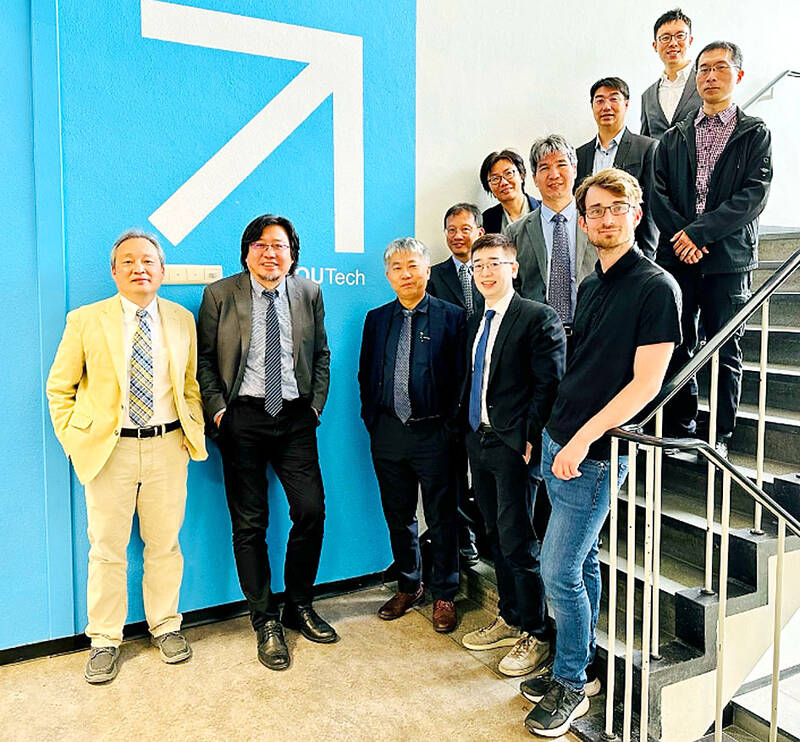
Photo courtesy of the National Science and Technology Council
The computing power of quantum computers would have a great impact on future information security, industry, finance and national defense, it said.
The Netherlands and Finland, with their research capacity and environment, have become strongholds for quantum technology in Europe, it said.
The delegation met with officials from the Finnish Ministry of Foreign Affairs and the Ministry of Economic Affairs and Employment, and toured IQM Quantum Computers, a pan-European leader in quantum computers, it said.
IQM, a spinoff of Aalto University and VTT Technical Research Centre of Finland, has raised more than 71 million euros (US$77.6 million) in funds and is building Finland’s first 54-qubit commercial quantum computer, it said.
Lin shared Taiwan’s manufacturing and research and development capabilities in the semiconductor industry, and expressed hope that Taiwan and Finland could launch research and industrial cooperation in quantum technology, it said.
In the Netherlands, the delegation visited QuTech, a research institute for quantum computing and quantum Internet, and other quantum technology start-ups, it said.
QuTech, founded by the Netherlands Organisation for Applied Scientific Research and Delft University of Technology in 2014, has worked with Intel to create the first silicon qubits at scale at Intel’s D1 factory in Hillsboro, Oregon, it said.
The delegation learned about the development of quantum technology in the Netherlands and explored the possibility of quantum research cooperation with Taiwan, it said.
Taiwan last year founded a “quantum national team,” which consists of 17 research and development teams of interdisciplinary experts, academics and companies, Lin said.
The teams focused on subjects such as quantum components, quantum computers, quantum algorithms and quantum communications, he said.
By integrating these subjects in joint research and development, the team hopes to develop Taiwan’s unique core technology of quantum technology software and hardware industry, he said.

Considering that most countries issue more than five denominations of banknotes, the central bank has decided to redesign all five denominations, the bank said as it prepares for the first major overhaul of the banknotes in more than 24 years. Central bank Governor Yang Chin-lung (楊金龍) is expected to report to the Legislative Yuan today on the bank’s operations and the redesign’s progress. The bank in a report sent to the legislature ahead of today’s meeting said it had commissioned a survey on the public’s preferences. Survey results showed that NT$100 and NT$1,000 banknotes are the most commonly used, while NT$200 and NT$2,000

The Centers for Disease Control (CDC) yesterday reported the first case of a new COVID-19 subvariant — BA.3.2 — in a 10-year-old Singaporean girl who had a fever upon arrival in Taiwan and tested positive for the disease. The girl left Taiwan on March 20 and the case did not have a direct impact on the local community, it said. The WHO added the BA.3.2 strain to its list of Variants Under Monitoring in December last year, but this was the first imported case of the COVID-19 variant in Taiwan, CDC Deputy Director-General Lin Ming-cheng (林明誠) said. The girl arrived in Taiwan on

South Korea is planning to revise its controversial electronic arrival card, a step Taiwanese officials said prompted them to hold off on planned retaliatory measures, a South Korean media report said yesterday. A Yonhap News Agency report said that the South Korean Ministry of Foreign Affairs is planning to remove the “previous departure place” and “next destination” fields from its e-arrival card system. The plan, reached after interagency consultations, is under review and aims to simplify entry procedures and align the electronic form with the paper version, a South Korean ministry official said. The fields — which appeared only on the electronic form

The Ministry of Foreign Affairs (MOFA) is suspending retaliation measures against South Korea that were set to take effect tomorrow, after Seoul said it is updating its e-arrival system, MOFA said today. The measures were to be a new round of retaliation after Taiwan on March 1 changed South Korea's designation on government-issued alien resident certificates held by South Korean nationals to "South Korea” from the "Republic of Korea," the country’s official name. The move came after months of protests to Seoul over its listing of Taiwan as "China (Taiwan)" in dropdown menus on its new online immigration entry system. MOFA last week


 RSS
RSS