


The Kaohsiung District Court has sentenced a National Sun Yat-sen University employee to four years in prison for embezzlement and counterfeiting.
The employee, a man surnamed Yang (楊), sold Carrefour gift vouchers that were entrusted to him and tried to pass off their photocopies as the originals, the court said.
The ruling can be appealed.
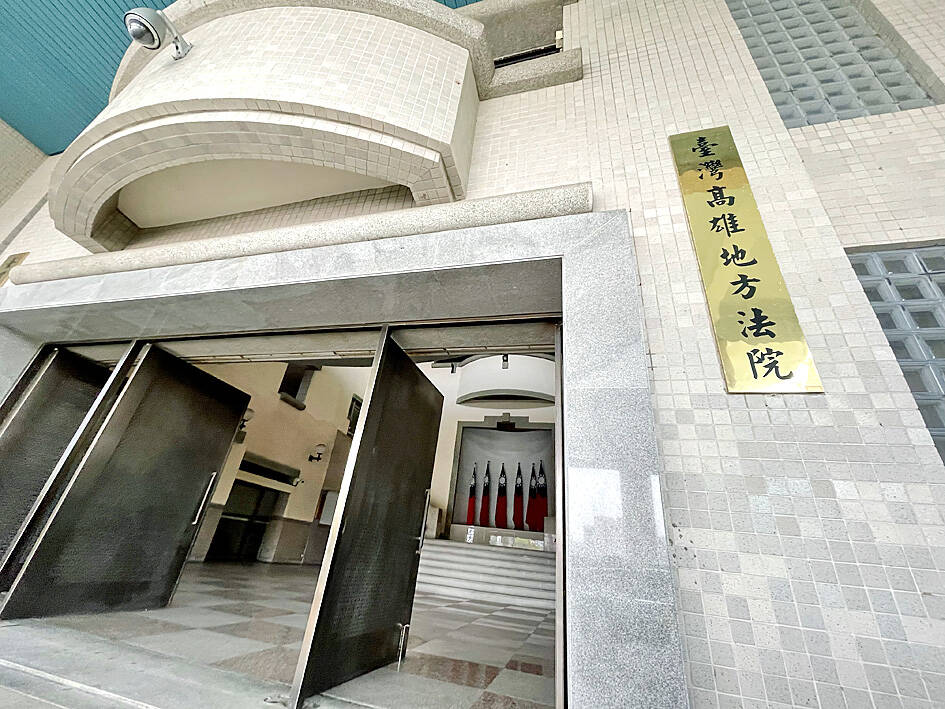
Photo: Huang Liang-chieh, Taipei Times
Yang started working at the university’s personnel office in 2020 and had access to a safe where hundreds of Carrefour gift vouchers worth NT$1,000 each were kept, the court said.
The university had purchased the vouchers in 2017 through an open tender to distribute them to employees on their birthdays, it said.
The court said Yang had gambling debts and tried to pay them back by selling the vouchers, after realizing that the university had not recorded the vouchers’ serial numbers and did not keep tabs on the total amount in the safe.
Yang in June 2020 stole 230 vouchers and sold them to a man surnamed Huang (黃) at NT$900 each after contacting him online, the court said.
He sold another 234 vouchers to Huang in September at the same price, it said.
Yang one month later stole 84 more vouchers from the safe and kept them for personal use, the court said.
The university in November procured 994 Carrefour gift vouchers, of which Yang stole 900 and again sold to Huang in two batches, the ruling said.
However, at the end of that month, university officials conducted a check and found that most of the vouchers were missing.
Asked about the matter, Yang told the officials that he had taken the vouchers home for safekeeping.
He later returned the vouchers that he had kept for himself and made 900 color photocopies to replace some of the vouchers he had stolen.
However, when taking inventory of contents of the safe two days later, university staff realized that the photocopy vouchers had a rough texture, the court said.
They contacted Carrefour to verify the amount of vouchers purchased by the university and their serial numbers, and discovered that Yang had used some of the stolen vouchers to shop at the hypermarket.
Yang’s parents tried to dissuade the staff from contacting the police by offering to buy 270 vouchers worth NT$1,000 each, but to no avail.
Yang denied any wrongdoing during initial questioning, telling police that he took the vouchers home for safekeeping, because the safe was not secured, the court said.
He also denied selling the vouchers and making counterfeit copies.
However, he admitted to his alleged misconducts during trial.
The court based its ruling on the Criminal Code, which stipulates a punishment of three to 10 years in prison for altering “government bonds, stock certificates or securities.”

Considering that most countries issue more than five denominations of banknotes, the central bank has decided to redesign all five denominations, the bank said as it prepares for the first major overhaul of the banknotes in more than 24 years. Central bank Governor Yang Chin-lung (楊金龍) is expected to report to the Legislative Yuan today on the bank’s operations and the redesign’s progress. The bank in a report sent to the legislature ahead of today’s meeting said it had commissioned a survey on the public’s preferences. Survey results showed that NT$100 and NT$1,000 banknotes are the most commonly used, while NT$200 and NT$2,000

The Centers for Disease Control (CDC) yesterday reported the first case of a new COVID-19 subvariant — BA.3.2 — in a 10-year-old Singaporean girl who had a fever upon arrival in Taiwan and tested positive for the disease. The girl left Taiwan on March 20 and the case did not have a direct impact on the local community, it said. The WHO added the BA.3.2 strain to its list of Variants Under Monitoring in December last year, but this was the first imported case of the COVID-19 variant in Taiwan, CDC Deputy Director-General Lin Ming-cheng (林明誠) said. The girl arrived in Taiwan on

South Korea is planning to revise its controversial electronic arrival card, a step Taiwanese officials said prompted them to hold off on planned retaliatory measures, a South Korean media report said yesterday. A Yonhap News Agency report said that the South Korean Ministry of Foreign Affairs is planning to remove the “previous departure place” and “next destination” fields from its e-arrival card system. The plan, reached after interagency consultations, is under review and aims to simplify entry procedures and align the electronic form with the paper version, a South Korean ministry official said. The fields — which appeared only on the electronic form

The Ministry of Foreign Affairs (MOFA) is suspending retaliation measures against South Korea that were set to take effect tomorrow, after Seoul said it is updating its e-arrival system, MOFA said today. The measures were to be a new round of retaliation after Taiwan on March 1 changed South Korea's designation on government-issued alien resident certificates held by South Korean nationals to "South Korea” from the "Republic of Korea," the country’s official name. The move came after months of protests to Seoul over its listing of Taiwan as "China (Taiwan)" in dropdown menus on its new online immigration entry system. MOFA last week


 RSS
RSS