


British Minister of State for Security Tom Tugendhat on Wednesday met with Minister of Digital Affairs Audrey Tang (唐鳳) to discuss mutual security interests, Reuters cited people with knowledge of the talks as saying.
The meeting broke with the UK’s conventional foreign policy, the report said.
Britain has no formal diplomatic relations with Taiwan.
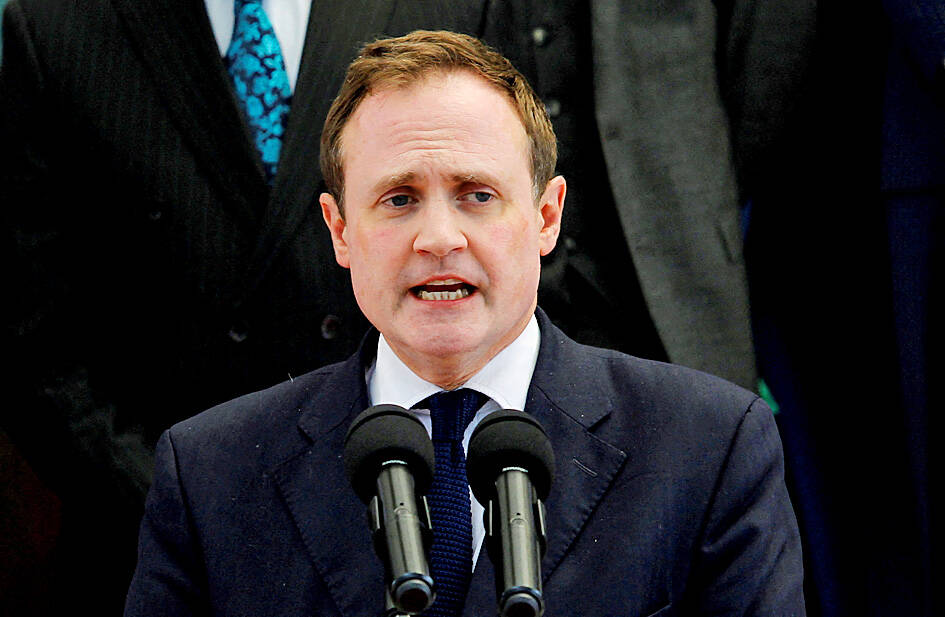
Photo: Reuters
Although junior British ministers hold talks with their Taiwanese counterparts, the convention was that senior British ministers do not meet with Taiwanese officials.
One source said that Tugendhat’s meeting with Tang was about mutual security interests.
Tugendhat, who was sanctioned by China two years ago for speaking out about alleged human rights abuses in Xinjiang, is not a full Cabinet minister, but attends Cabinet meetings in his role as security minister, which puts him in charge of countering terrorism, domestic state threats and economic crime.
Luke de Pulford, executive director of the Inter-Parliamentary Alliance on China, a group made up of lawmakers from democratic countries concerned about Beijing’s behavior, said that to his knowledge it was the first time a British minister who attends Cabinet had met with a Taiwanese minister.
“This is extremely welcome and sends the right message,” De Pulford said. “The security minister should be congratulated for facing down pressure from other departments and setting a new precedent, which all ministers can now follow.”
The sensitivity of the meeting was borne out by the reluctance of several serving officials and departments to talk to reporters about what was discussed.
A spokeswoman for the British Home Office said: “We do not routinely comment on private ministerial meetings.”
Tang’s office declined to comment.
In other developments, Minister of Foreign Affairs Joseph Wu (吳釗燮) on Friday met with members of the European Parliament in Brussels, including European Parliament Vice President Nicola Beer, as part of a previously announced European tour.
Prior to visiting Brussels, Wu, who arrived in Europe on Monday, made stops in Poland and the Czech Republic, international media reported.
The Ministry of Foreign Affairs did not provide a detailed itinerary for Wu’s trip, divulging only that he planned to give a talk at a summit and meet with Ukrainian refugees in Prague.
Knowledge of Wu’s Brussels visit became public after several members of the European parliament shared photographs on social media of themselves with the foreign minister.
Beer, who led the highest-level delegation from the European Parliament to Taiwan in July last year, welcomed Wu’s visit to Brussels following their meeting with six other members of parliament.
“Taiwan is an important and reliable economic partner for the EU and a firm member of the democratic family,” Beer wrote on Twitter, adding that they “agreed to further intensify political, economic and civil exchange and cooperation between the EU & Taiwan.”
Member of the European Parliament Rasa Jukneviciene from Lithuania also said that Taiwan had been a vital part of the democratic world and that “defending its democracy is just as important as defending Ukraine’s.”
The European Commission has declined to say whether any EU officials were scheduled to meet with Wu.
Additional reporting by CNA

FUKUOKA SITUATION: Japanese media reported that the pathogen is expected to be identified by the summer, while the CDC downplayed the idea that it was hMPV A “mysterious cold-like illness” reported in Japan’s Fukuoka Prefecture does not seem to be a new disease, but Japanese authorities have been asked about the situation, the Centers for Disease Control (CDC) said yesterday. The Fukuoka Prefectural Medical Association on Wednesday told a news conference that a “mystery cold” that has become a hot topic on social media is “highly likely to be caused by some kind of viral infection,” Japan’s KBC News reported. “Many people are experiencing symptoms starting with a sore throat, followed by a runny nose, phlegm and a severe cough,” KBC News reported, citing association officials. Health authorities are

Nvidia Corp CEO Jensen Huang (黃仁勳) arrived in Taiwan yesterday ahead of upcoming AI and technology events, saying he plans to meet with clients and Taiwan Semiconductor Manufacturing Co Chairman C.C. Wei (魏哲家) during his visit. After landing at Taipei Songshan Airport, Huang posed for photos with fans and handed out Yakult drinks to reporters and supporters waiting at the scene, saying he has “a lot to do” during the trip. Asked about reports that Nvidia’s planned headquarters site in Taipei’s Beitou Shilin Technology Park could break ground on May 27, Huang said that if the company holds an event, he would

The Ministry of Finance this afternoon announced the winning numbers for the March-April uniform invoice lottery. The winning number for the NT$10 million (US$318,060) special prize is 19531471, and the winning number for the NT$2 million grand prize is 85941329. Three numbers were drawn for the NT$200,000 first prize: 07225810, 20231230 and 83518781. Those with receipts matching the last seven digits of any of the first-prize numbers will win the NT$40,000 second prize, while those matching the last six digits will win the NT$10,000 third prize. Those whose receipts match the last five digits of the first-prize numbers can claim the NT$4,000 fourth prize,
Taiwan Travelogue (臺灣漫遊錄), which earlier this week became the first Taiwanese novel to win the International Booker Prize, is to be adapted into a television series through a Taiwan-Japan coproduction, producer Chang Chen-yu (張辰漁) said yesterday. Chang, a producer at World Softest Production Film Co, wrote on Facebook that the company had been searching for projects with international appeal that retain a strong Taiwanese identity after colleagues and Japanese partners strongly recommended the novel. After reading the book, Chang said he immediately decided to pursue the screen rights. “A great story has the power to transcend time and borders, and connect countless people,”


 RSS
RSS