


The Chinese government is likely to continue exerting pressure on Taiwan regardless of which candidate wins the presidential election in January next year, US academic Andrew Nathan said in a speech in Taipei yesterday.
China would not soften its policy toward Taiwan even after there is a new president in Taipei, ending the eight-year administration of President Tsai Ing-wen (蔡英文) of the Democratic Progressive Party (DPP), said Nathan, who is a political science professor at Columbia University in New York.
Beijing does not approve of Vice President William Lai (賴清德), who is the DPP’s presidential candidate, because of his stance on independence, Nathan said.
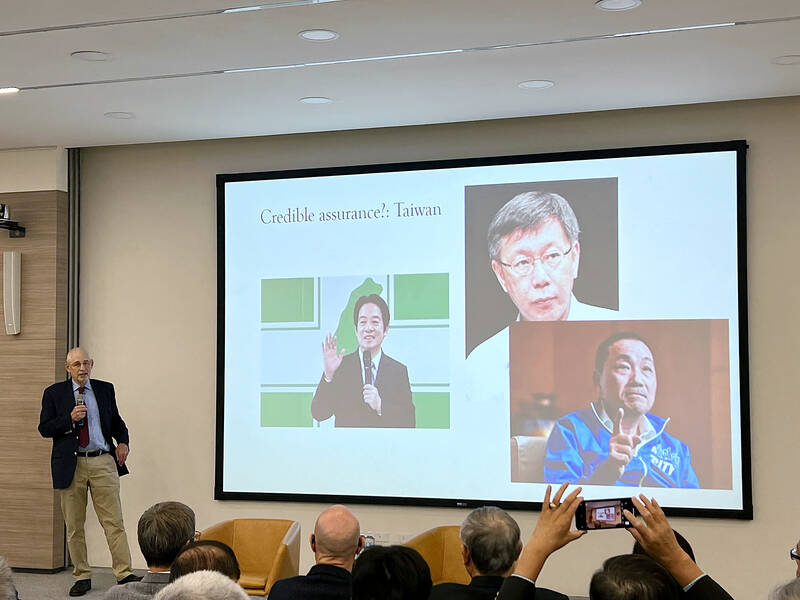
Photo: CNA
Due to a lack of trust in Lai, Beijing is unlikely to do anything to “make Lai’s life easier,” even if he were to become president and promise not to pursue an independence agenda, Nathan said.
However, even if the election went to New Taipei City Mayor Hou You-yi (侯友宜), the Chinese Nationalist Party’s (KMT) candidate, or former Taipei mayor Ko Wen-je (柯文哲), the Taiwan People’s Party candidate, that would not necessarily lead to warmer cross-strait ties, Nathan said.
Beijing has limited understanding of Hou and Ko, so it is likely to apply sustained pressure on Taipei to “test” the reactions of whoever wins, he said.
Chinese President Xi Jinping (習近平) is not interested in engaging in dialogue with Taiwan’s next leader, even though the three leading candidates have expressed a willingness to do so, Nathan said.
Xi does not believe in maintaining the “status quo” in the Taiwan Strait, Nathan said.
That is why Beijing frequently flies warplanes near Taiwan and is building up its military bases in the South China Sea, he said.
The US should exhibit prudence and end its “dangerous” anti-China stance if it wants to avoid a conflict in the Taiwan Strait, he said.
The Taiwan question is a “zero-sum game” for the US and China, he said.
Considering Taiwan’s strategic location in the first island chain, neither Washington nor Beijing can afford to see it controlled by or tilting too heavily toward the other side, he said.
He warned that there is “anti-China rhetoric” in the US Congress, adding that congresspeople often take a tough stance on China to bolster their own political interests.
The US government should “stick to its old policy,” he said, referring to Washington’s “one China” policy and “strategic ambiguity,” under which it does not take a public position on whether it would send troops to Taiwan in the event of a Chinese invasion.
The US should continue strengthening its partnership with Taiwan, but it should also refrain from making comments on the Taiwan issue that could be perceived by Beijing as acts of provocation, he added.

Considering that most countries issue more than five denominations of banknotes, the central bank has decided to redesign all five denominations, the bank said as it prepares for the first major overhaul of the banknotes in more than 24 years. Central bank Governor Yang Chin-lung (楊金龍) is expected to report to the Legislative Yuan today on the bank’s operations and the redesign’s progress. The bank in a report sent to the legislature ahead of today’s meeting said it had commissioned a survey on the public’s preferences. Survey results showed that NT$100 and NT$1,000 banknotes are the most commonly used, while NT$200 and NT$2,000

The Centers for Disease Control (CDC) yesterday reported the first case of a new COVID-19 subvariant — BA.3.2 — in a 10-year-old Singaporean girl who had a fever upon arrival in Taiwan and tested positive for the disease. The girl left Taiwan on March 20 and the case did not have a direct impact on the local community, it said. The WHO added the BA.3.2 strain to its list of Variants Under Monitoring in December last year, but this was the first imported case of the COVID-19 variant in Taiwan, CDC Deputy Director-General Lin Ming-cheng (林明誠) said. The girl arrived in Taiwan on

South Korea is planning to revise its controversial electronic arrival card, a step Taiwanese officials said prompted them to hold off on planned retaliatory measures, a South Korean media report said yesterday. A Yonhap News Agency report said that the South Korean Ministry of Foreign Affairs is planning to remove the “previous departure place” and “next destination” fields from its e-arrival card system. The plan, reached after interagency consultations, is under review and aims to simplify entry procedures and align the electronic form with the paper version, a South Korean ministry official said. The fields — which appeared only on the electronic form

The Ministry of Foreign Affairs (MOFA) is suspending retaliation measures against South Korea that were set to take effect tomorrow, after Seoul said it is updating its e-arrival system, MOFA said today. The measures were to be a new round of retaliation after Taiwan on March 1 changed South Korea's designation on government-issued alien resident certificates held by South Korean nationals to "South Korea” from the "Republic of Korea," the country’s official name. The move came after months of protests to Seoul over its listing of Taiwan as "China (Taiwan)" in dropdown menus on its new online immigration entry system. MOFA last week


 RSS
RSS