


US experts called on Washington to sign a free-trade agreement with Taiwan, as the relationship between the two countries is strategically significant, Deputy Minister of Foreign Affairs Roy Lee (李淳) said yesterday.
Lee made the remark during an interview with media personality Clara Chou (周玉蔻) a week after the two nations signed an initial agreement under the US-Taiwan Initiative on 21st-Century Trade.
Signing the agreement was a “big breakthrough” in economic and trade relations of the past two decades, and an important milestone for Taiwan’s overall economic and trade ties, he said.
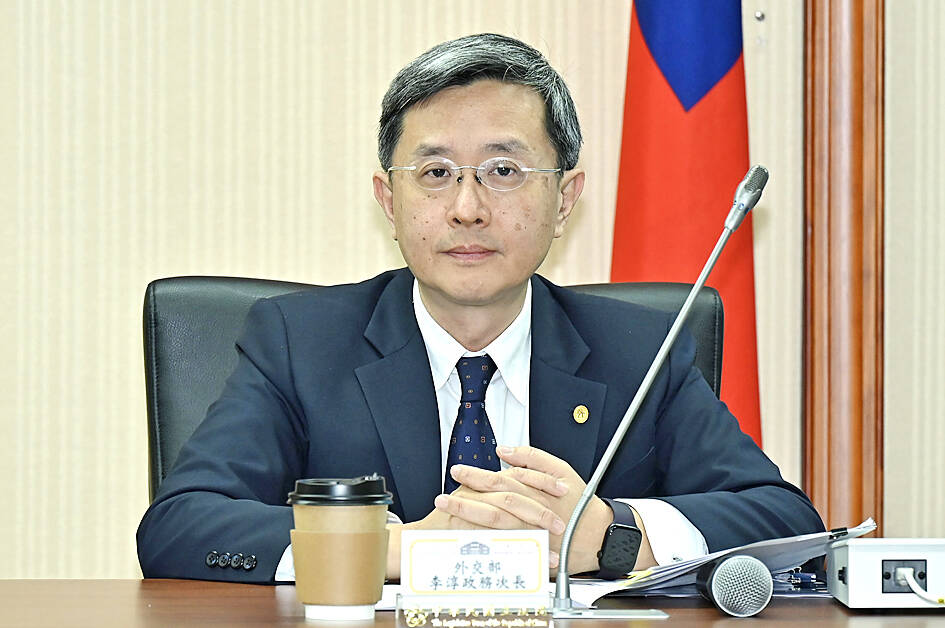
Photo: Tu Chien-jung, Taipei Times
The agreement would benefit both sides, he added.
Taiwan’s international position and pressure from China make it challenging for the nation to sign trade deals with countries that are not diplomatic allies, he said.
The deal with the US has the structure of a typical free-trade agreement, and can be expanded in scope and content, Lee said.
The agreement would hopefully be an example for other countries or trade blocs to follow in signing similar deals with Taiwan, he said.
The US is Taiwan’s second-largest export market, and economic and trade ties have grown closer in the past few years, he said.
Asked whether the US might replace China as Taiwan’s top export market, Lee said that “it definitely would.”
Taiwan and the US are able to work smoothly together because their interests align, he said.
Taiwanese businesses are following a global trend of reconsidering dependence on China and “derisking” by moving key operations out of the nation, Lee said.
The next step in ties with Washington would be to negotiate an agreement to eliminate double taxation, which would draw more firms to invest in the US, he added.
A free-trade agreement with Taiwan would be a strategic tool demonstrating the US’ support of the nation, a view backed by experts in the US, he said.
The benefits of the initial agreement might not be obvious in the short term and would be difficult to quantify, he added.
However, three committees are to be established to discuss trade facilitation, small and medium-sized enterprises, and good regulatory practices, Lee said.
The discussions would be broader and more innovative than under the Trade and Investment Framework Agreement, which focused on resolving trade obstacles, he said.

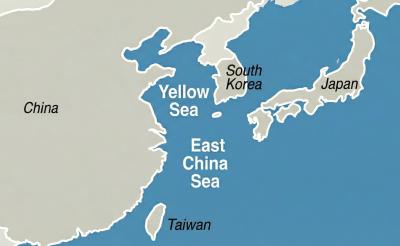
China has reserved offshore airspace in the Yellow Sea and East China Sea from March 27 to May 6, issuing alerts usually used to warn of military exercises, although no such exercises have been announced, the Wall Street Journal (WSJ) reported yesterday. Reserving such a large area for 40 days without explanation is an “unusual step,” as military exercises normally only last a few days, the paper said. These alerts, known as Notice to Air Missions (Notams), “are intended to inform pilots and aviation authorities of temporary airspace hazards or restrictions,” the article said. The airspace reserved in the alert is
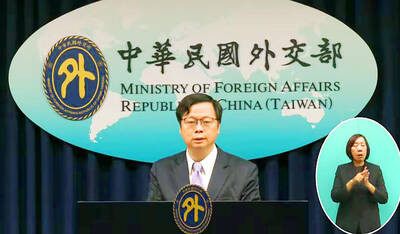
NAMING SPAT: The foreign ministry called on Denmark to propose an acceptable solution to the erroneous nationality used for Taiwanese on residence permits Taiwan has revoked some privileges for Danish diplomatic staff over a Danish permit that lists “Taiwan” as “China,” Eric Huang (黃鈞耀), head of the Ministry of Foreign Affairs’ Department of European Affairs, told a news conference in Taipei yesterday. Reporters asked Huang whether the Danish government had responded to the ministry’s request that it correct the nationality on Danish residence permits of Taiwanese, which has been listed as “China” since 2024. Taiwan’s representative office in Denmark continues to communicate with the Danish government, and the ministry has revoked some privileges previously granted to Danish representatives in Taiwan and would continue to review
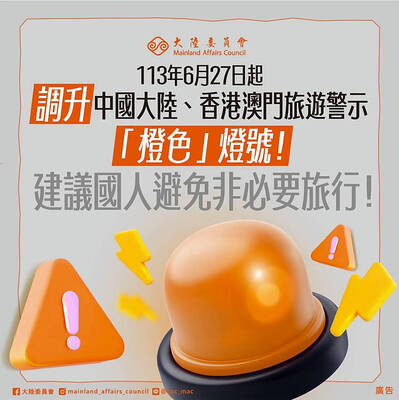
More than 6,000 Taiwanese students have participated in exchange programs in China over the past two years, despite the Mainland Affairs Council’s (MAC) “orange light” travel advisory, government records showed. The MAC’s publicly available registry showed that Taiwanese college and university students who went on exchange programs across the Strait numbered 3,592 and 2,966 people respectively. The National Immigration Agency data revealed that 2,296 and 2,551 Chinese students visited Taiwan for study in the same two years. A review of the Web sites of publicly-run universities and colleges showed that Taiwanese higher education institutions continued to recruit students for Chinese educational programs without
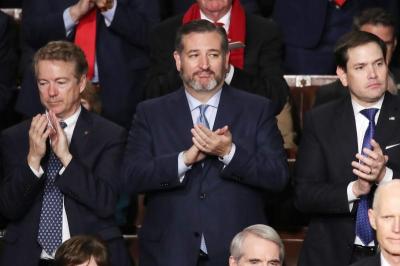
A bipartisan group of US senators has introduced a bill to enhance cooperation with Taiwan on drone development and to reduce reliance on supply chains linked to China. The proposed Blue Skies for Taiwan Act of 2026 was introduced by Republican US senators Ted Cruz and John Curtis, and Democratic US senators Jeff Merkley and Andy Kim. The legislation seeks to ease constraints on Taiwan-US cooperation in uncrewed aerial systems (UAS), including dependence on China-sourced components, limited access to capital and regulatory barriers under US export controls, a news release issued by Cruz on Wednesday said. The bill would establish a "Blue UAS


 RSS
RSS