


The Taichung City Government has said that it is investigating an alleged poisoning of an elementary-school student by their classmates using sugar water laced with devil’s ivy.
The Taichung Education Bureau confirmed on Saturday that it received a report on May 11 that a student experienced dizziness, nausea and stomach pain after ingesting sugar water laced with the common houseplant.
China Medical University Hospital Department of Toxicology director Hung Tung-jung (洪東榮), who treated the student, said he suspected prolonged exposure to toxins from the plant, which is also known as golden pathos.
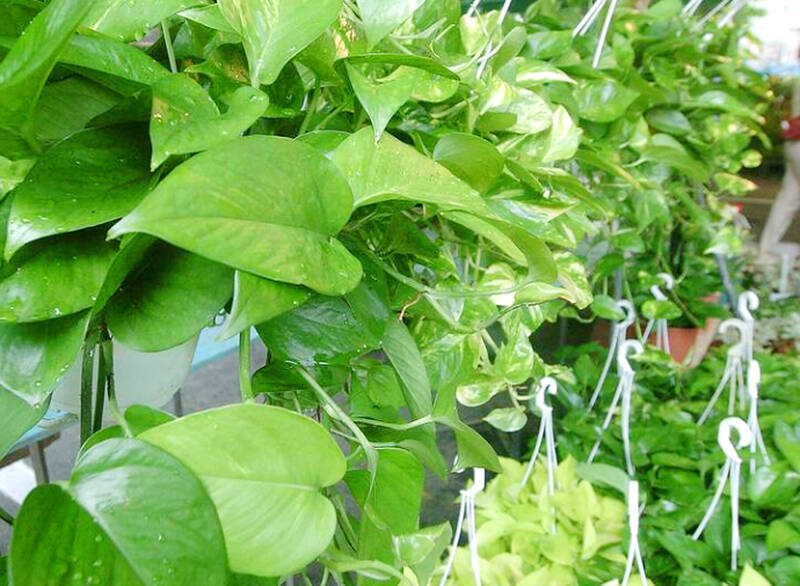
Photo: Taipei Times file
In a post on the online forum Dcard that has since been deleted, a user accused “Student A” of poisoning “Student R” with the intent to kill over an argument.
Although a teacher attempted to mediate, Student A found three classmates to help them poison Student R late last month, the post said.
Through online research they decided on either devil’s ivy, Asian taro or oleander, and chose one at random, it said.
The post then said that the four students made a juice from the plant mixed with sugar and added it to Student R’s water bottle.
Initially suspecting food poisoning, the teacher held a meeting with Student R’s parents and the school before finding a bottle with the mixture under Student A’s desk the next day, the post said.
Both sets of parents on May 11 informed the police, who confirmed receiving the report, but forwarded the case to the bureau, as minors younger than 12 are not criminally liable.
The bureau said that the school has spoken with the students involved, while the parents have filed numerous bullying and gender discrimination complaints with the school.
Asian taro and devil’s ivy are in the Araceae family of plants, which contain calcium oxalate crystals and saponins, Taichung Veterans General Hospital Department of Toxicology doctor Mao Yen-chiao (毛彥喬) said.
The crystals can cause redness and mild pain if touched, and can cause mouth sores, throat pain, abdominal pain and diarrhea if ingested, Mao said.

Considering that most countries issue more than five denominations of banknotes, the central bank has decided to redesign all five denominations, the bank said as it prepares for the first major overhaul of the banknotes in more than 24 years. Central bank Governor Yang Chin-lung (楊金龍) is expected to report to the Legislative Yuan today on the bank’s operations and the redesign’s progress. The bank in a report sent to the legislature ahead of today’s meeting said it had commissioned a survey on the public’s preferences. Survey results showed that NT$100 and NT$1,000 banknotes are the most commonly used, while NT$200 and NT$2,000

The Centers for Disease Control (CDC) yesterday reported the first case of a new COVID-19 subvariant — BA.3.2 — in a 10-year-old Singaporean girl who had a fever upon arrival in Taiwan and tested positive for the disease. The girl left Taiwan on March 20 and the case did not have a direct impact on the local community, it said. The WHO added the BA.3.2 strain to its list of Variants Under Monitoring in December last year, but this was the first imported case of the COVID-19 variant in Taiwan, CDC Deputy Director-General Lin Ming-cheng (林明誠) said. The girl arrived in Taiwan on

South Korea is planning to revise its controversial electronic arrival card, a step Taiwanese officials said prompted them to hold off on planned retaliatory measures, a South Korean media report said yesterday. A Yonhap News Agency report said that the South Korean Ministry of Foreign Affairs is planning to remove the “previous departure place” and “next destination” fields from its e-arrival card system. The plan, reached after interagency consultations, is under review and aims to simplify entry procedures and align the electronic form with the paper version, a South Korean ministry official said. The fields — which appeared only on the electronic form

The Ministry of Foreign Affairs (MOFA) is suspending retaliation measures against South Korea that were set to take effect tomorrow, after Seoul said it is updating its e-arrival system, MOFA said today. The measures were to be a new round of retaliation after Taiwan on March 1 changed South Korea's designation on government-issued alien resident certificates held by South Korean nationals to "South Korea” from the "Republic of Korea," the country’s official name. The move came after months of protests to Seoul over its listing of Taiwan as "China (Taiwan)" in dropdown menus on its new online immigration entry system. MOFA last week


 RSS
RSS