

Eslite Bookstore yesterday denied allegations that its online store, Eslite.com, had leaked personal data of its customers to entities abroad.
Here I Stand Project deputy executive secretary Yang Hsin-tzu (楊欣慈) on Sunday said that the bookstore might have leaked her information, as she received a telephone call from people spreading Chinese “united front” rhetoric after she purchased the book If China Attacks (阿共打來怎麼辦) from Eslite’s online store in February.
Yang said that she received multiple phone calls from people saying they wanted to speak to her about purchasing a book covering “such a sensitive topic.”

Photo courtesy of Eslite
They spouted Chinese “united front” rhetoric throughout the conversation, she said.
Minister of Digital Development Audrey Tang (唐鳳) yesterday said that the ministry has asked Eslite to respond to the claims.
Eslite said it was conducting an internal investigation.
The ministry would investigate and determine what happened, she said, adding that it is also working to introduce mechanisms, such as steganography and zero-trust security architecture, to prevent such incidents.
Shih Wei-jen (施偉仁), deputy head of the Administration for Digital Industries’ Platform Economy Division, said that the agency hopes to conclude its investigation into the incident within two weeks — in line with the Executive Yuan’s policy to combat scammers.
Eslite would be fined if it is found to have contravened the regulations, Shih said.
Elite said in a statement that it would work with investigators and step up information security measures.
Its online store gives customers a greater variety of products to choose from, and none of the data the platform generates are connected to overseas servers, it said.
Its system are maintained by third-party information technology professionals, it said.
Over the past year, the company has sent nearly 8 million text messages and e-mails warning people about phishing and scam calls, it said.
Such incidents are likely to be politicized ahead of the presidential election next year, it said, adding that it believed the ministry would handle the incident in a fair and just manner.

The donation of offshore patrol vessel Kinmen to the Philippines includes provisions that protect Taiwanese fishers and facilitate security cooperation across the First Island Chain, officials said yesterday. The comment was made during the Cabinet’s comprehensive administrative report at the legislature after Chinese Nationalist Party (KMT) Legislator Hsu Yu-chen (許宇甄) expressed concerns about the decision to give a ship to a country whose coast guard had in 2013 fired on a Taiwanese trawler and killed its captain without provocation. The Cabinet should lay out the safeguards that have been established to prevent the Philippine government from using the Kinmen to harass, expel
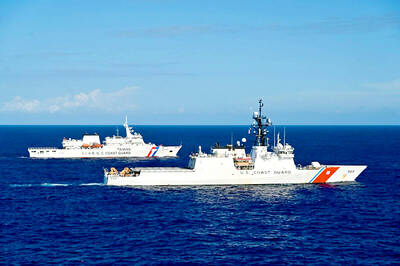
GROWING TIES: The CGA is planning a goodwill mission to the Philippines, in what would be the first time since 1975 a Taiwanese paramilitary vessel has visited the country The Coast Guard Administration (CGA) plans to significantly expand its participation in international security cooperative frameworks and its operational capabilities, a budget proposal for next year showed. The budget indicates a transformation of the CGA from a maritime law enforcement arm into a national defense and intelligence gathering entity capable of tackling larger regional security matters. The proposal showed that personnel from the coast guard’s Intelligence Division and Special Action Support Center are to participate in high-level national security talks with the US. As the CGA has dealt with China’s rising “gray zone” threats around Taiwan, it has become a valuable asset to
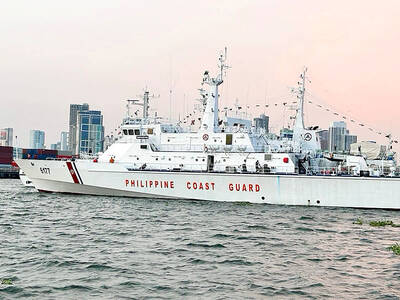
A patrol vessel donated by the Coast Guard Administration (CGA) to the Philippines was commissioned into the Philippine Coast Guard (PCG) on Friday, a Philippine non-governmental organization said. The CGA on Sept. 16 confirmed media reports that Taiwan had donated a retired 500-tonne patrol vessel to the Philippines. The Manila-based We Protect Our Seas (WPS) foundation, which served as an intermediary in the transfer, said that the vessel was formerly the CGA’s 500-tonne petrol vessel Kinmen (CG123). The WPS, in a statement issued on Friday, said the vessel, renamed as the BRP Sarangani, had been commissioned into the PCG the
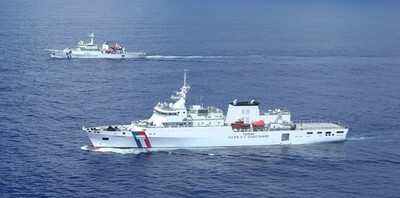
The Coast Guard Administration (CGA) today said that two of its patrol vessels have docked at Palau's Malakal Harbor as part of an expedition exercise and diplomatic visit, during which a senior official is expected to meet with the Palauan president. The two vessels, the 4,000-tonne-class Chiayi (嘉義) and the 1,000-tonne-class Penghu (澎湖), set sail for Palau from Taiwan last week and arrived at Malakal Harbor yesterday, the CGA's Fleet Branch said in a statement. The journey marked the second time the CGA has dispatched a "Friendship Fleet" to another country, after it sent its first-ever goodwill fleet, comprising the Hualien (花蓮)


 RSS
RSS