


A congratulatory telephone call that President Tsai Ing-wen (蔡英文) made to then-US president-elect Donald Trump in 2016 was not an impromptu act and had been planned for six months, former representative to the US Stanley Kao (高碩泰) said on Saturday.
Kao made the remarks during a launch event for his memoir. He served as representative to the US from May 2016 to July 2020 and facilitated the telephone call.
The call took place on Dec. 2, 2016, and marked the first time that a US president or president-elect had directly spoken with a Taiwanese president since the countries severed official diplomatic relations in 1979.
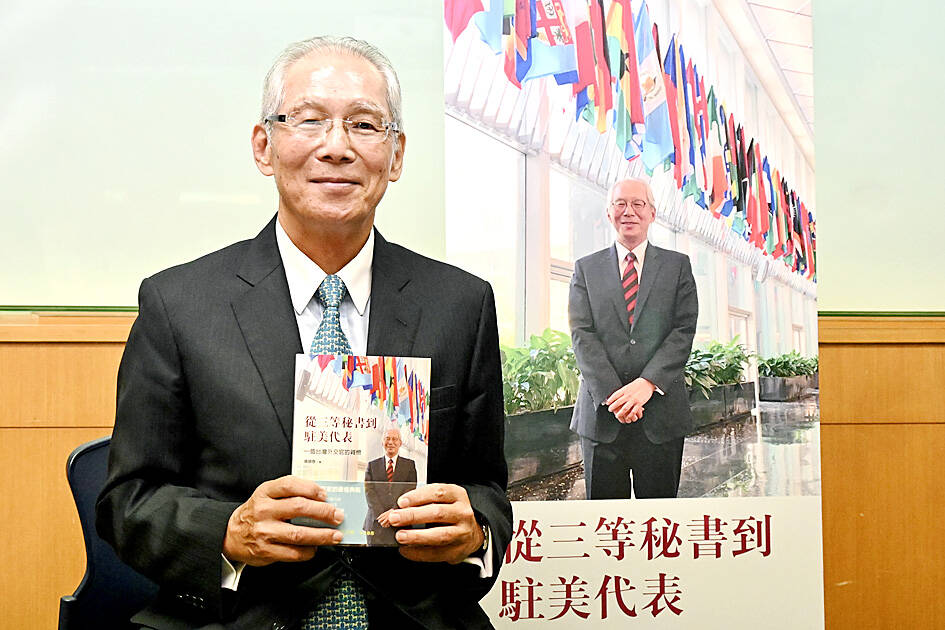
Photo: George Tsorng, Taipei Times
Kao on Saturday said Washington Post foreign policy columnist Josh Rogin in his 2021 book Chaos Under Heaven: Trump, Xi and the Battle for the Twenty-First Century says that the phone call was an “accident” or “improvisation.”
However, he said Rogin’s account is just “one version of the many speculations made about the phone call,” which is incomplete, because Rogin “could not see the forest for the trees.”
Rogin’s version of events fails to give credit to the low-profile, but intensive communications between officials in Taiwan and the US in preparation for the call, whose planning started as far back as the summer of 2016, after Tsai was inaugurated in May that year, Kao said.
Only a handful of people in Washington, himself included, knew of the call before it happened, he said.
In his book, Kao says that Taiwan’s representative office in Washington contacted Trump’s team immediately after learning about his election victory on Nov. 8 in 2016.
Kao said he was so nervous the night before the phone call that he could hardly sleep.
At the time, he was carrying a small piece of paper with the numbers of Trump’s office at all times for fear of a sudden change of mind or schedule on Trump’s part, he said.
Finally, the call went through and Tsai and Trump spoke on the phone for about 10 minutes, double the originally planned time, he said.
Kao said the call was the result of collective efforts from both sides.
Kao entered the foreign service in 1980. He was responsible for North American affairs for most of his 40-year diplomatic career and has served as the nation’s deputy representative to Washington; as well as top representative to Hungary and Italy. He retired in July 2020.
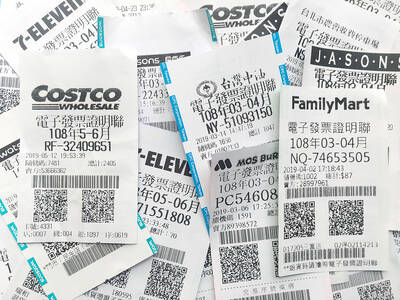
A NT$39 receipt for two bottles of tea at a FamilyMart was among the NT$10 million (US $312,969) special prize winners in the January-February uniform invoice lottery. FamilyMart said that two NT$10 million-winning receipts were issued at its stores, as well as two NT$2 million grand prizes and three NT$200,000 first prizes. The two NT$10 million receipts were issued at stores in Pingtung County and Yilan County’s Dongshan Township (冬山). One winner spent just NT$39 on two bottles of tea, while another spent NT$80 on water, tea and coffee, the company said. Meanwhile, 7-Eleven reported three NT$10 million winners — in New Taipei

Considering that most countries issue more than five denominations of banknotes, the central bank has decided to redesign all five denominations, the bank said as it prepares for the first major overhaul of the banknotes in more than 24 years. Central bank Governor Yang Chin-lung (楊金龍) is expected to report to the Legislative Yuan today on the bank’s operations and the redesign’s progress. The bank in a report sent to the legislature ahead of today’s meeting said it had commissioned a survey on the public’s preferences. Survey results showed that NT$100 and NT$1,000 banknotes are the most commonly used, while NT$200 and NT$2,000

ANNUAL EVENT: Two massive Pokemon balloons are to be set up in Daan Park, with an event zone operating from 10am to 6pm This year’s Taipei Floral Picnic is to be held at Daan Park today and tomorrow, featuring an exclusive Pokemon Go event, a themed food market, a coffee rave picnic area and stage performances, the Taipei Department of Information and Tourism said yesterday. Two massive Pokemon balloons are to be set up in the park as attractions, with an exclusive event zone operating from 10am to 6pm, it said. Participants who complete designated tasks on-site would have a chance to receive limited-edition souvenirs, it added. People could also try the newly launched game Pokemon Pokopia in the trial area, the department said. Three PokeStops are

The Centers for Disease Control (CDC) yesterday reported the first case of a new COVID-19 subvariant — BA.3.2 — in a 10-year-old Singaporean girl who had a fever upon arrival in Taiwan and tested positive for the disease. The girl left Taiwan on March 20 and the case did not have a direct impact on the local community, it said. The WHO added the BA.3.2 strain to its list of Variants Under Monitoring in December last year, but this was the first imported case of the COVID-19 variant in Taiwan, CDC Deputy Director-General Lin Ming-cheng (林明誠) said. The girl arrived in Taiwan on


 RSS
RSS