


The military on Saturday found the wreckage of a suspected Chinese weather balloon on one of the islets in Lienchiang County.
The army’s Matsu Defense Command, which is responsible for guarding the outlying county, said its Juguang Defense Team found the wreckage on a road outside one of its camps during a patrol.
The balloon bears the simplified Chinese characters for “Shanghai Chang Wang Meteorological Technology Co” (上海長望氣象科技股份有限公司) and “GTS12 digital radiosonde” imprinted on it, the command said in a statement.
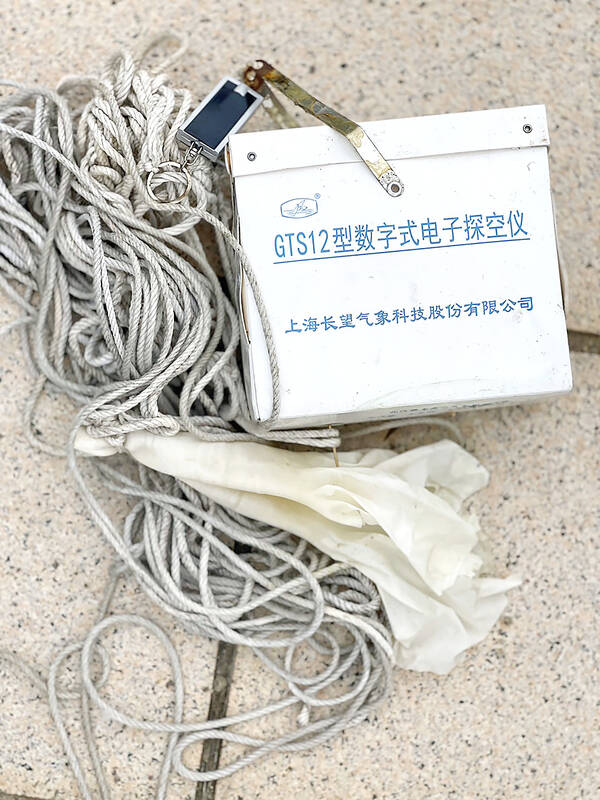
Photo courtesy of the Ministry of National Defense
Taiwan uses traditional Chinese characters, while China uses simplified ones.
An initial probe has concluded that the wreckage likely belonged to a weather balloon, the command said, adding that the army would examine the object further.
The army plans to continue to bolster its patrols to closely monitor movements around military bases, the statement said.
The Juguang Defense Team is responsible for guarding Juguang Township’s (莒光) two major islands — Dongju (東莒) and Xiju (西莒). The township lies less than 10km from China’s Fujian Province.
The military found similar wreckage in February. That finding was made by the Matsu Defense Command’s unit on Dongyin Island (東引).
The military earlier this year said that Chinese balloons detected in Taiwan’s airspace were weather balloons and did not pose a security threat that would require them to be shot down.
Alleged Chinese spy balloon programs have drawn global attention after such a balloon was spotted above the US and shot down on Feb. 4.
The incident also led to a diplomatic dispute, with US Secretary of State Antony Blinken calling off a planned trip to China.
Beijing has denied that the balloon was used for spying, and said it was a civilian airship used for meteorological research that had blown off course.
A Chinese Ministry of Foreign Affairs spokesman in February also accused the US of flying high-altitude balloons over China and other countries without permission more than 10 times since the beginning of last year.


An essay competition jointly organized by a local writing society and a publisher affiliated with the Chinese Communist Party (CCP) might have contravened the Act Governing Relations Between the People of the Taiwan Area and the Mainland Area (臺灣地區與大陸地區人民關係條例), the Mainland Affairs Council (MAC) said on Thursday. “In this case, the partner organization is clearly an agency under the CCP’s Fujian Provincial Committee,” MAC Deputy Minister and spokesperson Liang Wen-chieh (梁文傑) said at a news briefing in Taipei. “It also involves bringing Taiwanese students to China with all-expenses-paid arrangements to attend award ceremonies and camps,” Liang said. Those two “characteristics” are typically sufficient
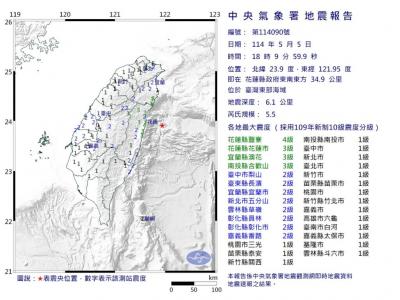
A magnitude 5.9 earthquake that struck about 33km off the coast of Hualien City was the "main shock" in a series of quakes in the area, with aftershocks expected over the next three days, the Central Weather Administration (CWA) said yesterday. Prior to the magnitude 5.9 quake shaking most of Taiwan at 6:53pm yesterday, six other earthquakes stronger than a magnitude of 4, starting with a magnitude 5.5 quake at 6:09pm, occurred in the area. CWA Seismological Center Director Wu Chien-fu (吳健富) confirmed that the quakes were all part of the same series and that the magnitude 5.5 temblor was

The brilliant blue waters, thick foliage and bucolic atmosphere on this seemingly idyllic archipelago deep in the Pacific Ocean belie the key role it now plays in a titanic geopolitical struggle. Palau is again on the front line as China, and the US and its allies prepare their forces in an intensifying contest for control over the Asia-Pacific region. The democratic nation of just 17,000 people hosts US-controlled airstrips and soon-to-be-completed radar installations that the US military describes as “critical” to monitoring vast swathes of water and airspace. It is also a key piece of the second island chain, a string of
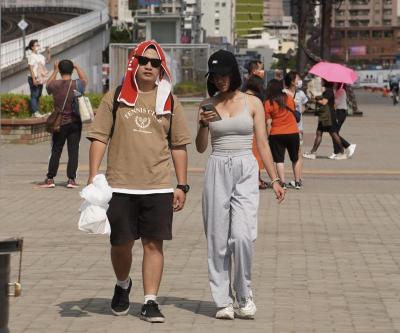
The Central Weather Administration has issued a heat alert for southeastern Taiwan, warning of temperatures as high as 36°C today, while alerting some coastal areas of strong winds later in the day. Kaohsiung’s Neimen District (內門) and Pingtung County’s Neipu Township (內埔) are under an orange heat alert, which warns of temperatures as high as 36°C for three consecutive days, the CWA said, citing southwest winds. The heat would also extend to Tainan’s Nansi (楠西) and Yujing (玉井) districts, as well as Pingtung’s Gaoshu (高樹), Yanpu (鹽埔) and Majia (瑪家) townships, it said, forecasting highs of up to 36°C in those areas


 RSS
RSS