


Pregnant women should follow Health Promotion Administration (HPA) nutrition guidelines, the agency said on Thursday ahead of Mother’s Day today.
Among Taiwanese women aged 19 to 44, 35.9 percent dine out 14 times or more per week, the agency said, citing a report it prepared on dietary habits in Taiwan from 2017 to 2020.
Only 5.8 percent of women eat the recommended three daily servings of vegetables, the study showed.
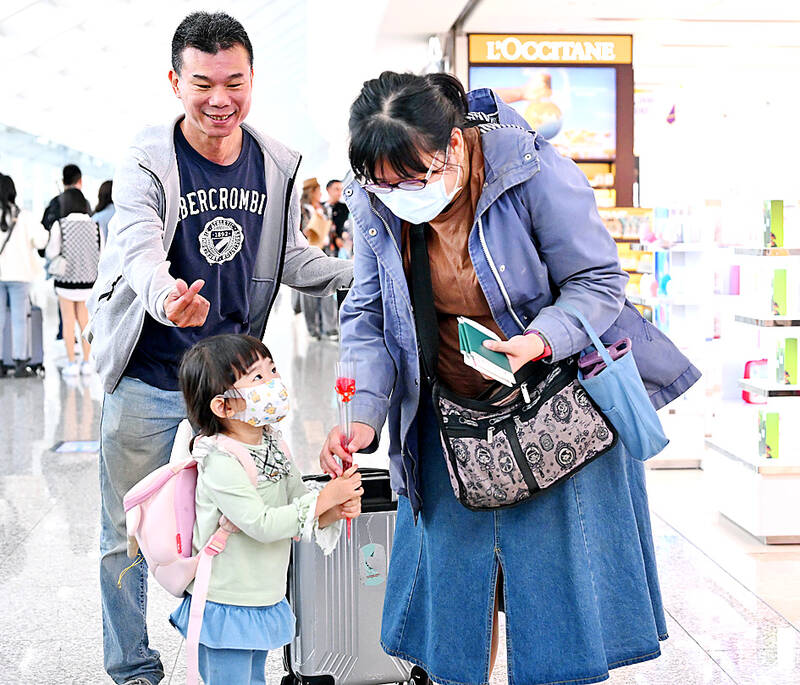
Photo: Chu Pei-hsiung, Taipei Time
Common nutritional problems during pregnancy include excessive calorie intake, a lack of nutrients needed to properly support pregnancy and insufficient fiber that could lead to constipation or hemorrhoids, the agency said.
Pregnant women should avoid eating too much, eat more boiled food, make sure they are getting enough high-quality protein, fiber, calcium, iron and folate, and limit caffeine, it said.
Pregnant women should eat to about 70 percent full at restaurants, the report said, citing Serine Li (李婉萍), a nutritionist at Reshining Clinic.
Shrimp, sea cucumber, squid, beef shank and chicken are recommended because they are high in protein and low in fat, while deep-fried, sweet-and-sour or velveted dishes are best avoided, Li said.
Green vegetables and a fistful of fruit per meal can help with bowel movement and promote gut health, she said, adding that spinach, red spinach and kale are healthy vegetables commonly served in restaurants.
Maternal sucrose can be absorbed through the placenta to negatively affect fetal health by increasing the risk of macrosomia and low blood sugar, so for dessert, cheesecake, which tends to have less sugar and is calcium-rich, purple rice or red bean porridge, which are rich in fiber and iron, should replace items such as cream puffs, she said.
Tea and coffee should be drunk in moderation, with a 300cc cup of coffee being enough, Li said, adding that freshly squeezed kiwifruit or pineapple juice, and black bean or barley tea are good sources of hydration.
More information is on the HPA’s maternity care Web site: https://mammy.hpa.gov.tw/ or via its nutritionist’s hotline, 0800-870-870, the agency said.

Considering that most countries issue more than five denominations of banknotes, the central bank has decided to redesign all five denominations, the bank said as it prepares for the first major overhaul of the banknotes in more than 24 years. Central bank Governor Yang Chin-lung (楊金龍) is expected to report to the Legislative Yuan today on the bank’s operations and the redesign’s progress. The bank in a report sent to the legislature ahead of today’s meeting said it had commissioned a survey on the public’s preferences. Survey results showed that NT$100 and NT$1,000 banknotes are the most commonly used, while NT$200 and NT$2,000

The Centers for Disease Control (CDC) yesterday reported the first case of a new COVID-19 subvariant — BA.3.2 — in a 10-year-old Singaporean girl who had a fever upon arrival in Taiwan and tested positive for the disease. The girl left Taiwan on March 20 and the case did not have a direct impact on the local community, it said. The WHO added the BA.3.2 strain to its list of Variants Under Monitoring in December last year, but this was the first imported case of the COVID-19 variant in Taiwan, CDC Deputy Director-General Lin Ming-cheng (林明誠) said. The girl arrived in Taiwan on

South Korea is planning to revise its controversial electronic arrival card, a step Taiwanese officials said prompted them to hold off on planned retaliatory measures, a South Korean media report said yesterday. A Yonhap News Agency report said that the South Korean Ministry of Foreign Affairs is planning to remove the “previous departure place” and “next destination” fields from its e-arrival card system. The plan, reached after interagency consultations, is under review and aims to simplify entry procedures and align the electronic form with the paper version, a South Korean ministry official said. The fields — which appeared only on the electronic form

The Ministry of Foreign Affairs (MOFA) is suspending retaliation measures against South Korea that were set to take effect tomorrow, after Seoul said it is updating its e-arrival system, MOFA said today. The measures were to be a new round of retaliation after Taiwan on March 1 changed South Korea's designation on government-issued alien resident certificates held by South Korean nationals to "South Korea” from the "Republic of Korea," the country’s official name. The move came after months of protests to Seoul over its listing of Taiwan as "China (Taiwan)" in dropdown menus on its new online immigration entry system. MOFA last week


 RSS
RSS