


Deputy Minister of Health and Welfare Victor Wang (王必勝) on Wednesday said his ministry had “no timetable” for deciding whether to ease a ban on residues of two pesticides commonly used on Japanese strawberries, appearing to contradict remarks made by another senior health official last week.
Asked about the issue by reporters, Wang said the Food and Drug Administration (FDA) had received a request from Japan to set maximum residue limits for the chemicals chlorfenapyr and flonicamid, but warned that such reviews often take at least three years.
The process, which includes soliciting expert opinion on the matter, is ongoing, and there is no timetable for making an announcement, he said.
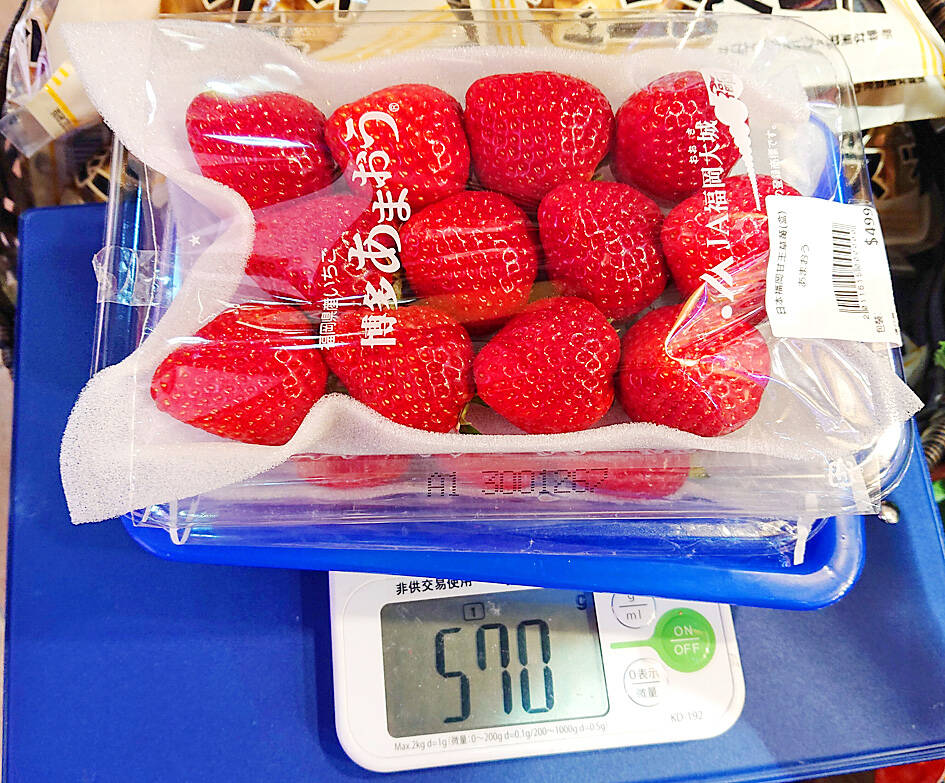
Photo courtesy of the Taipei Department of Health
Wang’s remarks came after FDA Director-General Wu Show-mei (吳秀梅) sparked controversy on Wednesday last week by saying that her agency would announce a policy proposal on the matter within two weeks.
Wu’s announcement drew strong pushback from the Chinese Nationalist Party (KMT), which accused the government of turning a blind eye to potential health risks to curry favor with Japan.
Groups in Miaoli County’s Dahu Township (大湖), Taiwan’s main strawberry-growing region, also said that it was unreasonable to allow pesticides that are not authorized for use in Taiwan on imports, and risked turning the public against strawberries in general.
According to the FDA, Japanese exporters submitted the request in February to replace the ban on residues of the two pesticides with maximum residue limits, in response to multiple residue-related seizures of Japanese strawberries at the border.
Wang on Wednesday said that Taiwan has set maximum residue limits for 400 types of pesticides and herbicides for domestic food products and 391 types for imports.
Of the pesticide residue limits approved for imported foods, 302 were set in the past five years, and 89 of them were set in response to requests from Japan, he said.
Pesticides without defined maximum residue limits are banned by default, he said.
Chlorfenapyr is used for crop protection against a variety of insects and mites, while flonicamid is used to control aphids, thrips and whiteflies.

Considering that most countries issue more than five denominations of banknotes, the central bank has decided to redesign all five denominations, the bank said as it prepares for the first major overhaul of the banknotes in more than 24 years. Central bank Governor Yang Chin-lung (楊金龍) is expected to report to the Legislative Yuan today on the bank’s operations and the redesign’s progress. The bank in a report sent to the legislature ahead of today’s meeting said it had commissioned a survey on the public’s preferences. Survey results showed that NT$100 and NT$1,000 banknotes are the most commonly used, while NT$200 and NT$2,000

The Centers for Disease Control (CDC) yesterday reported the first case of a new COVID-19 subvariant — BA.3.2 — in a 10-year-old Singaporean girl who had a fever upon arrival in Taiwan and tested positive for the disease. The girl left Taiwan on March 20 and the case did not have a direct impact on the local community, it said. The WHO added the BA.3.2 strain to its list of Variants Under Monitoring in December last year, but this was the first imported case of the COVID-19 variant in Taiwan, CDC Deputy Director-General Lin Ming-cheng (林明誠) said. The girl arrived in Taiwan on

South Korea is planning to revise its controversial electronic arrival card, a step Taiwanese officials said prompted them to hold off on planned retaliatory measures, a South Korean media report said yesterday. A Yonhap News Agency report said that the South Korean Ministry of Foreign Affairs is planning to remove the “previous departure place” and “next destination” fields from its e-arrival card system. The plan, reached after interagency consultations, is under review and aims to simplify entry procedures and align the electronic form with the paper version, a South Korean ministry official said. The fields — which appeared only on the electronic form

The Ministry of Foreign Affairs (MOFA) is suspending retaliation measures against South Korea that were set to take effect tomorrow, after Seoul said it is updating its e-arrival system, MOFA said today. The measures were to be a new round of retaliation after Taiwan on March 1 changed South Korea's designation on government-issued alien resident certificates held by South Korean nationals to "South Korea” from the "Republic of Korea," the country’s official name. The move came after months of protests to Seoul over its listing of Taiwan as "China (Taiwan)" in dropdown menus on its new online immigration entry system. MOFA last week


 RSS
RSS