


A judicial investigation into a construction incident in Taichung that killed one person and injured 10 is under way, with Highwealth Construction Co ordered to stop all work pending a safety probe.
A train on the Taichung MRT system on Wednesday hit a crane boom that had fallen onto the tracks.
Taichung Mass Rapid Transit Corp (TMRT) interim chairman Lin Liang-tay (林良泰) yesterday released video footage of the incident and said the company would file for damage compensation of NT$200 million (US$6.5 million) from Highwealth Construction.

Photo courtesy of the Taichung Fire Bureau
The video from surveillance cameras showed that the boom from a condominum building separated from a crane and fell onto the MRT track 150m in front of Feng-le Park Station. The MRT train stopped at the station at 12:27:05pm. When the train was restarting at 12:27:22pm, several people, including an MRT attendant and the station’s security guard, who saw the twisted metal of the crane boom, shouted and signaled the train to stop. The attendant is seen on the video calling on a wireless radio for someone to use the emergency hand brake to stop the train.
However, the warnings failed and the train smashed into the crane boom at 12:27:45pm, resulting in the death of an assistant professor at Providence University in Taichung, and injuring 10 people, including a Canadian language teacher surnamed Bardsley.
TMRT transportation section chief Hsu Tai-ming (許泰銘) said a system to detect objects on tracks and to stop MRT trains is in place and should be working, but the distance between the crane boom and the station was too short, so there was not enough time to stop the train.
Taichung police yesterday took the statements of workers at the condominium building: the construction site supervisor and seven workers and equipment operators. The eight were transferred to Taichung prosecutors for further questioning.
The site supervisor, surnamed Tsai (蔡), was released on bail of NT$500,000, a crane equipment supervisor, surnamed Liu (劉), was freed on bail of NT$300,000, and a crane operator, surnamed Lu (呂), and onsite signal operator, surnamed Hsu (許), were released on bail of NT$200,000 each.
The four men are likely to face charges of offenses against public safety, along with negligence resulting in death and bodily harm. The other four workers were released without bail, while prosecutors also gathered material and took testimony from witnesses and passengers in the damaged MRT cars.
Taichung Urban Development Bureau Director Lee Cheng-wei (李正偉) ordered Highwealth to stop its nine building projects in the city as the agency conducts safety inspections.
Lee said the company has been fined NT$810,000 for contravening the Building Act (建築法), while the Ministry of Labor fined it NT$300,000 for safety breaches.
Despite the imposed shutdown, city inspectors found one building project in which Highwealth crews were still working for which it was fined an additional NT$270,000.
Reports by the Chinese-language Liberty Times (the sister paper of the Taipei Times) said that Highwealth and its subsidiaries have a poor record on workplace safety, causing 10 deaths in 10 incidents over the past five years.
Ministry of Labor officials confirmed the reports and said that inspections should be carried out for all of the work sites of the company and its subsidiaries in Taiwan.
Records showed Highwealth companies were embroiled in four major work site incidents in Taichung within the past four years, including a construction worker falling to his death in October 2020, another worker falling from a construction site the following month, a fire at a company site in 2020 and another fire in 2021. The six other fatal incidents took place in other cities in the past five years.
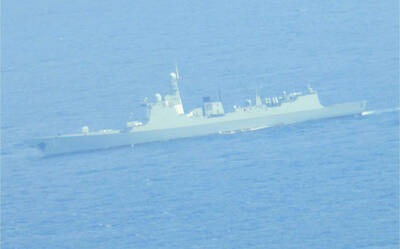
The military has spotted two Chinese warships operating in waters near Penghu County in the Taiwan Strait and sent its own naval and air forces to monitor the vessels, the Ministry of National Defense (MND) said. Beijing sends warships and warplanes into the waters and skies around Taiwan on an almost daily basis, drawing condemnation from Taipei. While the ministry offers daily updates on the locations of Chinese military aircraft, it only rarely gives details of where Chinese warships are operating, generally only when it detects aircraft carriers, as happened last week. A Chinese destroyer and a frigate entered waters to the southwest

A magnitude 6.1 earthquake struck off the coast of Yilan County at 8:39pm tonight, the Central Weather Administration (CWA) said, with no immediate reports of damage or injuries. The epicenter was 38.7km east-northeast of Yilan County Hall at a focal depth of 98.3km, the CWA’s Seismological Center said. The quake’s maximum intensity, which gauges the actual physical effect of a seismic event, was a level 4 on Taiwan’s 7-tier intensity scale, the center said. That intensity level was recorded in Yilan County’s Nanao Township (南澳), Hsinchu County’s Guansi Township (關西), Nantou County’s Hehuanshan (合歡山) and Hualien County’s Yanliao (鹽寮). An intensity of 3 was
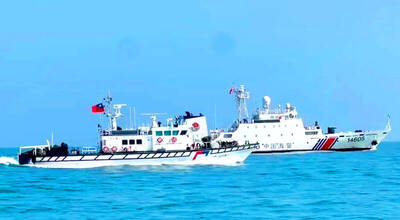
Instead of focusing solely on the threat of a full-scale military invasion, the US and its allies must prepare for a potential Chinese “quarantine” of Taiwan enforced through customs inspections, Stanford University Hoover fellow Eyck Freymann said in a Foreign Affairs article published on Wednesday. China could use various “gray zone” tactics in “reconfiguring the regional and ultimately the global economic order without a war,” said Freymann, who is also a nonresident research fellow at the US Naval War College. China might seize control of Taiwan’s links to the outside world by requiring all flights and ships entering or leaving Taiwan
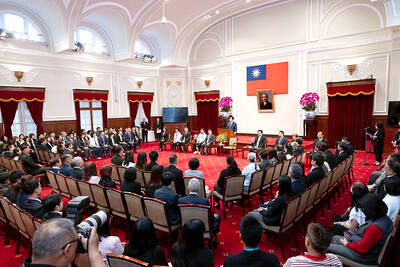
The next minimum wage hike is expected to exceed NT$30,000, President William Lai (賴清德) said yesterday during an award ceremony honoring “model workers,” including migrant workers, at the Presidential Office ahead of Workers’ Day today. Lai said he wished to thank the awardees on behalf of the nation and extend his most sincere respect for their hard work, on which Taiwan’s prosperity has been built. Lai specifically thanked 10 migrant workers selected for the award, saying that although they left their home countries to further their own goals, their efforts have benefited Taiwan as well. The nation’s industrial sector and small businesses lay


 RSS
RSS