


The lower house of the Swiss legislature on Tuesday passed a resolution calling for closer ties with the Legislative Yuan.
The Swiss National Council voted 97-87 with eight abstentions to instruct parliamentary offices to “strengthen” relations with the Legislative Yuan to help bolster democracy, peace and stability, and deepen economic, political, scientific and cultural exchanges between Switzerland and Taiwan.
Legislators of left-leaning parties supported the measure, while those of the main right-wing and free-market parties opposed it.
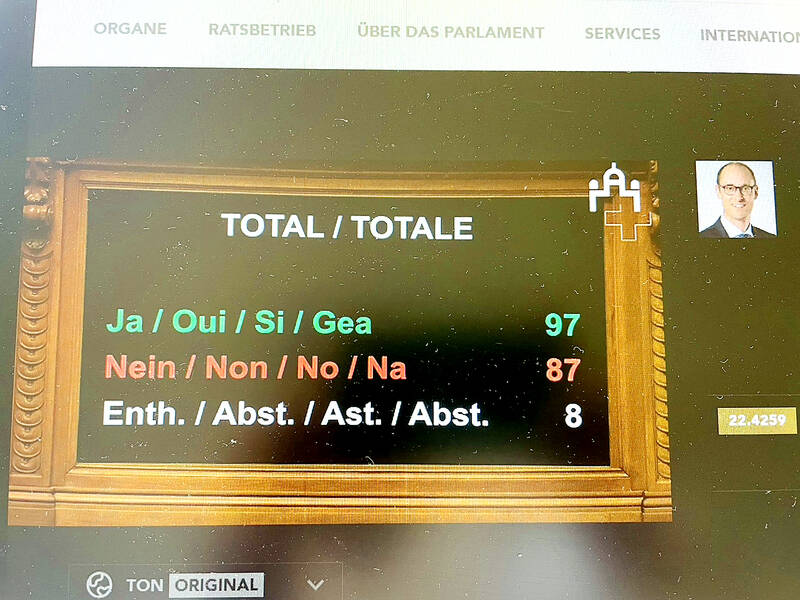
Photo courtesy of the Taipei Cultural and Economic Delegation in Switzerland via CNA
The measure only relates to the lower house; the upper house — the Council of States — does not necessarily have to vote on the motion for it to take effect, the Swiss legislature’s press office said.
The resolution was forwarded to a foreign affairs committee to explore how to put it into practice. The measure has been championed by Swiss lawmaker Fabian Molina, a cochair of the Swiss-Taiwan parliamentary group who led a delegation to Taiwan in February that met with President Tsai Ing-wen (蔡英文).
In a telephone interview, Molina said the vote demonstrated Swiss sovereignty.
“Switzerland has very close political relations with China — I would say sometimes too close — because it hinders us to also speak up against certain human rights violations or against certain problems,” Molina said.
However, he said the vote “does not mean that we make a complete U-turn in our relations with China.”
Swiss daily Tagesanzeiger said the passage of the resolution was an “explosive” move, as Switzerland does not have diplomatic relations with Taiwan.
The newspaper said the resolution showed the lower house’s intention to bolster ties with Taiwan on its own, instead of securing the approval of the more conservative-leaning Council of States.
Edith Graf-Litscher, a spokeswomen for Molina’s office, said it was legitimate for the lower house to seek closer ties with the Legislative Yuan, and it is in line with Swiss foreign policy principles of pursuing peace and stability.
Swiss lawmaker Nicolas Walder, the other cochair of the Swiss-Taiwan parliamentary group, said the resolution was not intended to provoke Beijing, but to show Switzerland’s support for Taiwan.
The Swiss Ministry of Foreign Affairs said in an e-mail that Switzerland is adhering to its “one China” policy, which “excludes formal diplomatic relations with the authorities in Taiwan; however, exchange on a technical level is possible and desirable.”
Liu Yuyin (劉玉印), a spokesman for China’s diplomatic mission in Geneva, Switzerland, said the “one China” principle was the “prevailing consensus” in the international community and the “foundation” of China’s diplomatic ties with other countries.
In Taipei, the Ministry of Foreign Affairs thanked the council, vowing to continue deepening Taiwan’s ties with Switzerland.
Legislative Speaker You Si-kun (游錫?) expressed his “sincere gratitude” to the council, adding that it is the first parliamentary body in Europe to pass such a measure .
Additional reporting by Lu Yi-hsuan
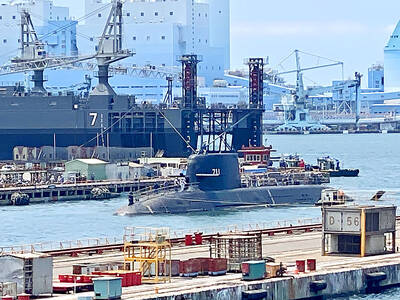
AGING: While Japan has 22 submarines, Taiwan only operates four, two of which were commissioned by the US in 1945 and 1946, and transferred to Taiwan in 1973 Taiwan would need at least 12 submarines to reach modern fleet capabilities, CSBC Corp, Taiwan chairman Chen Cheng-hung (陳政宏) said in an interview broadcast on Friday, citing a US assessment. CSBC is testing the nation’s first indigenous defense submarine, the Hai Kun (海鯤, Narwhal), which is scheduled to be delivered to the navy next month or in July. The Hai Kun has completed torpedo-firing tests and is scheduled to undergo overnight sea trials, Chen said on an SET TV military affairs program. Taiwan would require at least 12 submarines to establish a modern submarine force after assessing the nation’s operational environment and defense

A white king snake that frightened passengers and caused a stir on a Taipei MRT train on Friday evening has been claimed by its owner, who would be fined, Taipei Rapid Transit Corp (TRTC) said yesterday. A person on Threads posted that he thought he was lucky to find an empty row of seats on Friday after boarding a train on the Bannan (Blue) Line, only to spot a white snake with black stripes after sitting down. Startled, he jumped up, he wrote, describing the encounter as “terrifying.” “Taipei’s rat control plan: Release snakes on the metro,” one person wrote in reply, referring
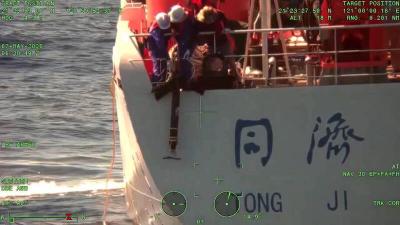
The coast guard today said that it had disrupted "illegal" operations by a Chinese research ship in waters close to the nation and driven it away, part of what Taipei sees a provocative pattern of China's stepped up maritime activities. The coast guard said that it on Thursday last week detected the Chinese ship Tongji (同濟號), which was commissioned only last year, 29 nautical miles (54km) southeast of the southern tip of Taiwan, although just outside restricted waters. The ship was observed lowering ropes into the water, suspected to be the deployment of scientific instruments for "illegal" survey operations, and the coast
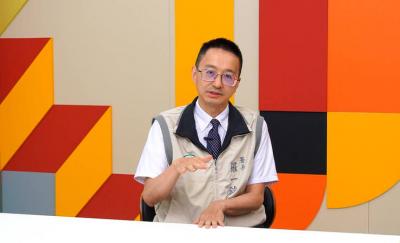
Taiwan’s two cases of hantavirus so far this year are on par with previous years’ case numbers, and the government is coordinating rat extermination work, so there should not be any outbreaks, Centers for Disease Control (CDC) Director-General Philip Lo (羅一鈞) said today in an interview with the Liberty Times (the Taipei Times’ sister newspaper). An increase in rat sightings in Taipei and New Taipei City has raised concerns about the spread of hantavirus, as rats can carry the disease. In January, a man in his 70s who lived in Taipei’s Daan District (大安) tested positive posthumously for hantavirus, Taiwan’s


 RSS
RSS