


Prosecutors yesterday rejected accusations of political persecution by former Chinese Nationalist Party (KMT) legislator Yen Kuan-heng (顏寬恒) following his indictment.
“We completed the investigation before bringing charges against the defendants, based on evidence and facts. The matter is now in the hands of the court,” Taichung District Prosecutors’ Office Deputy Chief Prosecutor Chan Chang-hui (詹常輝) said.
“We will not respond to the remarks Yen made during a news conference earlier in the day,” Chan said.
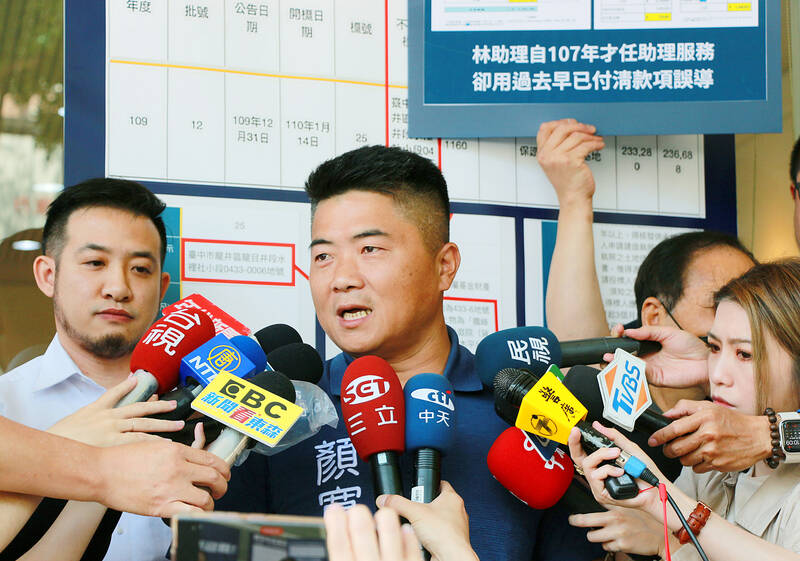
Photo: CNA
Yen and his wife, Chen Li-ling (陳麗淩), were on Wednesday indicted on charges of corruption and forgery.
They have been accused of fabricating documents and receipts to pocket the wages of an office assistant when Yen served as KMT legislator from 2016 to 2020.
They have also been accused of fraudulent transactions and illegal acquisition of public land to build a luxury mansion in Taichung, valued at about NT$90 million (US$2.93 million).
Yen told the news conference in Taichung that he was facing “trumped-up charges” and was targeted by the prosecutors for political persecution.
He also denied the accusations leveled against him and his wife.
“The indictment is clearly politically motivated,” Yen said.
“I will not tolerate prosecutors attacking me personally. I must defend my innocence. I will fight for the opportunity to serve my constituents,” he said.
KMT spokesperson Lu Ching-wei (呂謦煒) supported Yen.
“We ask the justice system to uphold fairness and conduct the trial with transparency,” he said.
Democratic Progressive Party (DPP) Legislator Lin Ching-yi (林靜儀), who defeated Yen in last year’s by-election to represent Taichung’s second electoral district, said Yen should respect the results of the investigation, and not claim political persecution when evidence points to contraventions of the law.

Considering that most countries issue more than five denominations of banknotes, the central bank has decided to redesign all five denominations, the bank said as it prepares for the first major overhaul of the banknotes in more than 24 years. Central bank Governor Yang Chin-lung (楊金龍) is expected to report to the Legislative Yuan today on the bank’s operations and the redesign’s progress. The bank in a report sent to the legislature ahead of today’s meeting said it had commissioned a survey on the public’s preferences. Survey results showed that NT$100 and NT$1,000 banknotes are the most commonly used, while NT$200 and NT$2,000

The Centers for Disease Control (CDC) yesterday reported the first case of a new COVID-19 subvariant — BA.3.2 — in a 10-year-old Singaporean girl who had a fever upon arrival in Taiwan and tested positive for the disease. The girl left Taiwan on March 20 and the case did not have a direct impact on the local community, it said. The WHO added the BA.3.2 strain to its list of Variants Under Monitoring in December last year, but this was the first imported case of the COVID-19 variant in Taiwan, CDC Deputy Director-General Lin Ming-cheng (林明誠) said. The girl arrived in Taiwan on

South Korea is planning to revise its controversial electronic arrival card, a step Taiwanese officials said prompted them to hold off on planned retaliatory measures, a South Korean media report said yesterday. A Yonhap News Agency report said that the South Korean Ministry of Foreign Affairs is planning to remove the “previous departure place” and “next destination” fields from its e-arrival card system. The plan, reached after interagency consultations, is under review and aims to simplify entry procedures and align the electronic form with the paper version, a South Korean ministry official said. The fields — which appeared only on the electronic form

The Ministry of Foreign Affairs (MOFA) is suspending retaliation measures against South Korea that were set to take effect tomorrow, after Seoul said it is updating its e-arrival system, MOFA said today. The measures were to be a new round of retaliation after Taiwan on March 1 changed South Korea's designation on government-issued alien resident certificates held by South Korean nationals to "South Korea” from the "Republic of Korea," the country’s official name. The move came after months of protests to Seoul over its listing of Taiwan as "China (Taiwan)" in dropdown menus on its new online immigration entry system. MOFA last week


 RSS
RSS