


The Mainland Affairs Council (MAC) yesterday said former president Ma Ying-jeou’s (馬英九) comments at the Delphi Economic Forum were unbecoming of his status. The council said it regretted that Ma acted in an unpresidential manner while attending an event in Greece.
Ma on Friday criticized President Tsai Ing-wen (蔡英文) at the forum, and said her comments over the past three years have contravened the Act Governing Relations Between the People of the Taiwan Area and the Mainland Area (臺灣地區與大陸地區人民關係條例) and failed to meet her oath to follow and abide by the Constitution.
Ma said he was referring to Tsai twice stating that “the People’s Republic of China and the Republic of China are two separate entities that existed independently of each other.”
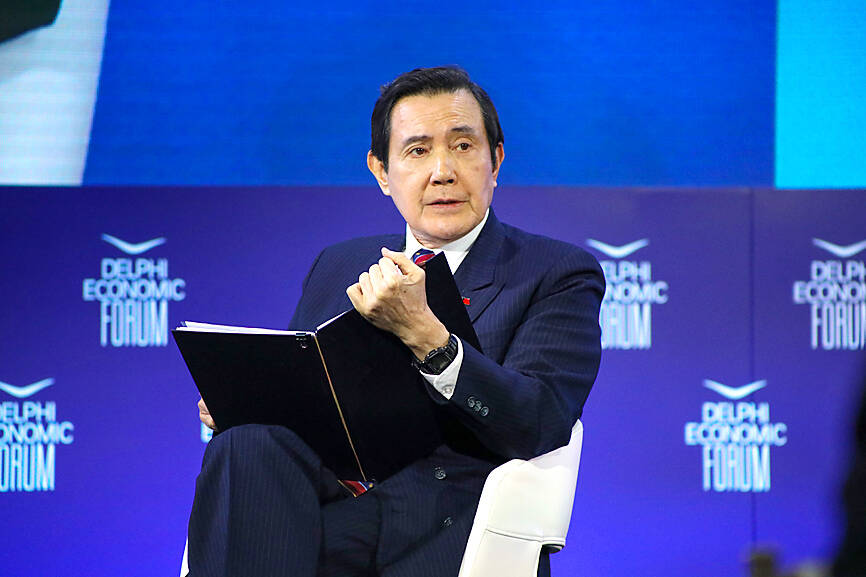
Photo courtesy of Ma Ying-jeou’s Office via CNA
The MAC said Ma’s interpretation of the Constitution was his reading, and Ma should not have cited personal opinions as grounds to attack a sitting Taiwanese president at a foreign event.
Taiwan must uphold the nation’s sovereignty and its democratic way of government, and has refused Beijing’s demands to accept its “one China” principle, which is the cause for suspended semi-official cross-strait interactions, the MAC said.
The MAC accused Ma of “pandering” to Beijing at an event where attendees were not familiar with the cross-strait situation.
Ma should “not forget” that during his 2015 meeting with Chinese President Xi Jinping (習近平), he “bowed to Beijing’s pressure” not to discuss that “each side has its own interpretation of what ‘China’ means,” a staple of Chinese Nationalist Party (KMT) ideology.
The MAC said that Ma was setting himself up to become a “national pariah,” and urged the nation to be united in upholding Taiwan’s dignity.
Ma spokesperson Hsiao Hsu-tsen (蕭旭岑) yesterday said that only by observing the Constitution and maintaining that both sides of the Taiwan Strait are not separate countries could Taiwan’s interests be observed.
Ma’s comments at the forum “reflect a majority opinion in Taiwan” for cross-strait relations to be peaceful, Hsiao said.
The MAC was behaving like “crazed dogs” to prevent the international community from hearing what Ma has to say, he added.
If Tsai’s comments that “neither side of the Taiwan Strait belongs to the other” held true, the MAC serves no function, as the Ministry of Foreign Affairs handles state-to-state relations, and should be disbanded by Tsai’s own logic, Hsiao said.

The military has spotted two Chinese warships operating in waters near Penghu County in the Taiwan Strait and sent its own naval and air forces to monitor the vessels, the Ministry of National Defense (MND) said. Beijing sends warships and warplanes into the waters and skies around Taiwan on an almost daily basis, drawing condemnation from Taipei. While the ministry offers daily updates on the locations of Chinese military aircraft, it only rarely gives details of where Chinese warships are operating, generally only when it detects aircraft carriers, as happened last week. A Chinese destroyer and a frigate entered waters to the southwest

A magnitude 6.1 earthquake struck off the coast of Yilan County at 8:39pm tonight, the Central Weather Administration (CWA) said, with no immediate reports of damage or injuries. The epicenter was 38.7km east-northeast of Yilan County Hall at a focal depth of 98.3km, the CWA’s Seismological Center said. The quake’s maximum intensity, which gauges the actual physical effect of a seismic event, was a level 4 on Taiwan’s 7-tier intensity scale, the center said. That intensity level was recorded in Yilan County’s Nanao Township (南澳), Hsinchu County’s Guansi Township (關西), Nantou County’s Hehuanshan (合歡山) and Hualien County’s Yanliao (鹽寮). An intensity of 3 was

Japanese Prime Minister Sanae Takaichi’s comment last year on Tokyo’s potential reaction to a Taiwan-China conflict has forced Beijing to rewrite its invasion plans, a retired Japanese general said. Takaichi told the Diet on Nov. 7 last year that a Chinese naval blockade or military attack on Taiwan could constitute a “survival-threatening situation” for Japan, potentially allowing Tokyo to exercise its right to collective self-defense. Former Japan Ground Self-Defense Force general Kiyofumi Ogawa said in a recent speech that the remark has been interpreted as meaning Japan could intervene in the early stages of a Taiwan Strait conflict, undermining China’s previous assumptions
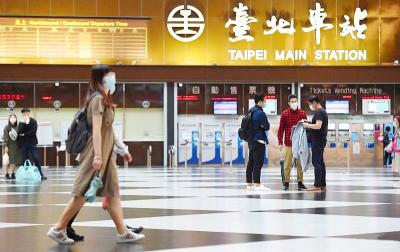
Taiwan Railways Corp (TRC) today announced that Shin Kong Mitsukoshi has been selected as the preferred bidder to operate the Taipei Railway Station shopping mall, replacing the current operator, Breeze Development Co Ltd. Among eight qualified firms that delivered presentations and were evaluated by a review committee, Shin Kong Mitsukoshi was ranked first, while Breeze was named the runner-up, the rail company said in a statement. Contract negotiations are to proceed in accordance with regulations, it said, adding that if negotiations with the top bidder fail, it could invite the second-ranked applicant to enter talks. Breeze in a statement today expressed doubts over


 RSS
RSS