


Taiwan People’s Party Chairman (TPP) Ko Wen-je (柯文哲) on Wednesday said he met with US National Security Council officials during a visit to the American Institute in Taiwan (AIT) headquarters in Washington.
Ko told reporters in Washington that he had met AIT Chair Laura Rosenberger during a visit to AIT headquarters on Thursday last week and on Wednesday met with US security officials to discuss Taiwan’s national defense and cross-strait issues.
When he was asked by reporters whom he met, his aide was heard telling him to “only say that you spoke with high-level US officials, as both sides have agreed to keep the names confidential.”
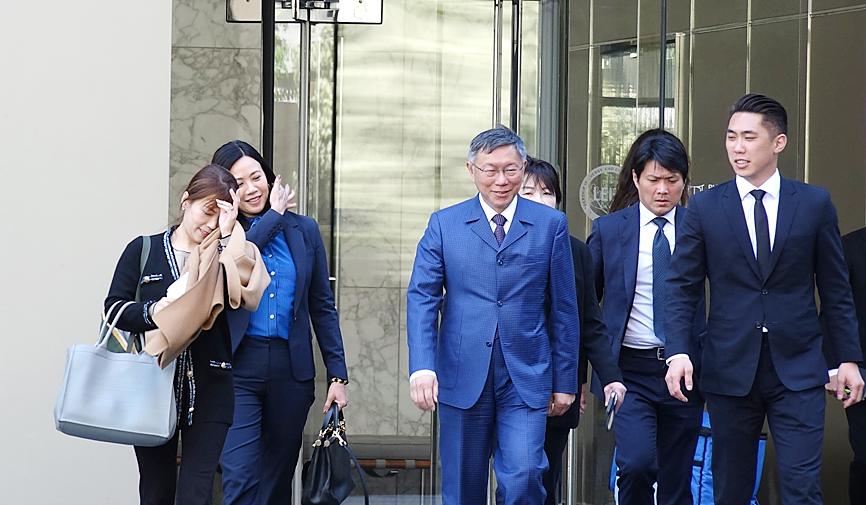
Photo: CNA
However, AIT Political-Military Affairs Director Matthew Tritle was seen at AIT headquarters during Ko’s visit.
The meeting — which also touched upon Taiwan’s procurement of arms from the US, compulsory military service in Taiwan and other related issues — was “very informative,” Ko said.
He said he told US officials at the meeting that while Taiwan should continue to focus on national defense, its priority should be economic growth, adding that he hoped the US would assist Taiwan in joining regional economic organizations.
The former Taipei mayor also said that Taiwan, the US and China should maintain good communication, and that the “status quo” in the Taiwan Strait should not be unilaterally changed.
In the afternoon, Ko met with US Congressional Taiwan Caucus cochair Mario Diaz-Balart, thanking him and the caucus for their long-term support for Taiwan, and for facilitating cross-party cooperation on Taiwan-related issues.
Ko also met with former AIT deputy director David Keegan at Johns Hopkins University, where Keegan is an adjunct lecturer in the Chinese studies program.
Ko said he told Keegan that Beijing’s “one China” policy is not a problem, as “nobody in the world thinks there are two Chinas.”
However, problems exist with China’s interpretation of the so-called “1992 consensus,” which Beijing interprets to mean that the People’s Republic of China (PRC) is the only legitimate representative of China, and that Taiwan is part of the PRC, he said.
As China has failed to properly explain its interpretation of the “1992 consensus” to Taiwan, causing it to become stigmatized in Taiwan, Beijing should no longer insist that Taiwan adhere to it, he said.
The “1992 consensus” — a term that former Mainland Affairs Council chairman Su Chi (蘇起) in 2006 admitted making up in 2000 — refers to a tacit understanding between the Chinese Nationalist Party (KMT) and the Chinese Communist Party that both sides of the Taiwan Strait acknowledge that there is “one China,” with each side having its own interpretation of what “China” means.

Considering that most countries issue more than five denominations of banknotes, the central bank has decided to redesign all five denominations, the bank said as it prepares for the first major overhaul of the banknotes in more than 24 years. Central bank Governor Yang Chin-lung (楊金龍) is expected to report to the Legislative Yuan today on the bank’s operations and the redesign’s progress. The bank in a report sent to the legislature ahead of today’s meeting said it had commissioned a survey on the public’s preferences. Survey results showed that NT$100 and NT$1,000 banknotes are the most commonly used, while NT$200 and NT$2,000

The Centers for Disease Control (CDC) yesterday reported the first case of a new COVID-19 subvariant — BA.3.2 — in a 10-year-old Singaporean girl who had a fever upon arrival in Taiwan and tested positive for the disease. The girl left Taiwan on March 20 and the case did not have a direct impact on the local community, it said. The WHO added the BA.3.2 strain to its list of Variants Under Monitoring in December last year, but this was the first imported case of the COVID-19 variant in Taiwan, CDC Deputy Director-General Lin Ming-cheng (林明誠) said. The girl arrived in Taiwan on

South Korea is planning to revise its controversial electronic arrival card, a step Taiwanese officials said prompted them to hold off on planned retaliatory measures, a South Korean media report said yesterday. A Yonhap News Agency report said that the South Korean Ministry of Foreign Affairs is planning to remove the “previous departure place” and “next destination” fields from its e-arrival card system. The plan, reached after interagency consultations, is under review and aims to simplify entry procedures and align the electronic form with the paper version, a South Korean ministry official said. The fields — which appeared only on the electronic form

The Ministry of Foreign Affairs (MOFA) is suspending retaliation measures against South Korea that were set to take effect tomorrow, after Seoul said it is updating its e-arrival system, MOFA said today. The measures were to be a new round of retaliation after Taiwan on March 1 changed South Korea's designation on government-issued alien resident certificates held by South Korean nationals to "South Korea” from the "Republic of Korea," the country’s official name. The move came after months of protests to Seoul over its listing of Taiwan as "China (Taiwan)" in dropdown menus on its new online immigration entry system. MOFA last week


 RSS
RSS