


About 67 percent of Taiwanese consider China to be more of a threat to the nation than the US, a survey conducted by the Asia-Pacific Elite Interchange Association showed yesterday.
The poll was conducted after President Tsai Ing-wen (蔡英文) and former president Ma Ying-jeou (馬英九) concluded their respective visits to the US and China.
About 53 percent of respondents said that the US shares similar interests with Taiwan, while 51 percent said Taiwan could not afford to distance itself from the US and China.
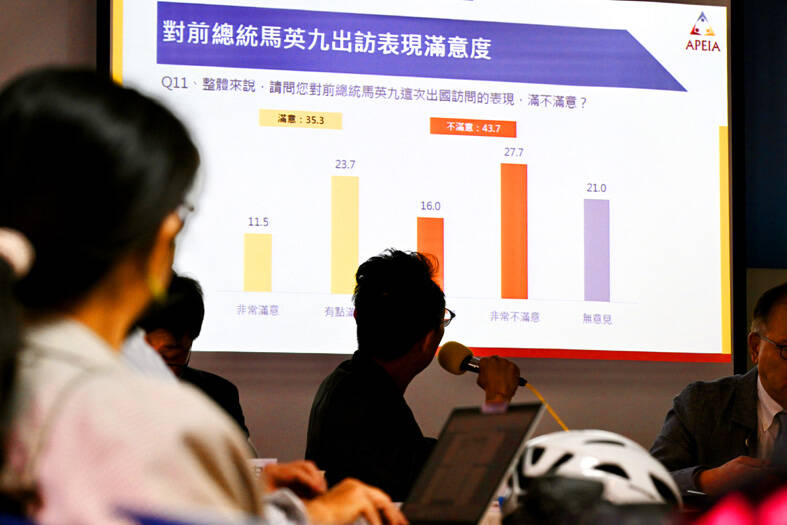
Photo: George Tsorng, Taipei Times
Responding to the poll’s hypothetical question of whom they would choose if forced to pick between the US and China, 60.8 percent sided with Washington, while only 25 percent said they wished to maintain closer ties with Beijing.
Tsai’s stopovers in the US before and after her visit to Central American allies received general public acclaim, with 61.6 percent of respondents saying the visits helped improve Taiwan-US relations, and 72.2 percent saying the president’s international visits helped increase Taiwan’s international profile.
About 80 percent of respondents said they were proud to be Taiwanese, the poll showed.
Comparing the visits by Tsai and Ma, 47.9 percent of respondents said Tsai fared better, while 25 percent said that Ma performed better.
Asked to consider the visits separately, 60.6 percent were satisfied with Tsai’s performance during her visit, while only 35 percent were satisfied with Ma’s.
Association secretary-general Wang Chih-sheng (王智盛) said the results of the survey showed that Taiwanese favor the US over China, adding that they might serve as a reference basis for cross-strait policies proposed by the candidates in next year’s presidential election.
The poll was conducted on Monday and Tuesday via random landline telephone sampling, targeting citizens aged 20 or above across the nation’s 22 municipalities.
The results had a confidence level of 95 percent and a margin of error of 3.1 percentage points.
Additional weighting was given to poll data based on the respondents’ place of residence, gender and age, all of which referenced a January report by the Ministry of the Interior’s Department of Household Registration.
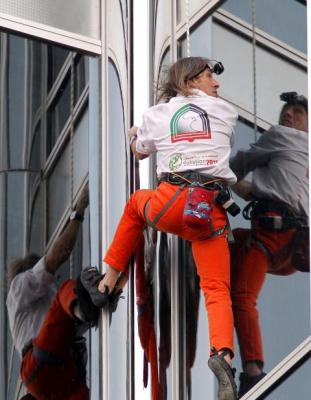
Alain Robert, known as the "French Spider-Man," praised Alex Honnold as exceptionally well-prepared after the US climber completed a free solo ascent of Taipei 101 yesterday. Robert said Honnold's ascent of the 508m-tall skyscraper in just more than one-and-a-half hours without using safety ropes or equipment was a remarkable achievement. "This is my life," he said in an interview conducted in French, adding that he liked the feeling of being "on the edge of danger." The 63-year-old Frenchman climbed Taipei 101 using ropes in December 2004, taking about four hours to reach the top. On a one-to-10 scale of difficulty, Robert said Taipei 101

Nipah virus infection is to be officially listed as a category 5 notifiable infectious disease in Taiwan in March, while clinical treatment guidelines are being formulated, the Centers for Disease Control (CDC) said yesterday. With Nipah infections being reported in other countries and considering its relatively high fatality rate, the centers on Jan. 16 announced that it would be listed as a notifiable infectious disease to bolster the nation’s systematic early warning system and increase public awareness, the CDC said. Bangladesh reported four fatal cases last year in separate districts, with three linked to raw date palm sap consumption, CDC Epidemic Intelligence
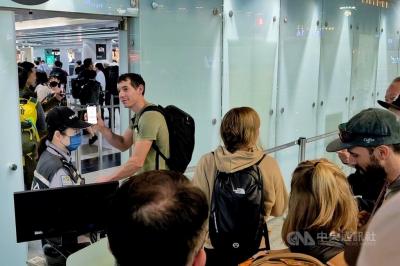
US climber Alex Honnold left Taiwan this morning a day after completing a free-solo ascent of Taipei 101, a feat that drew cheers from onlookers and gained widespread international attention. Honnold yesterday scaled the 101-story skyscraper without a rope or safety harness. The climb — the highest urban free-solo ascent ever attempted — took just more than 90 minutes and was streamed live on Netflix. It was covered by major international news outlets including CNN, the New York Times, the Guardian and the Wall Street Journal. As Honnold prepared to leave Taiwan today, he attracted a crowd when he and his wife, Sanni,
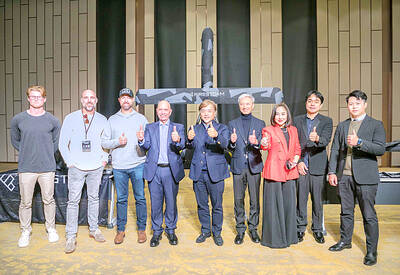
Taiwanese and US defense groups are collaborating to introduce deployable, semi-autonomous manufacturing systems for drones and components in a boost to the nation’s supply chain resilience. Taiwan’s G-Tech Optroelectronics Corp subsidiary GTOC and the US’ Aerkomm Inc on Friday announced an agreement with fellow US-based Firestorm Lab to adopt the latter’s xCell, a technology featuring 3D printers fitted in 6.1m container units. The systems enable aerial platforms and parts to be produced in high volumes from dispersed nodes capable of rapid redeployment, to minimize the risk of enemy strikes and to meet field requirements, they said. Firestorm chief technology officer Ian Muceus said


 RSS
RSS