


Private businesses could be fined up to NT$10 million (US$327,912) for failing to take proper action to safeguard personal data security, the Executive Yuan said yesterday.
The amendment to the Personal Data Protection Act (個人資料保護法), which was approved at the weekly Cabinet meeting yesterday morning, was proposed after personal data breaches were reported at China Airlines, Breeze Center, and vehicle-sharing service operator iRent.
“Currently, private businesses must first be asked to address the data breaches and would only be fined if the breaches persist. The amendment would authorize the government to impose fines directly and raise the penalty up to NT$10 million,” said Yang Shu-ling (楊淑玲), director of the Department of Regulatory Reform at the National Development Council.
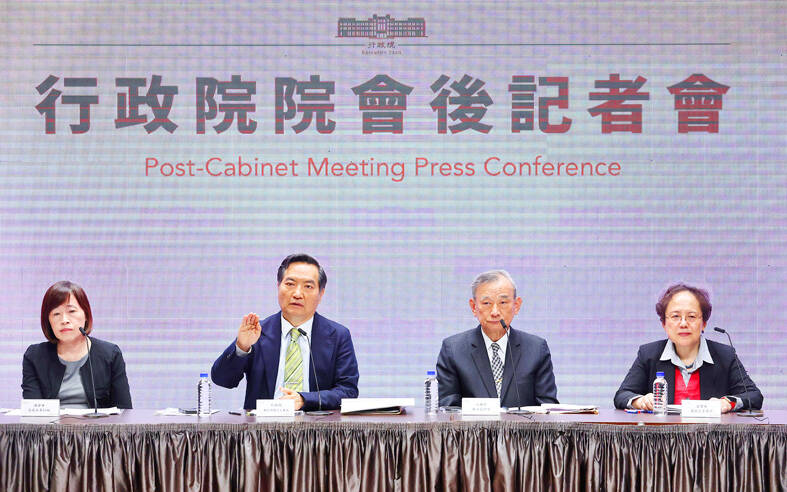
Photo: CNA
The amendment stipulates that private organizations or businesses would be fined NT$20,000 to NT$2 million if their negligence leads to data breaches and would be ordered to address the breaches within a designated period.
Those that fail to address data security issues by the deadline may be penalized consecutively, with the fine increasing to NT$100,000 to NT$10 million per data breach.
However, the starting fine for a major data breach would be NT$100,000 to NT$10 million, the amendment says.
Private businesses would be fined until the breaches are addressed, it says.
The amendment would also authorize the government to establish a personal data protection commission to enforce the Personal Data Protection Act.
“A preparatory office for the commission will first be established to stipulate temporary rules to help it handle cases of data breaches, as well as draft a personal data protection commission organic act,” NDC Deputy Minister Kao Shien-quey (高仙桂) said. “We hope the draft organic act would be deliberated during the first legislative session next year.”
The Cabinet also approved a proposed amendment to the Securities Investment Trust and Consulting Act (證券投資信託及顧問法) to deter investment scams on social media.
Many scammers post phishing ads on social media featuring Taiwanese celebrities to attract investors, Executive Yuan acting spokesman Lo Ping-cheng (羅秉成) told a news briefing after the Cabinet meeting.
“Although investment fraud cases were not the highest compared with other types of fraud, financial losses from investment fraud from last year to February [this year] topped NT$3.84 billion, accounting for half of total losses from fraud. As such, it is necessary to amend relevant regulations to deter it,” Lo said.
Financial Supervisory Commission Deputy Chairperson Hsiao Tsui-ling (蕭翠玲) said the amendment would require online advertisers or sponsors to disclose their real names and other information.
“Platform operators are obligated to review the advertisements in advance and must remove fraudulent ads after being notified. Platform operators and advertisers would be held jointly liable for financial losses reported by consumers if they fail to conduct due diligence ahead of time and fail to take down fraudulent ads after being notified,” she said.
However, platform operators might be exempt from joint liability if they did not intentionally show fraudulent ads on their platform, voluntarily removed the ads after being notified and did not make a profit from them, Hsiao said, adding that the commission would make a decision on a case-by-case basis.
Individuals or entities who are neither securities investment companies nor trust fund operators must not use such ads to mislead people that they are licensed to conduct investment activities, the amendment says.
“They are banned from falsely claiming endorsements by celebrities and organizations in their ads to attract investors,” it says. “The ads must not contain statements guaranteeing profits from the investment.”
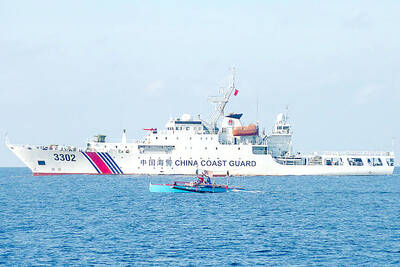
EXPANSIONIST: China deploys an average of 40 to 50 warships and coast guard vessels daily in the South China Sea, despite pledges not to militarize the region, an official said China is attempting to expand its influence across the First Island Chain and increase pressure on Japan by sending coast guard vessels into waters off of Taiwan under the pretext of maritime negotiations with Japan and the Philippines, a national security official said yesterday. China’s recent actions in the waters east of Taiwan and Japan and the Philippines’ exclusive economic zones (EEZ) are attempts to establish dominance in First Island Chain waters, said the official who declined to be named, adding that this is “expansion disguised as law enforcement.” Framing China’s actions solely as a cross-strait issue is a serious misjudgment that
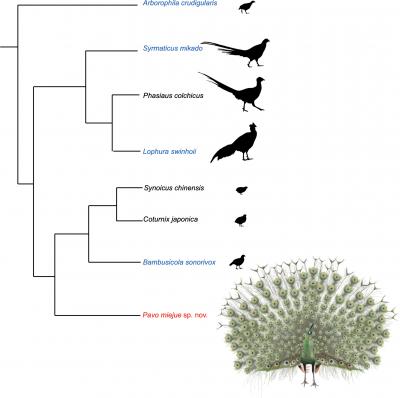
Through analyzing fossil evidence, a research team at National Taiwan University (NTU) discovered the largest endemic bird to have lived in Taiwan, naming it Pavo miejue, or extinct peafowl (滅絕孔雀). The Mikado pheasant, which is printed on the back of the NT$1,000 bank note, was previously believed to be the biggest endemic bird to Taiwan. The research team’s findings suggest that Pavo miejue lived during the Pleistocene epoch tens of thousands of years ago. It is the first endemic extinct bird species discovered and formally named in Taiwan. The study was coauthored by NTU Institute of Ecology and Evolutionary Biology professor Tsai Cheng-hsiu (蔡政修),
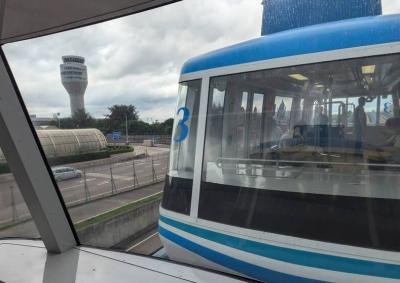
Taiwan Taoyuan International Airport is to suspend its automated Skytrain service connecting Terminal 1 and Terminal 2 starting on July 1 to facilitate connection works for the upcoming Terminal 3, the airport operator said today. Passengers and staff who need to travel between the two terminals after the suspension can instead use the Taoyuan MRT or the airport's 24-hour shuttle bus service, Taoyuan International Airport Corp said. The Taoyuan MRT Airport Line directly links the two terminals, while the shuttle buses are to operate around the clock, the company added. The Skytrain provides free transportation between the airport’s two terminals for travelers and
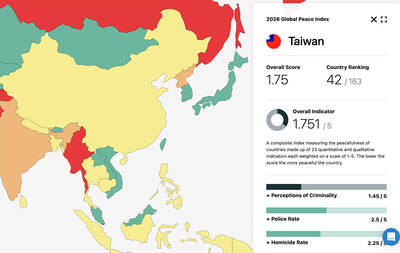
Taiwan ranked 42nd in terms of peacefulness among 163 countries, down five places from last year, according to this year’s Global Peace Index. With an overall score of 1.751, Taiwan dropped from 37th last year, the report published by the global Institute for Economics and Peace showed. The overall score measures a country’s level of peacefulness using 23 quantitative and qualitative indicators across three domains — ongoing domestic and international conflict, societal safety and security, and militarization. While Taiwan ranked 42nd worldwide, it was listed in ninth place among the 19 Asian-Pacific countries in the report, after New Zealand, Singapore, Japan, Malaysia,


 RSS
RSS