


The Council of Agriculture’s egg import policy was designed to benefit chain stores, Chinese Nationalist Party (KMT) Taipei City Councilor Hsu Chiao-hsin (徐巧芯) said on Thursday.
After the policy was introduced, 5.5 million eggs were imported last month to address a shortage in northern Taiwan.
The council said that the nation would import 30 million eggs this month and next month.
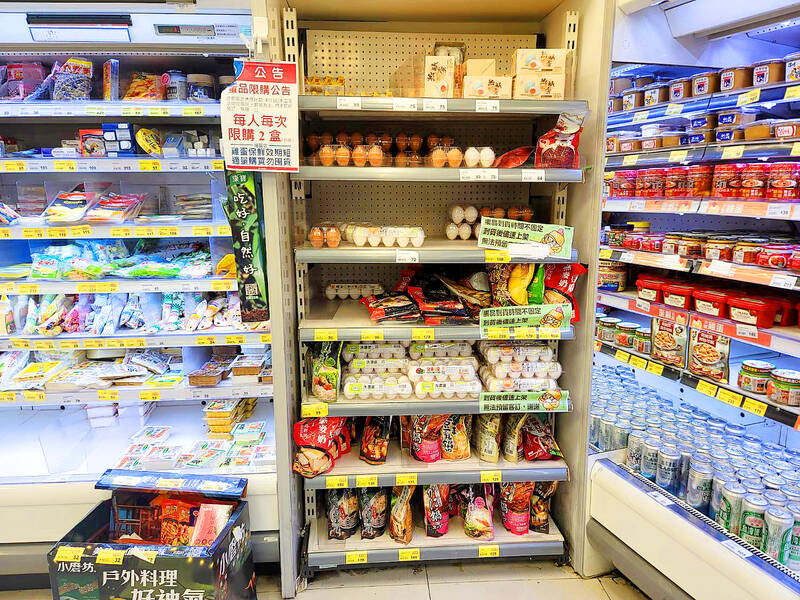
Photo: Yeh Yung-chien, Taipei Times
When introducing the policy, the council said that the imported eggs would be sold at chain stores for NT$65 per 10-egg crate, adding that it would absorb any price differences.
However, not all store chains can obtain the eggs, Hsu said, adding that prices are fluctuating.
She said that the eggs are sold for NT$68 at Pxmart, NT$69 at A-Mart and NT$65 to NT$79 at Simple Mart.
The import program is funded with taxpayer money, but the distribution is limited to certain stores, which can buy the eggs cheap and sell them at a profit, she said.
Hsu said the program is unfair, as it benefits chain markets.
The council said that it drafted the program based on consumers’ needs and that surplus eggs are offered to smaller stores.
Department of Animal Industry Deputy Director Chiang Wen-chuan (江文全) said that 50 percent of domestic eggs are made available to the restaurant and food industries, while 25 percent go to convenience stores and supermarkets, 15 percent to schools and the military, and 5 percent each to traditional markets and smaller stores.
The import program was designed to address shortages in any of the marketing channels, he said, adding that it prioritizes retailers, as this would benefit consumers most.
There is no favoritism, he added.
Chiang said the council has also traded imported eggs for eggs stored at processed food plants.
The council said the distribution of imported eggs is based on market data and pricing, adding that the mechanism was suggested by the Taipei Egg Retailers’ Union.
The eggs are clearly labeled to inform consumers where they are from, it said
The policy seeks to ensure that people can buy eggs for acceptable prices, while not affecting the business of egg farmers, it added.

Considering that most countries issue more than five denominations of banknotes, the central bank has decided to redesign all five denominations, the bank said as it prepares for the first major overhaul of the banknotes in more than 24 years. Central bank Governor Yang Chin-lung (楊金龍) is expected to report to the Legislative Yuan today on the bank’s operations and the redesign’s progress. The bank in a report sent to the legislature ahead of today’s meeting said it had commissioned a survey on the public’s preferences. Survey results showed that NT$100 and NT$1,000 banknotes are the most commonly used, while NT$200 and NT$2,000

The Centers for Disease Control (CDC) yesterday reported the first case of a new COVID-19 subvariant — BA.3.2 — in a 10-year-old Singaporean girl who had a fever upon arrival in Taiwan and tested positive for the disease. The girl left Taiwan on March 20 and the case did not have a direct impact on the local community, it said. The WHO added the BA.3.2 strain to its list of Variants Under Monitoring in December last year, but this was the first imported case of the COVID-19 variant in Taiwan, CDC Deputy Director-General Lin Ming-cheng (林明誠) said. The girl arrived in Taiwan on

South Korea is planning to revise its controversial electronic arrival card, a step Taiwanese officials said prompted them to hold off on planned retaliatory measures, a South Korean media report said yesterday. A Yonhap News Agency report said that the South Korean Ministry of Foreign Affairs is planning to remove the “previous departure place” and “next destination” fields from its e-arrival card system. The plan, reached after interagency consultations, is under review and aims to simplify entry procedures and align the electronic form with the paper version, a South Korean ministry official said. The fields — which appeared only on the electronic form

The Ministry of Foreign Affairs (MOFA) is suspending retaliation measures against South Korea that were set to take effect tomorrow, after Seoul said it is updating its e-arrival system, MOFA said today. The measures were to be a new round of retaliation after Taiwan on March 1 changed South Korea's designation on government-issued alien resident certificates held by South Korean nationals to "South Korea” from the "Republic of Korea," the country’s official name. The move came after months of protests to Seoul over its listing of Taiwan as "China (Taiwan)" in dropdown menus on its new online immigration entry system. MOFA last week


 RSS
RSS