


Taiwan Statebuilding Party (TSP) members on Friday accused the Ministry of National Defense of creating a “make-believe” civil defense handbook, given that the document contains dead Internet links and telephone numbers to canceled hotlines.
The handbook sparked controversy after it was published last year, prompting criticism that it had thin content and offered unrealistic recommendations.
Minister of National Defense Chiu Kuo-cheng (邱國正) promised at the time that mistakes in the handbook would be rectified, but the document shows no sign of improvement one year later, Taiwan Statebuilding Party Kaohsiung City Councilor Chang Po-yang (張博洋) told reporters in Taipei.
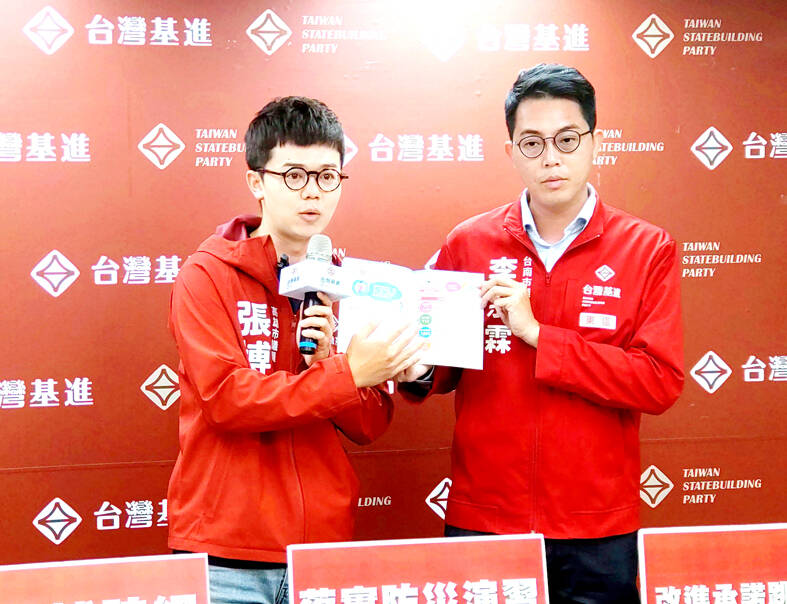
Photo: Yang Cheng-yu, Taipei Times
QR codes in the handbook meant to access important information do not work, and the 1991 hotline for people to report that they are are safe does not connect anywhere, he said.
The manual offers no information on how civilians can ensure their safety if they are caught amid gunfire, he added.
The manual does not include instruction on safety tasks for civilians during wartime or a code of conduct for civilians in an active war zone, a problem that has not been amended since the book’s publication, Chang said.
The central government offered no clear guidelines after telling local governments that they must adapt the manual for local needs, which hamstrung city and county-level efforts to write regional editions of the handbook, he said.
Assigning responsibility for conducting civil defense tasks to the National Conscription Agency and the civil affairs departments of local governments was a mistake, as personnel at the agencies have no training or knowledge in military affairs, he added.
Citing Kaohsiung as an example, Chang said funding was lacking and the 2,500 civil defense personnel had a small annual budget of NT$100,000 for training.
The ministry’s “negligence” and “laziness” in writing the handbook cast doubt on its ability to “manage a war even on paper,” said Tainan City Councilor Lee Chong-lim (李宗霖), who represents the TSP.
Watchout and other advocacy groups have translated foreign civil defense manuals, including one from Ukraine, which provide instructions on handling information and hybrid warfare, as well as guidelines to help civilians protect themselves in a war zone, Lee said.
President Tsai Ing-wen (蔡英文) has had seven years to fix the problems left by her predecessor, former president Ma Ying-jeou (馬英九), but she has not done so, he added.
The ministry later in the day said that 10 interdepartmental discussions and two expert panels had been convened to amend the handbook since the first edition’s publication, adding that an updated manual would be published soon.
Additional reporting by Wu Su-wei
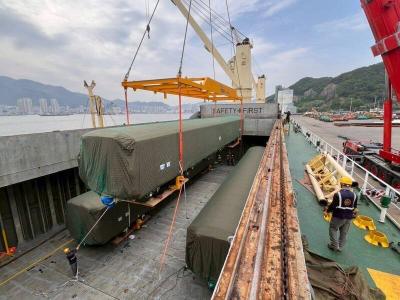
The first of 10 new high-capacity trains purchased from South Korea’s Hyundai Rotem arrived at the Port of Taipei yesterday to meet the demands of an expanding metro network, Taipei Rapid Transit Corp (TRTC) said yesterday. The train completed a three-day, 1,200km voyage from the Port of Masan in South Korea, the company said. Costing NT$590 million (US$18.79 million) each, the new six-carriage trains feature a redesigned interior based on "human-centric" transportation concepts, TRTC said. The design utilizes continuous longitudinal seating to widen the aisles and optimize passenger flow, while also upgrading passenger information displays and driving control systems for a more comfortable
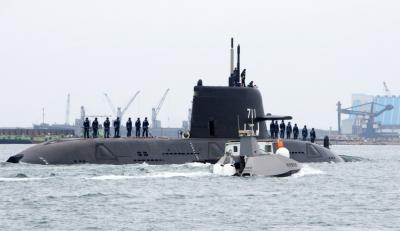
Taiwan's first indigenous defense submarine, the SS-711 Hai Kun (海鯤, or Narwhal), departed for its 13th sea trial at 7am today, marking its seventh submerged test, with delivery to the navy scheduled for July. The outing also marked its first sea deployment since President William Lai (賴清德) boarded the submarine for an inspection on March 19, drawing a crowd of military enthusiasts who gathered to show support. The submarine this morning departed port accompanied by CSBC Corp’s Endeavor Manta (奮進魔鬼魚號) uncrewed surface vessel and a navy M109 assault boat. Amid public interest in key milestones such as torpedo-launching operations and overnight submerged trials,
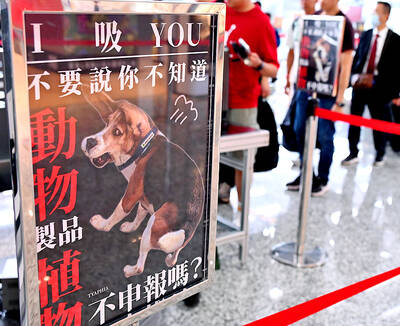
Quarantine awareness posters at Taiwan Taoyuan International Airport have gone viral for their use of wordplay. Issued by the airport branch of the Animal and Plant Health Inspection Agency, the posters feature sniffer dogs making a range of facial expressions, paired with advisory messages built around homophones. “We update the messages for holidays and campaign needs, periodically refreshing materials to attract people’s attention,” quarantine officials said. “The aim is to use the dogs’ appeal to draw focus to quarantine regulations.” A Japanese traveler visiting Taiwan has posted a photo on X of a poster showing a quarantine dog with a

Taiwan’s coffee community has launched a “one-person-one-e-mail” campaign, calling for people to send a protest-e-mail to the World Coffee Championships (WCC) urging it to redesignate Taiwanese competitors as from “Taiwan,” rather than “Chinese Taipei.” The call followed sudden action last week after the WCC changed all references to Taiwanese competitors from “Taiwan” to “Chinese Taipei,” including recent World Latte Art champion Bala (林紹興), who won the World Latte Art Championship in San Diego earlier this month. When Bala received the trophy, he was referred to as representing Taiwan, as well as in the announcement on the WCC’s Web site, until it


 RSS
RSS