


Taiwan’s transformation to green energy and sustainable development is behind schedule due to corruption, Taiwan People’s Party (TPP) lawmakers said on Friday.
Delays on solar and wind energy projects have been hindered by collusion between government officials, corporations and “criminal elements,” they said.
The government plans to have energy from renewable sources constitute 20 percent of power generation by 2025, with carbon emissions reaching net zero by 2050. About NT$900 billion (US$29.62 billion) has been pledged toward climate change goals until 2030.

Photo: CNA
“In the drive to push for green energy, government agencies are using solar and wind power projects to grant favors to a few big conglomerates that are colluding with criminal elements,” TPP Legislator Jang Chyi-lu (張其祿) told a news conference at the Legislative Yuan in Taipei.
Conglomerates are receiving subsidies and incentives for renewable energy projects in which generated power could be sold to state-run Taiwan Power Co at high prices, he said.
These businesses have an “inside track” to “excessive profits” through “special connections to local government officials,” Jang said.
There has been “fierce competition between rival parties” to gain licenses and permission, leading to collusion between “local county and city governments, local councils, state enterprises and public-sector companies” for financial benefit, he said.
The alleged collusion also involves “wealthy families with political clout, special interest bodies, gangsters and organized crime elements,” in which “under-the-table deals, corruption and bribes,” and even “intimidation and violence against legitimate companies and rival interests” occur, Jang said.
The end result is “rent seeking” by these entities “without reciprocal contribution of productivity,” he said.
TPP Legislator Chen Wan-hui (陳琬惠) called these entities “green energy cockroaches,” citing records from the High Prosecutors’ Office that showed it had launched 60 investigations into alleged corruption and bribery regarding renewable energy projects, in which charges have been pressed against 66 people and 18 others were detained.
Although the intentions behind green energy projects are good, “local politicians are colluding with state enterprises and big business for corruption and illegal financial benefit,” she said.
“These entities are tied to gangsters and criminal elements to form a well-connected ‘green energy elite group’ that profits at public expense,” Chen said.
Jang and Chen called on fellow lawmakers to amend laws to provide stringent regulations to govern green energy projects and net zero emission targets.
They also urged the judiciary and law enforcement agencies to “clamp down on criminal elements” that interfere in these projects.

Yangmingshan National Park authorities yesterday urged visitors to respect public spaces and obey the law after a couple was caught on a camera livestream having sex at the park’s Qingtiangang (擎天崗) earlier in the day. The Shilin Police Precinct in Taipei said it has identified a suspect and his vehicle registration number, and would summon him for questioning. The case would be handled in accordance with public indecency charges, it added. The couple entered the park at about 11pm on Thursday and began fooling around by 1am yesterday, the police said, adding that the two were unaware of the park’s all-day live

Fast food chain McDonald's is to raise prices by up to NT$5 on some products at its restaurants across Taiwan, starting on Wednesday next week, the company announced today. The prices of all extra value meals and sharing boxes are to increase by NT$5, while breakfast combos and creamy corn soup would go up by NT$3, the company said in a statement. The price of the main items of those meals, if ordered individually, would remain the same. Meanwhile, the price of a medium-sized lemon iced tea and hot cappuccino would rise by NT$3, extra dipping sauces for chicken nuggets would go up
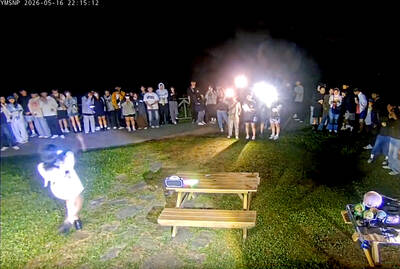
Yangmingshan National Park’s Qingtiangang (擎天崗) nature area has gone viral after a park livestream camera observed a couple in the throes of intimate congress, which was broadcast live on YouTube, drawing large late-night crowds and sparking a backlash over noise, bright lights and disruption to wildlife habitat. The area’s livestream footage appeared to show a couple engaging in sexual activity on a picnic table in the park on Friday last week, with the uncensored footage streamed publicly online. The footage quickly spread across social media, prompting a tide of visitors to travel to the site to “check in” and recreate the

Minister of Digital Affairs Lin Yi-ching (林宜敬) yesterday cited regulatory issues and national security concerns as an expert said that Taiwan is among the few Asian regions without Starlink. Lin made the remarks on Facebook after funP Innovation Group chief executive officer Nathan Chiu (邱繼弘) on Friday said Taiwan and four other countries in Asia — China, North Korea, Afghanistan and Syria — have no access to Starlink. Starlink has become available in 166 countries worldwide, including Ukraine, Malaysia, the Philippines and Vietnam, in the six years since it became commercial, he said. While China and North Korea block Starlink, Syria is not


 RSS
RSS