


The Kaohsiung branch of the High Court has upheld a death sentence against a man who was convicted of the rape and murder of a Malaysian student of Chang Jung Christian University in Tainan in October 2020.
Chiu Ming-hung (邱明弘), chief judge of the hearing, told reporters that the court had upheld Liang Yu-chih’s (梁育誌) sentence due to his lack of remorse or empathy for his 24-year-old victim, surnamed Chung (鍾), as well as his high risk of recidivism.
The ruling can be appealed.
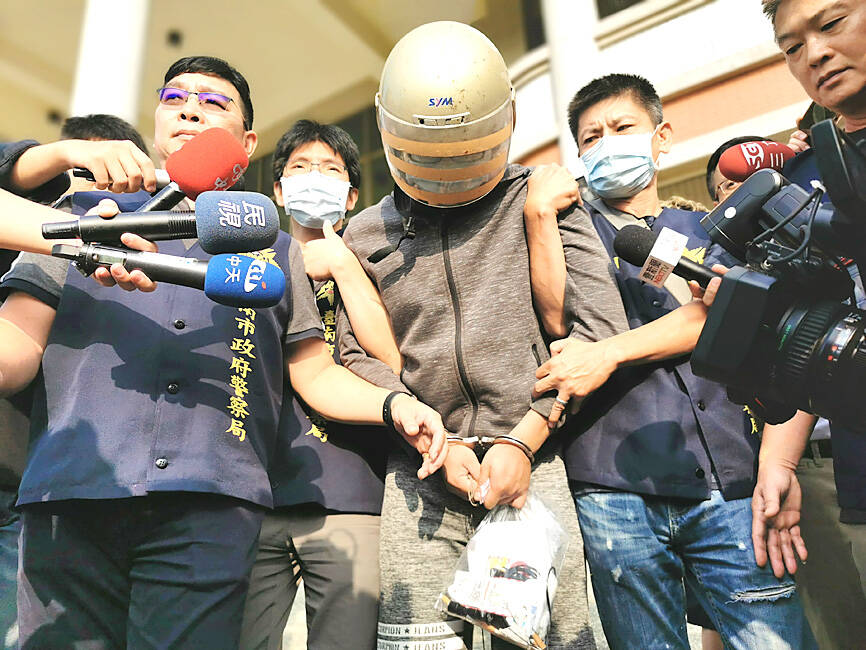
Photo: Wu Chun-feng, Taipei Times
Liang, who confessed to the murder following his arrest, was sentenced to death by a district court on March 18 last year.
Prosecutors said Liang abducted Chung on Oct. 28, 2020, while she was walking alone along a railway overpass near her school at about 8pm.
Liang confessed to raping and strangling the Malaysian student with rope before dumping her body in the mountains of Kaohsiung’s Alian District (阿蓮), they said.
After receiving a missing persons report from Chung’s university, police used security camera footage to identify Liang as a suspect and arrested him in Kaohsiung on Oct. 29, 2020.
Liang allegedly attempted to rape another person prior to murdering Chung, police said.
The murder drew significant media attention in Malaysia, given that Chung was a member of a prominent local family in the state of Sarawak.
Before the lower court sentenced Liang to death, Chung’s parents had asked for “life for life” as an appropriate administration of justice.
Chung’s mother said on social media that justice had been served by yesterday’s ruling.
Malaysian media reported that Chung studied at Malaysia’s Sibu Methodist Pilley Institute from 2014 to 2017 for a three-year diploma before transferring to Chang Jung Christian University for a three-year business management degree.
The schools have a partnership in which students can complete their studies on each other’s campuses.

Considering that most countries issue more than five denominations of banknotes, the central bank has decided to redesign all five denominations, the bank said as it prepares for the first major overhaul of the banknotes in more than 24 years. Central bank Governor Yang Chin-lung (楊金龍) is expected to report to the Legislative Yuan today on the bank’s operations and the redesign’s progress. The bank in a report sent to the legislature ahead of today’s meeting said it had commissioned a survey on the public’s preferences. Survey results showed that NT$100 and NT$1,000 banknotes are the most commonly used, while NT$200 and NT$2,000

The Centers for Disease Control (CDC) yesterday reported the first case of a new COVID-19 subvariant — BA.3.2 — in a 10-year-old Singaporean girl who had a fever upon arrival in Taiwan and tested positive for the disease. The girl left Taiwan on March 20 and the case did not have a direct impact on the local community, it said. The WHO added the BA.3.2 strain to its list of Variants Under Monitoring in December last year, but this was the first imported case of the COVID-19 variant in Taiwan, CDC Deputy Director-General Lin Ming-cheng (林明誠) said. The girl arrived in Taiwan on

South Korea is planning to revise its controversial electronic arrival card, a step Taiwanese officials said prompted them to hold off on planned retaliatory measures, a South Korean media report said yesterday. A Yonhap News Agency report said that the South Korean Ministry of Foreign Affairs is planning to remove the “previous departure place” and “next destination” fields from its e-arrival card system. The plan, reached after interagency consultations, is under review and aims to simplify entry procedures and align the electronic form with the paper version, a South Korean ministry official said. The fields — which appeared only on the electronic form

The Ministry of Foreign Affairs (MOFA) is suspending retaliation measures against South Korea that were set to take effect tomorrow, after Seoul said it is updating its e-arrival system, MOFA said today. The measures were to be a new round of retaliation after Taiwan on March 1 changed South Korea's designation on government-issued alien resident certificates held by South Korean nationals to "South Korea” from the "Republic of Korea," the country’s official name. The move came after months of protests to Seoul over its listing of Taiwan as "China (Taiwan)" in dropdown menus on its new online immigration entry system. MOFA last week


 RSS
RSS