


Sports supporters said they plan to boycott events organized by Bros Sports Marketing Co over Taiwan’s early exit from the World Baseball Classic (WBC) earlier this month.
Taiwan hosted Pool A of the WBC in Taichung from March 8 to 12, with all four of their games sold out.
Bros Sports reportedly secured the contract to organize the Pool A games for US$4.4 million. The company also received assistance from the Sports Administration, Taiwan’s CTBA baseball governing body and other government agencies.
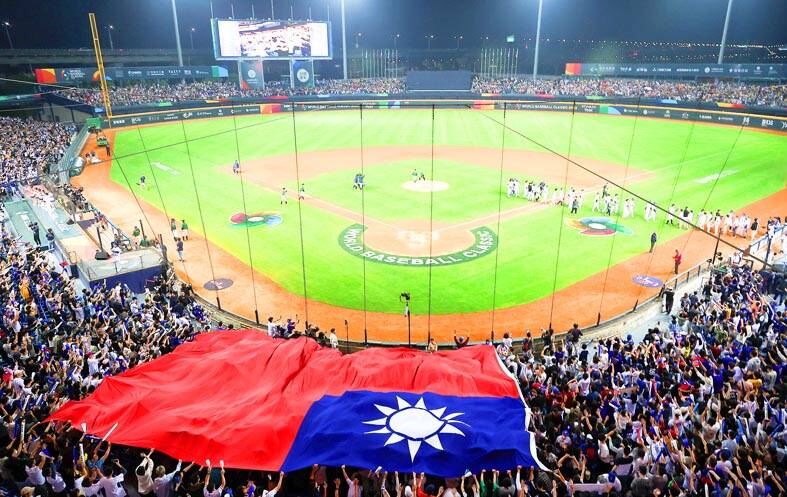
Photo: CNA
Taiwan opened with a loss to Panama, then won the next two games over Italy and the Netherlands, but succumbed to Cuba 7-1 in a crucial last game on March 12. Ultimately, all five teams in Pool A won two games and lost two, resulting in a tiebreaker.
However, the key tiebreaker is runs allowed, and Taiwan allowed the most runs of any team in the group. Cuba and Italy took the top two spots, advancing to the quarter-finals in Japan.
Taiwanese supporters blamed their team’s loss on Bros Sports, because of the schedule on the last two days. Taiwan had to play the Netherlands on Saturday at 7pm, then had to take on Cuba the following day at noon.
Over the past week, supporters complained online that Taiwan lost because they did not get enough sleep before playing against a well-rested Cuba, who did not have a game on Saturday.
People also objected to high ticket prices, merchandise defects and delivery problems, there being too few entry and exit gates at the games, and a lack of safety controls, among other issues.
Bros Sports chief marketing officer Kao Wei-kai (高偉凱) fired back at “one-day-only fans” on Facebook on Sunday, saying they know nothing about sports.
He compared them to “feral dogs on the streets barking” at him, saying that he was in Japan, and would explain more when he was back in Taiwan.
People should not blame their team’s loss on scheduling, as is was negotiated with the WBC, Kao said.
“[Taiwan] lost out in the end... Could it be because their skills could not compete against the other teams? Is that too difficult to accept?” he said.
Kao’s comments riled up more people, who said that tickets for the Pool A games cost up to 10 times that of regular CPBL games, with the most expensive costing NT$3,200 (US$104.83) and tickets averaging NT$2,200.
“We are a private business, why can we not make a profit?” Kao said.
Asked about the company applying for subsidies from the Sports Administration, he said: “It is normal to apply for subsidies when hosting international competitions. We also had to pay fees to the CTBA and government agency executives.”
However, citing Independent Legislator Huang Kuo-shu (黃國書), people said that Bros Sports should not have applied for government subsidies, because it had already made more than NT$100 million in profit.
Ticket sales from WBC games in Taiwan totaled NT$160 million, while Bros Sports received NT$128 million in corporate sponsorship funding, for a total revenue of NT$288 million, Huang had said.
“Total expenditures added up to NT$185 million, so the company made a profit. Therefore the Sports Administration turned down Bros Sports’ application for a government subsidy,” Huang said.

Considering that most countries issue more than five denominations of banknotes, the central bank has decided to redesign all five denominations, the bank said as it prepares for the first major overhaul of the banknotes in more than 24 years. Central bank Governor Yang Chin-lung (楊金龍) is expected to report to the Legislative Yuan today on the bank’s operations and the redesign’s progress. The bank in a report sent to the legislature ahead of today’s meeting said it had commissioned a survey on the public’s preferences. Survey results showed that NT$100 and NT$1,000 banknotes are the most commonly used, while NT$200 and NT$2,000

The Centers for Disease Control (CDC) yesterday reported the first case of a new COVID-19 subvariant — BA.3.2 — in a 10-year-old Singaporean girl who had a fever upon arrival in Taiwan and tested positive for the disease. The girl left Taiwan on March 20 and the case did not have a direct impact on the local community, it said. The WHO added the BA.3.2 strain to its list of Variants Under Monitoring in December last year, but this was the first imported case of the COVID-19 variant in Taiwan, CDC Deputy Director-General Lin Ming-cheng (林明誠) said. The girl arrived in Taiwan on

South Korea is planning to revise its controversial electronic arrival card, a step Taiwanese officials said prompted them to hold off on planned retaliatory measures, a South Korean media report said yesterday. A Yonhap News Agency report said that the South Korean Ministry of Foreign Affairs is planning to remove the “previous departure place” and “next destination” fields from its e-arrival card system. The plan, reached after interagency consultations, is under review and aims to simplify entry procedures and align the electronic form with the paper version, a South Korean ministry official said. The fields — which appeared only on the electronic form

The Ministry of Foreign Affairs (MOFA) is suspending retaliation measures against South Korea that were set to take effect tomorrow, after Seoul said it is updating its e-arrival system, MOFA said today. The measures were to be a new round of retaliation after Taiwan on March 1 changed South Korea's designation on government-issued alien resident certificates held by South Korean nationals to "South Korea” from the "Republic of Korea," the country’s official name. The move came after months of protests to Seoul over its listing of Taiwan as "China (Taiwan)" in dropdown menus on its new online immigration entry system. MOFA last week


 RSS
RSS