


The Taipei City Government would help residents examine presale housing contracts and publish data to give prospective buyers sufficient information about the housing market in the capital, Taipei Mayor Chiang Wan-an (蔣萬安) said yesterday.
People can look at blueprints, models and sample homes before buying a presale units, but they might have trouble identifying “traps” in contracts due to information asymmetry, Taipei Department of Land Administration Deputy Commissioner Wang Jui-yun (王瑞雲) said.
The city government has received a lot of requests for assistance in presale housing purchases, so it is launching a three-step program to help people feel safer when signing contracts, Chiang said.
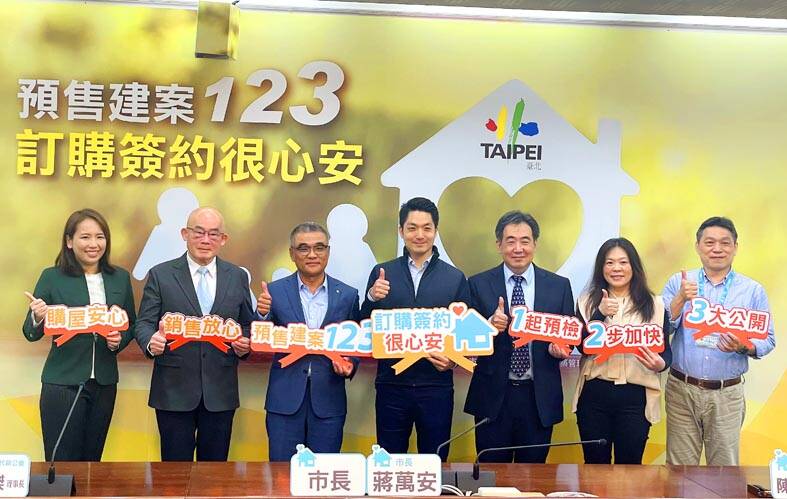
Photo: Tsai Ya-hua, Taipei Times
First, the city would provide a pre-examination service in which the department would examine the reservation agreement and purchase contract to make sure they meet mandatory and prohibitory rules, and do not have unfavorable terms for buyers, he said.
Second, it would accelerate the review process, shortening it from about 30 to eight days, Chiang said, adding that construction data reported by the developer would be automatically forwarded to the central government’s presale housing information report system to improve efficiency.
To save time, the department would begin examining the reservation agreement and purchase contract after a property developer applies for a construction permit and before it gets the green light, the department said.
Third, the city would publish information, including data on the construction project, the reservation agreement and the purchase contract, allowing prospective buyers to see accurate data online at the department’s Web site (househunt.land.gov.taipei) before a purchase, Chiang said.
The three steps would make the transaction process more transparent and safer for buyers, he said.
Coupled with the five-step plan for urban renewal that the city government launched previously, the multifaceted approach would hopefully make Taipei a more friendly and livable city, he added.
The city government is demolishing an apartment building in Wenshan District (文山) as part of an urban renewal project, Chiang said, adding that the project includes social housing and buildings integrated with MRT construction, so it would benefit public welfare.
The demolition is being carried out according to the law and the vast majority of households that agreed to the project hope to move in as soon as possible, so the city government is taking appropriate action, he said.

SECURITY: Starlink owner Elon Musk has taken pro-Beijing positions, and allowing pro-China companies to control Taiwan’s critical infrastructure is risky, a legislator said Starlink was reluctant to offer services in Taiwan because of the nation’s extremely high penetration rates in 4G and 5G services, the Ministry of Digital Affairs said yesterday. The ministry made the comments at a meeting of the legislature’s Transportation Committee, which reviewed amendments to Article 36 of the Telecommunications Management Act (電信管理法). Article 36 bans foreigners from holding more than 49 percent of shares in public telecommunications networks, while shares foreigners directly and indirectly hold are also capped at 60 percent of the total, unless specified otherwise by law. The amendments, sponsored by Chinese Nationalist Party (KMT) Legislator Ko

The eastern extension of the Taipei MRT Red Line could begin operations as early as late June, the Taipei Department of Rapid Transit Systems said yesterday. Taipei Rapid Transit Corp said it is considering offering one month of free rides on the new section to mark its opening. Construction progress on the 1.4km extension, which is to run from the current terminal Xiangshan Station to a new eastern terminal, Guangci/Fengtian Temple Station, was 90.6 percent complete by the end of last month, the department said in a report to the Taipei City Council's Transportation Committee. While construction began in October 2016 with an

NON-RED SUPPLY: Boosting the nation’s drone industry is becoming increasingly urgent as China’s UAV dominance could become an issue in a crisis, an analyst said Taiwan’s drone exports to Europe grew 41.7-fold from 2024 to last year, with demand from Ukraine’s fight against Russian aggression the most likely driver of growth, a study showed. The Institute for Democracy, Society and Emerging Technology (DSET) in a statement on Wednesday said it found that many of Taiwan’s uncrewed aerial vehicle (UAV) sales were from Poland and the Czech Republic. These countries likely transferred the drones to Ukraine to aid it in its fight against the Russian invasion that started in 2022, it said. Despite the gains, Taiwan is not the dominant drone exporter to these markets, ranking second and fourth

Japanese Prime Minister Sanae Takaichi’s comment last year on Tokyo’s potential reaction to a Taiwan-China conflict has forced Beijing to rewrite its invasion plans, a retired Japanese general said. Takaichi told the Diet on Nov. 7 last year that a Chinese naval blockade or military attack on Taiwan could constitute a “survival-threatening situation” for Japan, potentially allowing Tokyo to exercise its right to collective self-defense. Former Japan Ground Self-Defense Force general Kiyofumi Ogawa said in a recent speech that the remark has been interpreted as meaning Japan could intervene in the early stages of a Taiwan Strait conflict, undermining China’s previous assumptions


 RSS
RSS