


The US Navy is ready to come to Taiwan’s aid if it is ordered to do so, US Pacific Fleet Commander Admiral Samuel Paparo told a US television news program in a segment about the state of the navy in the face of China’s rapid military expansion.
“It’s a decision of the president of the United States and a decision of the Congress,” he told 60 Minutes reporter Norah O’Donnell in the 27-minute segment that aired on CBS on Sunday.
“But the bulk of the United States Navy will be deployed rapidly to the Western Pacific to come to the aid of Taiwan if the order comes to aid Taiwan in thwarting [a Chinese] invasion,” he said.
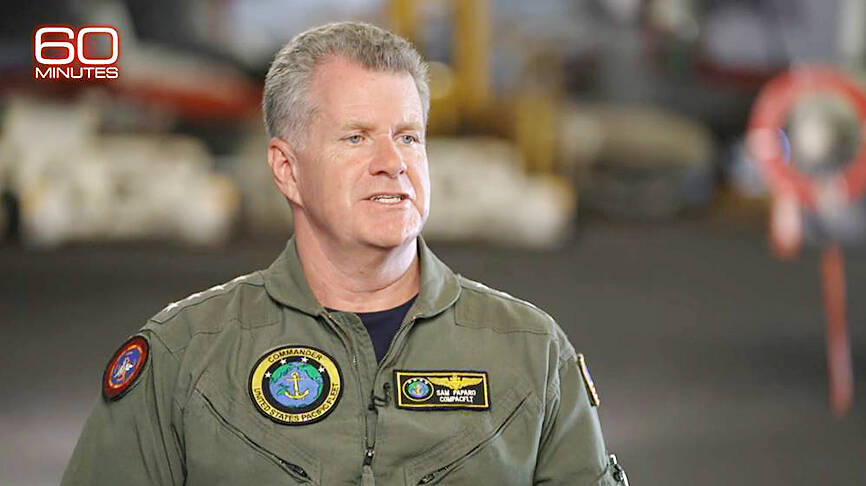
Photo: Screen grab from CBS “60 Minutes”
The navy is ready, but “I’ll never admit to being ready enough,” he added.
The interview took place last month on the aircraft carrier the USS Nimitz deployed near Guam.
The US Pacific Fleet accounts for about 60 percent of the entire US Navy.
One-third of the US Navy is deployed at all times, meaning there are about 100 of 300 ships at sea, Paparo said.
Nevertheless, its fleet is already outnumbered by the Chinese People’s Liberation Army (PLA) Navy, whose ships have increased to about 350 from only 37 in the early 2000s, he said.
“We call it the ‘Decade of Concern,’” he said. “We’ve seen a 10-fold increase in the size of the [PLA] Navy.”
However, the PLA is still working to catch up in terms of powerful aircraft carriers, with only two diesel-fueled versions in operation compared with the US’ 11 nuclear-powered vessels, the report said.
Asked if the numbers matter, Paparo said that “quantity has a quality all its own.”
“I’m not comfortable with the trajectory,” he added.
US Chief of Naval Operations Admiral Michael Gilday disagreed that the US Navy is being outpaced by China, saying it is still in a position to prevail.
“But that’s not blind confidence,” he told O’Donnell. “We are concerned with the trajectory that China’s on, with China’s behavior, but we are in a good position right now.”

Considering that most countries issue more than five denominations of banknotes, the central bank has decided to redesign all five denominations, the bank said as it prepares for the first major overhaul of the banknotes in more than 24 years. Central bank Governor Yang Chin-lung (楊金龍) is expected to report to the Legislative Yuan today on the bank’s operations and the redesign’s progress. The bank in a report sent to the legislature ahead of today’s meeting said it had commissioned a survey on the public’s preferences. Survey results showed that NT$100 and NT$1,000 banknotes are the most commonly used, while NT$200 and NT$2,000

The Centers for Disease Control (CDC) yesterday reported the first case of a new COVID-19 subvariant — BA.3.2 — in a 10-year-old Singaporean girl who had a fever upon arrival in Taiwan and tested positive for the disease. The girl left Taiwan on March 20 and the case did not have a direct impact on the local community, it said. The WHO added the BA.3.2 strain to its list of Variants Under Monitoring in December last year, but this was the first imported case of the COVID-19 variant in Taiwan, CDC Deputy Director-General Lin Ming-cheng (林明誠) said. The girl arrived in Taiwan on

South Korea is planning to revise its controversial electronic arrival card, a step Taiwanese officials said prompted them to hold off on planned retaliatory measures, a South Korean media report said yesterday. A Yonhap News Agency report said that the South Korean Ministry of Foreign Affairs is planning to remove the “previous departure place” and “next destination” fields from its e-arrival card system. The plan, reached after interagency consultations, is under review and aims to simplify entry procedures and align the electronic form with the paper version, a South Korean ministry official said. The fields — which appeared only on the electronic form

The Ministry of Foreign Affairs (MOFA) is suspending retaliation measures against South Korea that were set to take effect tomorrow, after Seoul said it is updating its e-arrival system, MOFA said today. The measures were to be a new round of retaliation after Taiwan on March 1 changed South Korea's designation on government-issued alien resident certificates held by South Korean nationals to "South Korea” from the "Republic of Korea," the country’s official name. The move came after months of protests to Seoul over its listing of Taiwan as "China (Taiwan)" in dropdown menus on its new online immigration entry system. MOFA last week


 RSS
RSS