


The High Court earlier this month overturned a ruling ordering a man to pay NT$4,000 to a woman he called “ugly,” saying that the insult would not harm the plaintiff, as the man is not an authority on aesthetics.
The incident occurred at a Taipei department store in June 2021 during an argument between two clerks at neighboring shops.
A merchant surnamed Cheng (鄭) later sued the other merchant, surnamed Lee (李), for calling her an “ugly woman,” citing Article 309 of the Criminal Code, which prohibits public insult.
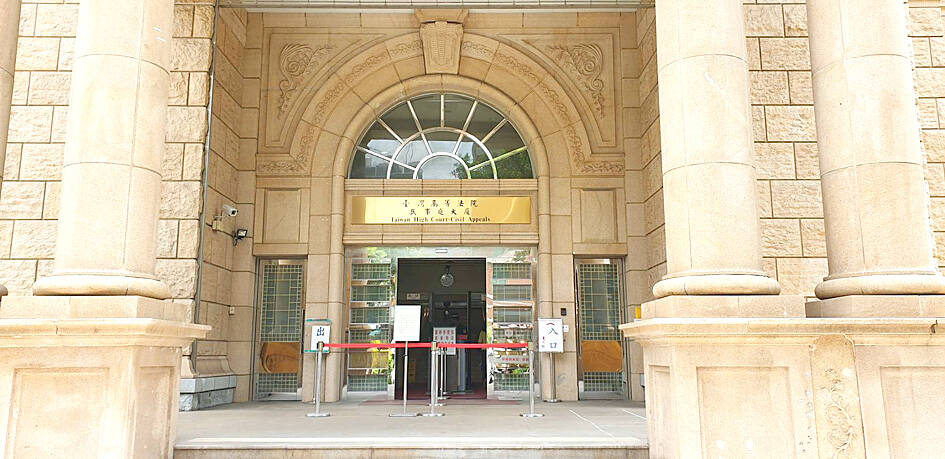
Photo: Yang Kuo-wen, Taipei Times
In the first ruling, the Taipei District Court ordered Lee to pay Cheng NT$4,000, as his comment “disrespected [Cheng’s] reputation and interests.”
Lee appealed to the High Court, which on Feb. 8 overturned the earlier ruling.
Calling someone ugly is an expression of personal aesthetic opinion and cannot be judged according to a standard, the court said.
It further cited the psychological concepts of “aesthetic fluency” and the “pleasure-interest model of aesthetic liking” to explain how the brain consciously processes aesthetics.
As Lee does not possess any expertise in aesthetic criticism, nor has any social capital in the field, the court ruled that his comment “only reflects the functioning of his individual mind and does not have authoritative social credibility.”
As such, it would not persuade or incite others, and therefore would not harm Cheng’s reputation, it said.
The court also said that from the content of their argument, it is impossible to determine whether Lee intentionally delivered an insult, even though the phrase angered Cheng.
The case has generated significant interest in the legal community as to whether calling someone ugly or actions such as giving someone the middle finger constitute a crime.
Similar cases cross the court docket regularly. The Taipei District Prosecutors’ Office said it receives about a dozen per month.
Some have photographic evidence showing the defendant pointing and looking at the plaintiff, while others are difficult to prove the insult was directed at a particular person.
The public insult clause in the Criminal Code stipulates a punishment of “short-term imprisonment” or a fine of up to NT$9,000.
The insult must also be public to be considered a crime, which in legal terms means a place where someone other than the person or people being accused can bear witness, attorney Ting Yu-jen (丁昱仁) said.
For instance, if someone shows someone else the middle finger on a street, it would be considered public because a third party could come by at any time, even if there were no witnesses to the incident itself, Ting said.
An insult is determined by whether there was the subjective intent to belittle another person, he said.
The law is intended to protect the “right of fame,” or the right to human dignity and reputation, Ting said.
It is expressed through the respect that people deserve in the process of social interaction, meaning that giving the middle finger is the same as cursing and would constitute a crime, he added.

Considering that most countries issue more than five denominations of banknotes, the central bank has decided to redesign all five denominations, the bank said as it prepares for the first major overhaul of the banknotes in more than 24 years. Central bank Governor Yang Chin-lung (楊金龍) is expected to report to the Legislative Yuan today on the bank’s operations and the redesign’s progress. The bank in a report sent to the legislature ahead of today’s meeting said it had commissioned a survey on the public’s preferences. Survey results showed that NT$100 and NT$1,000 banknotes are the most commonly used, while NT$200 and NT$2,000

The Centers for Disease Control (CDC) yesterday reported the first case of a new COVID-19 subvariant — BA.3.2 — in a 10-year-old Singaporean girl who had a fever upon arrival in Taiwan and tested positive for the disease. The girl left Taiwan on March 20 and the case did not have a direct impact on the local community, it said. The WHO added the BA.3.2 strain to its list of Variants Under Monitoring in December last year, but this was the first imported case of the COVID-19 variant in Taiwan, CDC Deputy Director-General Lin Ming-cheng (林明誠) said. The girl arrived in Taiwan on

South Korea is planning to revise its controversial electronic arrival card, a step Taiwanese officials said prompted them to hold off on planned retaliatory measures, a South Korean media report said yesterday. A Yonhap News Agency report said that the South Korean Ministry of Foreign Affairs is planning to remove the “previous departure place” and “next destination” fields from its e-arrival card system. The plan, reached after interagency consultations, is under review and aims to simplify entry procedures and align the electronic form with the paper version, a South Korean ministry official said. The fields — which appeared only on the electronic form

The Ministry of Foreign Affairs (MOFA) is suspending retaliation measures against South Korea that were set to take effect tomorrow, after Seoul said it is updating its e-arrival system, MOFA said today. The measures were to be a new round of retaliation after Taiwan on March 1 changed South Korea's designation on government-issued alien resident certificates held by South Korean nationals to "South Korea” from the "Republic of Korea," the country’s official name. The move came after months of protests to Seoul over its listing of Taiwan as "China (Taiwan)" in dropdown menus on its new online immigration entry system. MOFA last week


 RSS
RSS