


Nearly 70 percent of respondents said that China poses a great threat to the nation, while 76.7 percent said the US is more globally influential than China, a poll by the Association of Chinese Elite Leadership showed yesterday.
The poll found that 69 percent of respondents think China greatly threatens Taiwan, and when asked whether cross-strait interaction should be predicated on accepting China’s “one country, two systems” framework, the so-called “1992 consensus” or other similar concepts, respondents disagreed at 74.4 percent, 48.7 percent and 85.9 percent respectively.
The “1992 consensus” — a term that former Mainland Affairs Council chairman Su Chi (蘇起) in 2006 admitted making up in 2000 — refers to a tacit understanding between the Chinese Nationalist Party (KMT) and the Chinese Communist Party (CCP) that both sides of the Taiwan Strait acknowledge that there is “one China,” with each side having its own interpretation of what “China” means.

Photo: Tian Yu-hua, Taipei Times
When asked to rank opinions toward the US and China on a scale of one to 10 — with one being the lowest and 10 being the highest — the average rating toward the US stood at 5.7 percent, whereas China scored 3.7.
When asked which among the Democratic Progressive Party (DPP), the KMT and the Taiwan People’s Party could best protect Taiwanese sovereignty, 41.8 percent of respondents chose the DPP, 23 percent chose the KMT and 10.6 percent chose the Taiwan People’s Party, the poll showed.
Association secretary-general Wang Chih-sheng (王智盛) said the poll suggested that people aged under 40 prioritize Taiwan-US relations over cross-strait relations, while those older than 50 place more emphasis on cross-strait relations.
The CCP should know that Taiwanese consider sovereignty more important than the political ideologies touted by the KMT and the DPP, National Taiwan Normal University professor Fan Shih-ping (范世平) said.
The CCP’s “one country, two systems” formula has no adherents in Taiwan, Fan said, adding that most Taiwanese believe that maintaining distant, but friendly relations with China is sufficient.
The poll was conducted by telephone on Wednesday and Thursday, targeting people aged 20 or older. It received 1,035 valid responses and claimed a margin of error of 3.05 percentage points.
This story has been amended since it was first published.


An essay competition jointly organized by a local writing society and a publisher affiliated with the Chinese Communist Party (CCP) might have contravened the Act Governing Relations Between the People of the Taiwan Area and the Mainland Area (臺灣地區與大陸地區人民關係條例), the Mainland Affairs Council (MAC) said on Thursday. “In this case, the partner organization is clearly an agency under the CCP’s Fujian Provincial Committee,” MAC Deputy Minister and spokesperson Liang Wen-chieh (梁文傑) said at a news briefing in Taipei. “It also involves bringing Taiwanese students to China with all-expenses-paid arrangements to attend award ceremonies and camps,” Liang said. Those two “characteristics” are typically sufficient
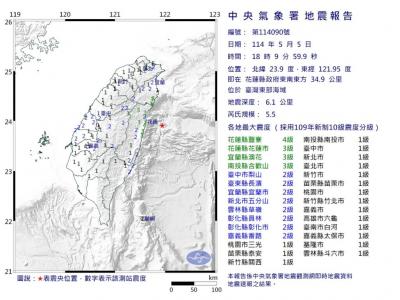
A magnitude 5.9 earthquake that struck about 33km off the coast of Hualien City was the "main shock" in a series of quakes in the area, with aftershocks expected over the next three days, the Central Weather Administration (CWA) said yesterday. Prior to the magnitude 5.9 quake shaking most of Taiwan at 6:53pm yesterday, six other earthquakes stronger than a magnitude of 4, starting with a magnitude 5.5 quake at 6:09pm, occurred in the area. CWA Seismological Center Director Wu Chien-fu (吳健富) confirmed that the quakes were all part of the same series and that the magnitude 5.5 temblor was
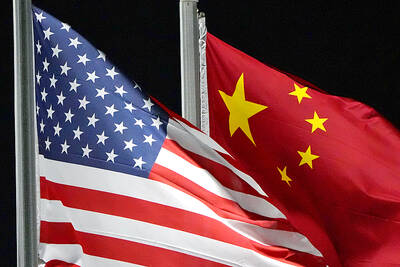
The brilliant blue waters, thick foliage and bucolic atmosphere on this seemingly idyllic archipelago deep in the Pacific Ocean belie the key role it now plays in a titanic geopolitical struggle. Palau is again on the front line as China, and the US and its allies prepare their forces in an intensifying contest for control over the Asia-Pacific region. The democratic nation of just 17,000 people hosts US-controlled airstrips and soon-to-be-completed radar installations that the US military describes as “critical” to monitoring vast swathes of water and airspace. It is also a key piece of the second island chain, a string of
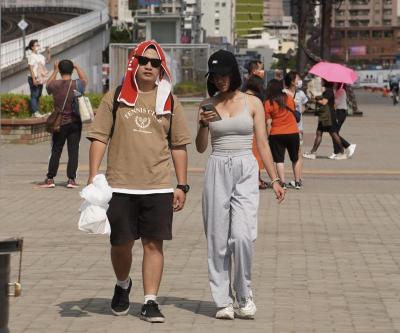
The Central Weather Administration has issued a heat alert for southeastern Taiwan, warning of temperatures as high as 36°C today, while alerting some coastal areas of strong winds later in the day. Kaohsiung’s Neimen District (內門) and Pingtung County’s Neipu Township (內埔) are under an orange heat alert, which warns of temperatures as high as 36°C for three consecutive days, the CWA said, citing southwest winds. The heat would also extend to Tainan’s Nansi (楠西) and Yujing (玉井) districts, as well as Pingtung’s Gaoshu (高樹), Yanpu (鹽埔) and Majia (瑪家) townships, it said, forecasting highs of up to 36°C in those areas


 RSS
RSS