


A blanket ban on smoking on college and university campuses took effect yesterday with the implementation of an amendment to the Tobacco Hazards Prevention Act (菸害防治法). The Ministry of Education said it has instructed schools to remove outdoor smoking areas and put up “no smoking” signs at campus entrances by the end of this month.
Schools must be wholly non-smoking environments by Wednesday, the ministry said, adding that they are required to patrol smoking hot spots and set penalties for contraventions, while faculty and staff are responsible for dissuading people from smoking on campus.
It ordered schools to inform faculty, staff, students and visitors about the no-smoking rules, with special emphasis on getting the message to students who live in campus dorms or attend classes at night, as well as foreign students.

Photo: CNA
The penalties for students should include guidance or education, such as removing a demerit if the student quits or reduces how much they smoke, it said.
In a notice issued to colleges and universities on tips to implement the amended act, the ministry said that patrols of smoking hot spots should be regular, and have regulations for routes and reporting mechanisms.
Schools should designate areas that faculty and staff members are responsible for, the ministry said, adding that local health departments can be contacted to help inspect smoking management areas, or measures can be discussed with local borough wardens or community groups to prevent residents from smoking on campus.
Schools with designated smoking areas are required to remove them before Wednesday, and are advised to put up signs saying that the “smoking” designation has been removed for the area and smoking is prohibited everywhere on campus, it said.
The ministry’s Department of Planning said that “no smoking on campus” signs should be placed at entrances, open campus borders and on maps.
The ministry also ordered institutes to establish task forces to help faculty and students handle smoking-related issues, for example health centers could provide smoking cessation programs or smokers could be referred to a hospital to get resources or more help to quit.
National Alliance of Presidents of Parents’ Associations president Wang Han-yang (王瀚陽) said that every corner of a campus is a public space, so a blanket ban on smoking is a good way to protect the health of young people and shows respect for the public interest.
Smoking is trendy among some students, but it severely damages their health, Wang said, adding that while removing designated smoking areas on campus might be inconvenient for smokers, it would create a better environment for them to quit.
Additional reporting by CNA

FUKUOKA SITUATION: Japanese media reported that the pathogen is expected to be identified by the summer, while the CDC downplayed the idea that it was hMPV A “mysterious cold-like illness” reported in Japan’s Fukuoka Prefecture does not seem to be a new disease, but Japanese authorities have been asked about the situation, the Centers for Disease Control (CDC) said yesterday. The Fukuoka Prefectural Medical Association on Wednesday told a news conference that a “mystery cold” that has become a hot topic on social media is “highly likely to be caused by some kind of viral infection,” Japan’s KBC News reported. “Many people are experiencing symptoms starting with a sore throat, followed by a runny nose, phlegm and a severe cough,” KBC News reported, citing association officials. Health authorities are

Nvidia Corp CEO Jensen Huang (黃仁勳) arrived in Taiwan yesterday ahead of upcoming AI and technology events, saying he plans to meet with clients and Taiwan Semiconductor Manufacturing Co Chairman C.C. Wei (魏哲家) during his visit. After landing at Taipei Songshan Airport, Huang posed for photos with fans and handed out Yakult drinks to reporters and supporters waiting at the scene, saying he has “a lot to do” during the trip. Asked about reports that Nvidia’s planned headquarters site in Taipei’s Beitou Shilin Technology Park could break ground on May 27, Huang said that if the company holds an event, he would

The Ministry of Finance this afternoon announced the winning numbers for the March-April uniform invoice lottery. The winning number for the NT$10 million (US$318,060) special prize is 19531471, and the winning number for the NT$2 million grand prize is 85941329. Three numbers were drawn for the NT$200,000 first prize: 07225810, 20231230 and 83518781. Those with receipts matching the last seven digits of any of the first-prize numbers will win the NT$40,000 second prize, while those matching the last six digits will win the NT$10,000 third prize. Those whose receipts match the last five digits of the first-prize numbers can claim the NT$4,000 fourth prize,
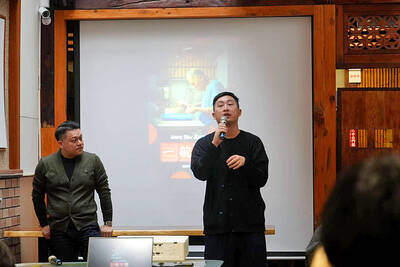
Taiwan Travelogue (臺灣漫遊錄), which earlier this week became the first Taiwanese novel to win the International Booker Prize, is to be adapted into a television series through a Taiwan-Japan coproduction, producer Chang Chen-yu (張辰漁) said yesterday. Chang, a producer at World Softest Production Film Co, wrote on Facebook that the company had been searching for projects with international appeal that retain a strong Taiwanese identity after colleagues and Japanese partners strongly recommended the novel. After reading the book, Chang said he immediately decided to pursue the screen rights. “A great story has the power to transcend time and borders, and connect countless people,”


 RSS
RSS